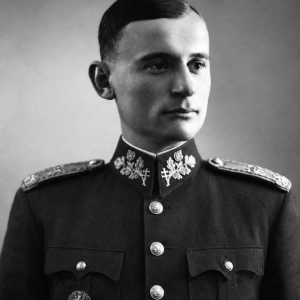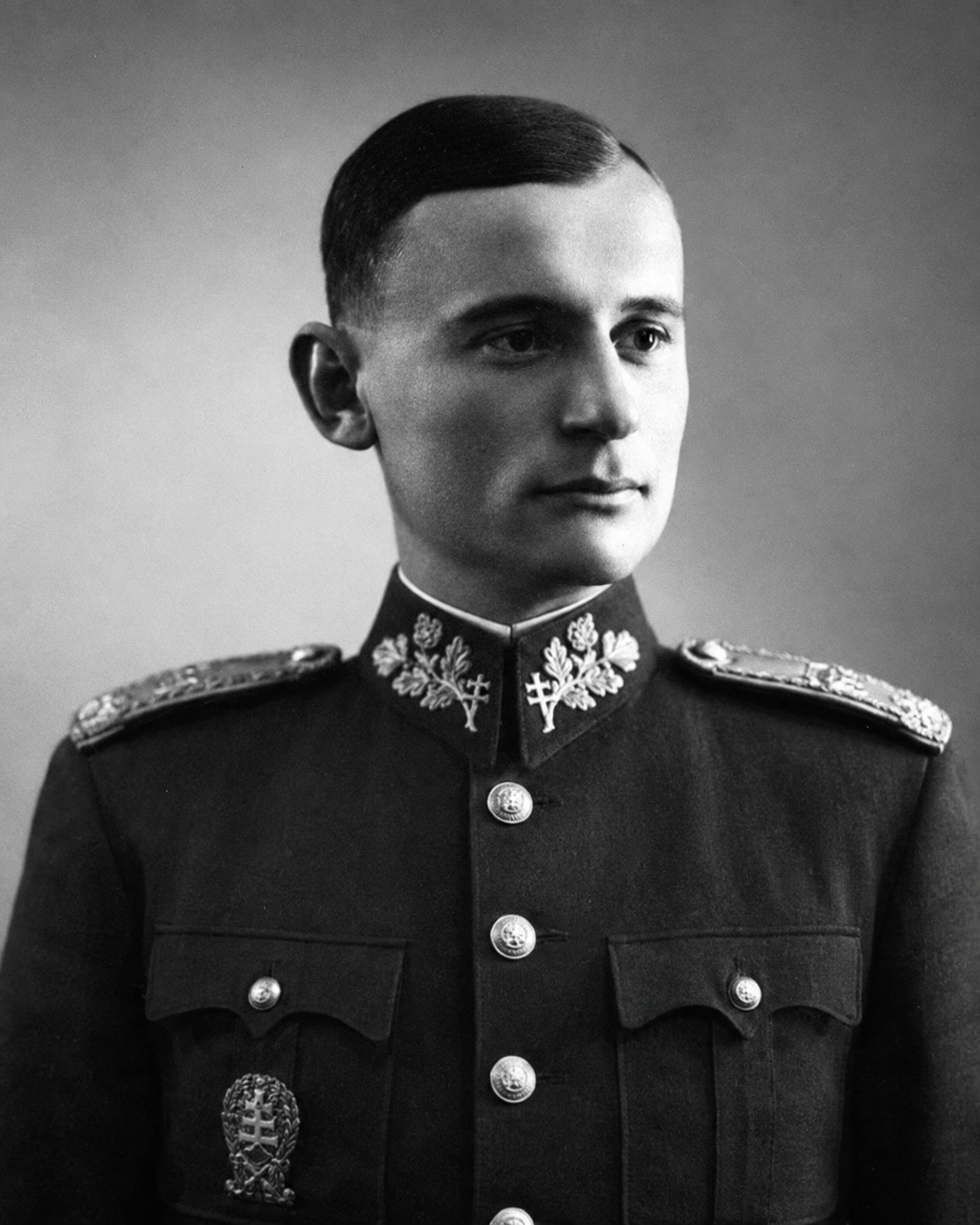
Colonel Jan Golian
Ján Golian is remembered as one of the most important Slovak military figures of the Second World War, a professional officer who rose through the ranks before becoming the principal military organiser of resistance against Nazi Germany. His career began conventionally within the Czechoslovak Army, but the destruction of Czechoslovakia and the creation of the German-aligned Slovak Republic eventually placed him in a position where loyalty to the state came into conflict with his opposition to Nazi domination.
He was born on 26 January 1906 in Dombóvár, then part of the Kingdom of Hungary. Raised in a Slovak family, he attended school at Bojná near Topoľčany before continuing his education at the Higher Industrial School of Mechanical Engineering in Bratislava between 1921 and 1925. His technical background proved useful in a military career that would increasingly involve artillery, communications and detailed staff planning.
In 1925, aged nineteen, he volunteered for service in the Czechoslovak Army and entered the Military Academy at Hranice in Moravia. After completing his training in August 1927 he was commissioned as a lieutenant in the artillery and posted to the 3rd Artillery Regiment at Litoměřice. Over the following years he developed a reputation as a capable and technically minded officer.
His early military career included work with communications platoons, artillery batteries and radio-telegraph units. He also undertook specialist training in communications, artillery and cavalry duties. Promotion to first lieutenant followed in 1931, and by the middle of the decade he had gained useful experience in both command and administration.
In 1937 he was selected to attend the War College in Prague, a significant step for any officer hoping to enter higher command or general staff work. His studies coincided with the growing political crisis in Europe, and in May 1938 he was assigned to the 10th Division at Banská Bystrica, where he served in staff positions.
The collapse of Czechoslovakia in March 1939 transformed his career. Slovakia emerged as a formally independent state closely aligned with Hitler's Germany, and many Slovak officers from the old Czechoslovak Army transferred into the newly created Slovak armed forces. He continued in military service and held a series of staff appointments involving operations, organisation and planning.
By December 1939 he had been recognised as a general staff officer, and in July 1940 he was promoted to major. Following Germany's invasion of the Soviet Union in June 1941, Slovak forces joined the campaign and he served on the Eastern Front. His wartime appointments included staff duties with Slovak formations operating alongside the Germans.
This period was important in shaping his later views. Service in the East exposed him to the realities of the war and strengthened his opposition to Nazi Germany. By January 1943 he had reached the rank of lieutenant colonel of the general staff and was regarded as an experienced and reliable professional soldier.
At the end of 1943 he was appointed chief of staff of the Slovak Army's Ground Forces Command at Banská Bystrica, taking up the post on 1 January 1944. This placed him in a strategically important position at a time when Germany's military fortunes were declining and opposition to the Slovak government was increasing.
Contacts gradually developed between anti-German officers, resistance groups, the underground Slovak National Council and the Czechoslovak government-in-exile. Because of his senior position, professional reputation and access to military planning, weapons and communications, he became central to preparations for an armed revolt.
In April 1944 President Edvard Beneš appointed him temporary leader of the military preparations for an uprising by Slovak forces. Soon afterwards he accepted responsibility for coordinating the military side of the resistance and was confirmed as commander of the secret Military Headquarters.
His task was extremely dangerous. Plans had to be made from inside an army that officially remained allied to Germany. Reliable officers had to be identified, weapons and supplies positioned, communications organised and units assessed according to whether they could be trusted when the moment for rebellion came.
The original plan envisaged a coordinated military rising timed to coincide with the advance of Soviet forces. Important Slovak formations in the east were expected to help secure routes through the Carpathians and assist the approaching Red Army. In practice, events moved more quickly than the planners intended.
As partisan activity increased during the summer of 1944, German leaders became increasingly concerned about Slovakia. When German troops began entering the country at the end of August, the resistance faced the danger of being disarmed before it could act.
On 29 August 1944 the coded order was issued to begin armed resistance. This marked the start of the Slovak National Uprising and made its military organiser the first commander of the insurgent forces.
Although the uprising itself became a major episode in Slovak wartime history, his personal importance rested especially on the preparation that came before it. For months he had worked secretly to transform elements of the Slovak Army into a force capable of turning against Germany.
During the fighting he continued to direct military operations until General Rudolf Viest arrived in October 1944 and took overall command, after which he served as deputy. As German pressure increased and organised resistance began to collapse, the commanders withdrew with surviving forces into the mountainous interior.
Following the fall of Banská Bystrica in late October, the remaining resistance dispersed into the mountains. On 3 November 1944 he and Viest were captured by German forces at Pohronský Bukovec.
They were taken through Banská Bystrica and Bratislava before being transported to Germany, where they were interrogated. His exact fate remains uncertain. It is widely believed that he was eventually taken to Flossenbürg concentration camp and executed during the final months of the war, although no completely conclusive record of the date or circumstances of his death has survived.
After the war his contribution was formally recognised. He received posthumous promotion and became one of the best-known military figures associated with Slovak resistance during the Second World War.
He is remembered most of all as the professional soldier who used his position inside the Slovak Army to prepare an organised military revolt against Nazi Germany. His importance lies not simply in commanding troops once fighting began, but in the months of clandestine preparation, planning and coordination that made large-scale armed resistance possible.
His career had begun with artillery and communications work in the peacetime Czechoslovak Army and progressed through increasingly senior staff appointments. By 1944 those same organisational skills were being used against Germany.
The decision ultimately cost him his life. From young artillery officer to senior staff planner, underground organiser and resistance commander, his career came to symbolise the role played by Slovak soldiers who rejected continued cooperation with Nazi Germany. Today Ján Golian remains most closely associated with the military organisation of the Slovak National Uprising and with the decision to turn resistance planning into open armed action in August 1944.