Boarhound Armoured Car
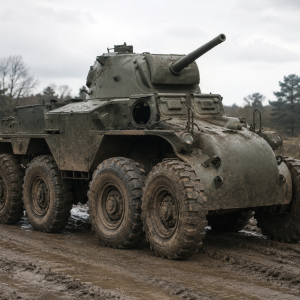
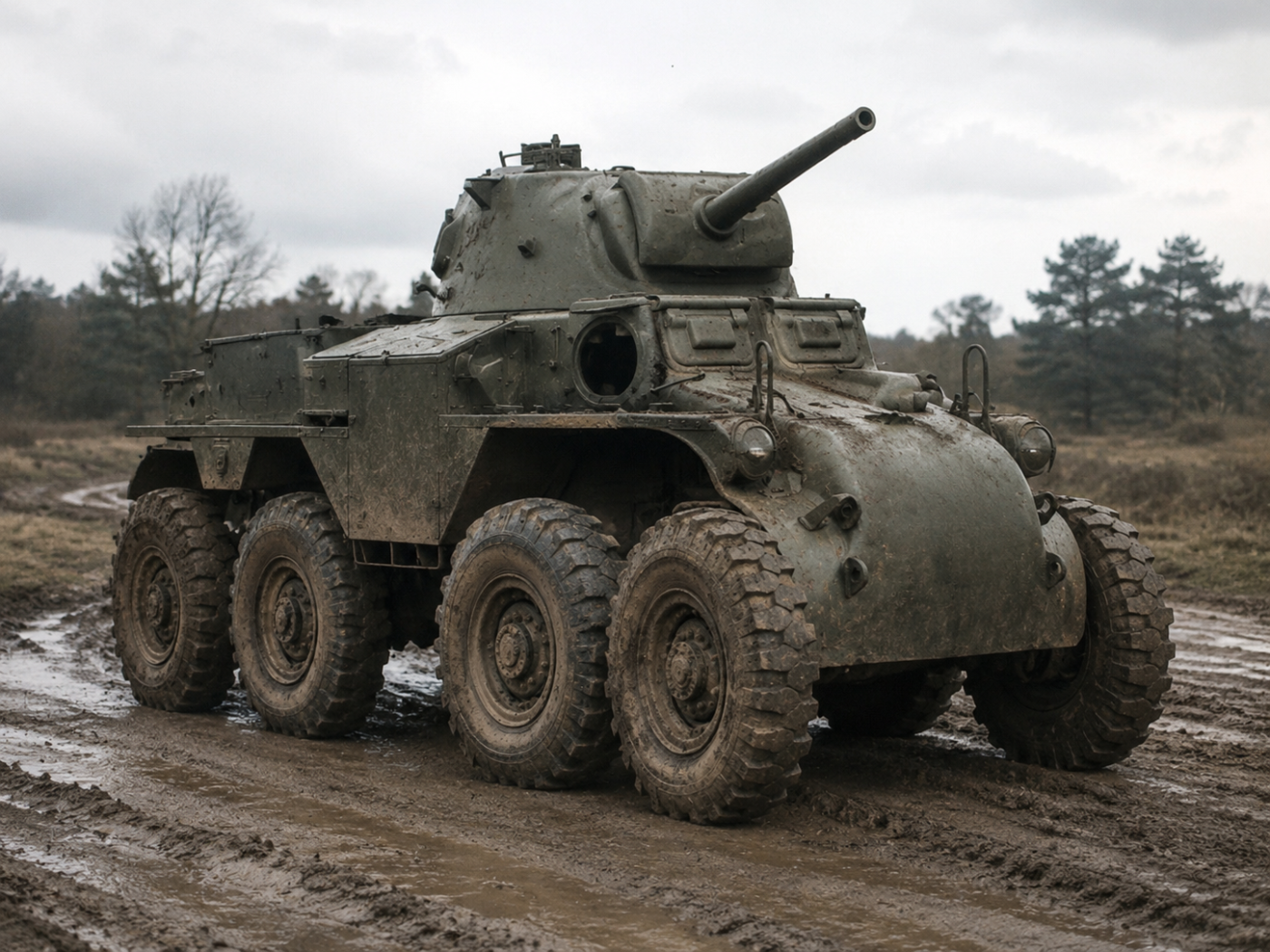
The T18E2 Boarhound was one of the most formidable armoured cars developed by the United States during the Second World War, a huge eight-wheeled fighting vehicle whose armour and firepower approached that of a medium tank. Although it never entered large-scale service, the Boarhound remains a fascinating example of how rapidly wartime requirements could change and how an apparently promising design could become obsolete before production had properly begun.
The origins of the Boarhound can be traced to 1941, when the United States Army began looking for heavily armed wheeled vehicles capable of reconnaissance, screening and long-range operations. The British Army was also showing considerable interest in powerful armoured cars, particularly for operations in North Africa where long distances, relatively open terrain and extensive road networks made wheeled vehicles extremely useful. British experience with vehicles such as the Daimler and AEC armoured cars demonstrated that a reconnaissance vehicle could sometimes require enough armour and firepower to fight its way out of trouble rather than simply observe the enemy.
The American Yellow Coach Company, a division of General Motors, was selected to develop a heavy armoured car under the designation T18. The original T18 design carried comparatively modest armament, but experience from the fighting in North Africa quickly showed the growing importance of heavier anti-armour weapons. This led to the improved T18E2 version, which became known by the British name “Boarhound.”
The T18E2 was enormous by armoured-car standards. It had eight wheels arranged in an 8×8 configuration and weighed approximately 26 tons, putting it in the same general weight class as some tracked tanks. Its sheer size gave the vehicle an imposing appearance but also worked against the traditional advantages expected from an armoured reconnaissance vehicle. It was expensive, mechanically complicated and extremely heavy for a wheeled machine.
Protection was exceptionally strong. Armour thickness varied around the vehicle, with the frontal protection reaching approximately 50 millimetres in some areas. For an armoured car of the period this was substantial and provided considerably greater protection than most reconnaissance vehicles. The hull was heavily plated and the turret was also well protected, giving the crew a reasonable chance of surviving hits from small-calibre anti-tank weapons and heavy machine-gun fire.
The principal weapon of the T18E2 was a 57 mm gun based on the British 6-pounder anti-tank gun. This was a major improvement over the lighter weapons fitted to many contemporary armoured cars. The 6-pounder had already proven itself capable of defeating a wide variety of German armoured vehicles, particularly when firing improved armour-piercing ammunition.
A coaxial .30 calibre Browning machine gun was mounted alongside the main gun, while another machine gun could be carried for close defence. The combination gave the Boarhound considerably greater firepower than the lightly armed scout cars normally associated with reconnaissance duties. In practical terms, the T18E2 possessed enough armament to engage many enemy tanks encountered during the middle years of the war.
Power came from twin GMC six-cylinder petrol engines mounted at the rear, producing a combined output of roughly 250 horsepower. The eight-wheel-drive system gave the vehicle respectable mobility despite its considerable mass, while its large fuel capacity was intended to provide the long operating range required for reconnaissance and desert warfare.
The crew consisted of five men, including the driver, assistant driver, commander, gunner and loader. Internally the vehicle was spacious compared with some smaller armoured cars, although the machinery required for its complex drivetrain occupied a significant proportion of the hull.
The British originally showed considerable enthusiasm for the Boarhound and placed a substantial order, reportedly running into thousands of vehicles. However, events on the battlefield overtook the programme. By the time the T18E2 was ready for production, the North African campaign was drawing towards its conclusion and the British Army had reassessed what it required from an armoured reconnaissance vehicle.
The Boarhound's greatest strengths had become its greatest weaknesses. Heavy armour and powerful armament had produced a vehicle weighing around 26 tons, reducing the speed, simplicity and strategic mobility normally expected of a reconnaissance vehicle. It was also considerably more expensive to manufacture and operate than lighter alternatives.
Only around 30 T18E2 Boarhounds were ultimately completed before production was cancelled. None saw significant combat service. Most disappeared after the war, making surviving examples exceptionally rare.
The T18E2 also illustrates an important development in wartime armoured vehicle design. Armoured cars were increasingly expected to perform several different jobs: reconnaissance, convoy protection, flank security and even anti-tank fighting. Attempting to combine all of these roles within one machine inevitably increased weight and complexity.
In the case of the Boarhound, the result was effectively a wheeled tank. Its thick armour and 57 mm gun made it exceptionally powerful for an armoured car, but those same features reduced the qualities of speed, economy and simplicity that made wheeled reconnaissance vehicles attractive in the first place.
A surviving T18E2 Boarhound is preserved at The Tank Museum at Bovington in Dorset, providing a rare opportunity to see just how substantial this unusual vehicle was. Standing beside it makes clear why contemporary observers sometimes regarded it less as an armoured car and more as a medium tank placed on eight enormous wheels.