
On this day in military history…
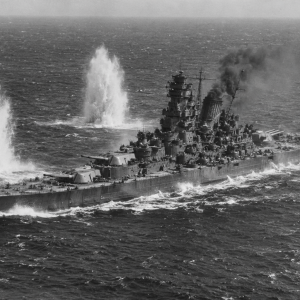
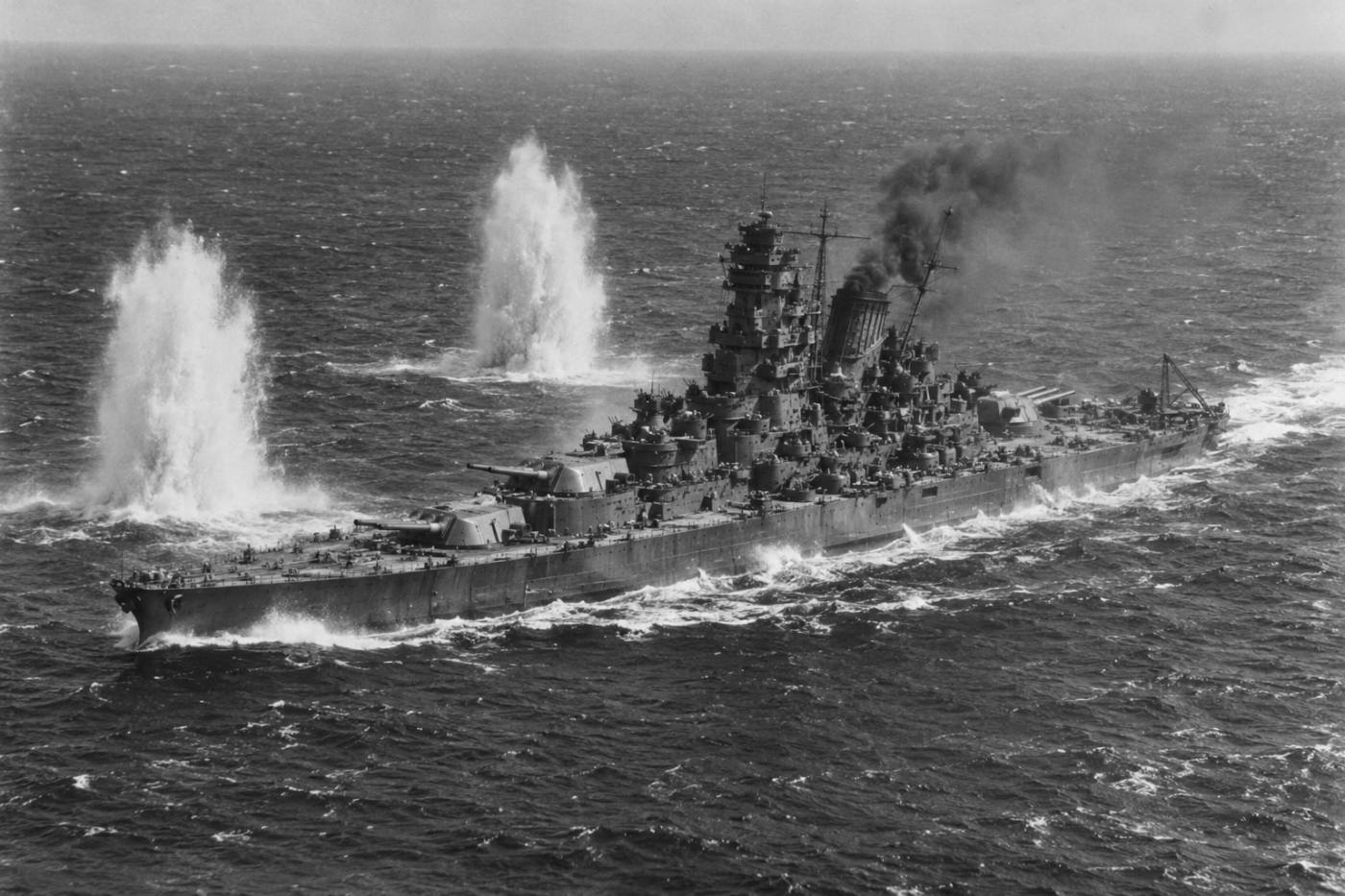
On 24 October 1944, the Japanese battleship Musashi sank in the Sibuyan Sea after hours of relentless attacks by American carrier aircraft. Alongside her sister ship Yamato, she was the largest battleship ever completed, built to overwhelm enemy warships through immense firepower and protection. Yet her final battle would be fought against aircraft, whose repeated attacks gradually overwhelmed even her formidable defences.
Built by Mitsubishi at Nagasaki, Musashi was laid down on 29 March 1938, launched on 1 November 1940 and commissioned on 5 August 1942. Construction proceeded under extraordinary secrecy, with huge screens concealing the slipway from outside observation. Named after an ancient Japanese province, she measured approximately 263 metres long and displaced around 73,000 tonnes fully loaded. Her main armament comprised nine enormous 460 mm, or 18.1-inch, guns in three triple turrets—the largest calibre guns ever mounted aboard a battleship.
Despite the resources invested in her, Musashi spent much of her short career moving between Japanese bases and the fleet anchorage at Truk. She served as flagship of the Combined Fleet, but opportunities to fight the decisive battleship engagement envisaged by Japan’s naval planners never materialised. By the time she entered her final operation, American carrier aviation had become a dominant force in the Pacific.
Her last voyage formed part of Japan’s attempt to defeat the American landings on Leyte in the Philippines. Vice Admiral Takeo Kurita’s powerful Centre Force was intended to reach the invasion area and attack the shipping supporting the troops ashore. Other Japanese formations would approach from different directions, while a carrier force to the north attempted to draw away Admiral William Halsey’s American Third Fleet. It was a complicated operation that committed much of Japan’s remaining naval strength.
On the morning of 24 October, American aircraft found Kurita’s ships crossing the Sibuyan Sea. Musashi, commanded by Rear Admiral Toshihira Inoguchi, soon became a principal target. The opening attacks struck during the late morning, with dive-bombers descending on the battleship while torpedo aircraft approached close to sea level. Fighters strafed her exposed gun positions, killing and wounding men as they attempted to defend the ship.
Throughout the day, successive waves returned. Bombs damaged the upper works and internal spaces, while torpedoes opened the hull beneath the waterline. Damage-control crews fought to contain flooding, shore up weakened compartments and preserve power. Counter-flooding helped correct her list, but it also increased the amount of water aboard. As the damage accumulated, the bow settled deeper and the battleship struggled to maintain her place in the formation.
Musashi’s resistance was remarkable. The commonly cited estimate credits the American attacks with approximately 19 torpedo hits and 17 bomb hits, although the precise totals remain disputed. Her enormous hull and extensive protection allowed her to survive punishment that would have destroyed many smaller warships much sooner. Nevertheless, each new attack reduced the crew’s ability to save her. By late afternoon, the battered vessel had fallen behind the main force.
As darkness approached, the struggle to keep her afloat failed. At about 7.30 that evening, Musashi capsized and sank, taking more than 1,000 men with her, including Inoguchi. Escorting destroyers rescued survivors from the sea. Men who had endured hours of bombing, torpedo explosions and flooding now faced the loss of their ship and hundreds of their comrades.
The sinking was a major American success, but it did not destroy Kurita’s entire force. His remaining ships continued towards the invasion area and fought off Samar the following morning. Musashi’s loss nevertheless demonstrated the vulnerability of even the most heavily protected battleship when exposed to sustained air attack without adequate fighter cover. Her great guns had offered no decisive answer to the aircraft that brought her down.
For more than seventy years, her resting place remained undiscovered. In March 2015, an expedition led by Microsoft co-founder Paul Allen located the wreck in the Sibuyan Sea. Underwater cameras revealed scattered remains of the once immense warship, bringing renewed attention to her final battle. Today, Musashi’s wreck is a war grave: the resting place of men lost during the destruction of one of the most powerful battleships ever built.