Anti Tank Dogs
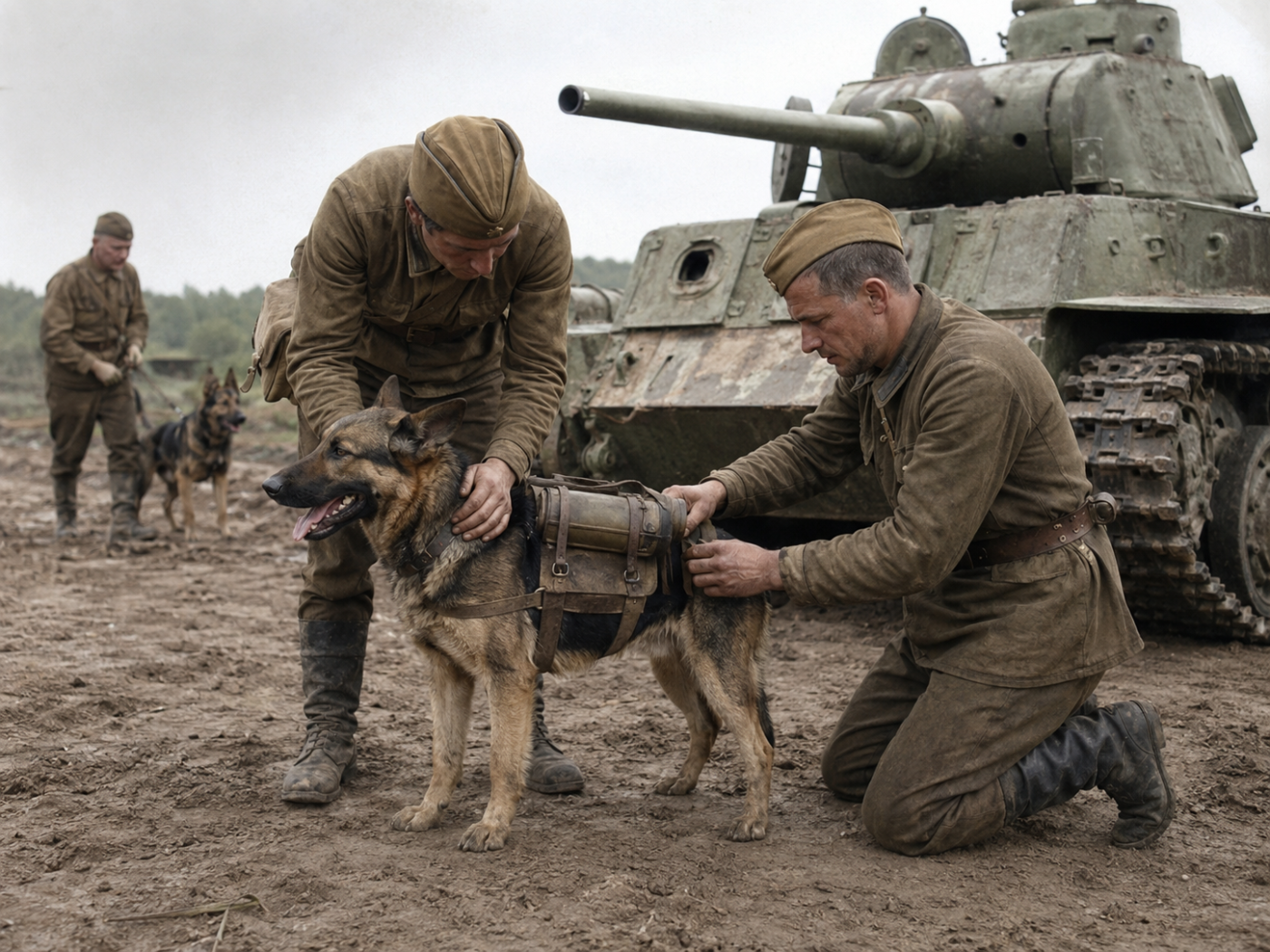
During the Second World War the Soviet Union experimented with one of its most unusual and controversial anti-tank weapons: dogs trained to carry explosive charges beneath enemy armoured vehicles. Known as anti-tank dogs, the idea was developed before the German invasion and expanded rapidly in 1941 when the Red Army faced overwhelming numbers of German tanks.
The Soviet military had been using dogs for military purposes since the 1920s, training them for tasks such as message delivery, mine detection, supply transport and casualty recovery. By the 1930s, specialist schools were also exploring their use against armour. The logic was simple: while tanks were heavily protected on the front and sides, their undersides were relatively vulnerable. An explosive placed beneath a tank could potentially disable or destroy it.
Early concepts attempted to train dogs to place and return from carrying detachable explosives, but this proved too complex. The system was simplified into a far more brutal method: dogs were fitted with explosive charges and a triggering device, then trained to run beneath tanks. Contact with the underside of the vehicle would detonate the charge, turning the animal into a mobile anti-tank mine.
Training relied on conditioning, often placing food beneath stationary tanks so dogs learned to associate vehicles with reward. Over time they were exposed to engines, noise and military activity, and later fitted with dummy harnesses. However, real battlefield conditions were impossible to replicate. Moving tanks, gunfire and explosions often confused or frightened the animals, causing them to flee or return to their handlers.
This created serious risks. A frightened dog carrying explosives could endanger Soviet troops as much as the enemy, and handlers were sometimes forced to shoot returning animals before they reached friendly lines. Another widely repeated claim suggests dogs were trained using Soviet diesel tanks and then mistakenly ran toward them instead of German vehicles, though this remains uncertain and is less supported than accounts of general battlefield confusion.
Despite these problems, the programme was deployed during the desperate early years of the German invasion. In 1941, when Soviet forces were suffering catastrophic losses, almost any method of stopping tanks was considered. Reports from training trials suggested that explosive charges placed beneath tanks could cause severe damage, proving the concept worked in principle.
In combat, handlers released dogs near advancing armour, hoping they would run underneath and detonate their charges. The method required extreme bravery, as soldiers had to operate close to enemy tanks under fire. German troops quickly learned of the tactic and were instructed to shoot approaching dogs, making success even more difficult.
The dogs were vulnerable to machine-gun fire, shell fragments and panic in chaotic battlefield conditions. While some Soviet accounts claim they destroyed enemy tanks, exact numbers are uncertain and difficult to verify due to the confusion of combat and multiple causes of tank losses.
The programme was most active during 1941 and 1942, particularly in defensive battles around Moscow and other critical fronts. However, as the war progressed, the Red Army developed far more effective anti-tank weapons, including improved artillery, mines, self-propelled guns and better armoured vehicles. As a result, the usefulness of anti-tank dogs declined rapidly.
By the later stages of the war, the system was largely abandoned. It had been a product of extreme desperation during the early invasion, when Soviet forces were searching for any possible means of slowing German armoured advances.
The programme also reflected the broader Soviet use of military dogs, which performed many valuable roles such as mine detection, message delivery and search-and-rescue work. The anti-tank role, however, was unique in that it required the animal’s survival to be sacrificed for the weapon to function.
Although the concept exploited a real vulnerability in tank design—the relatively thin underside armour—it ultimately suffered from a critical flaw: unpredictability. Once released, the handler had no control over the dog’s behaviour, making the system unreliable in combat.
Today, the Soviet anti-tank dog programme remains one of the most unsettling examples of wartime improvisation on the Eastern Front. It emerged from a period of extreme crisis, when the Soviet Union was willing to experiment with almost any method to halt German armour. While it never became a decisive weapon, it stands as a stark reminder of the desperation and innovation that characterised the early years of the war.