Admiral David Beatty
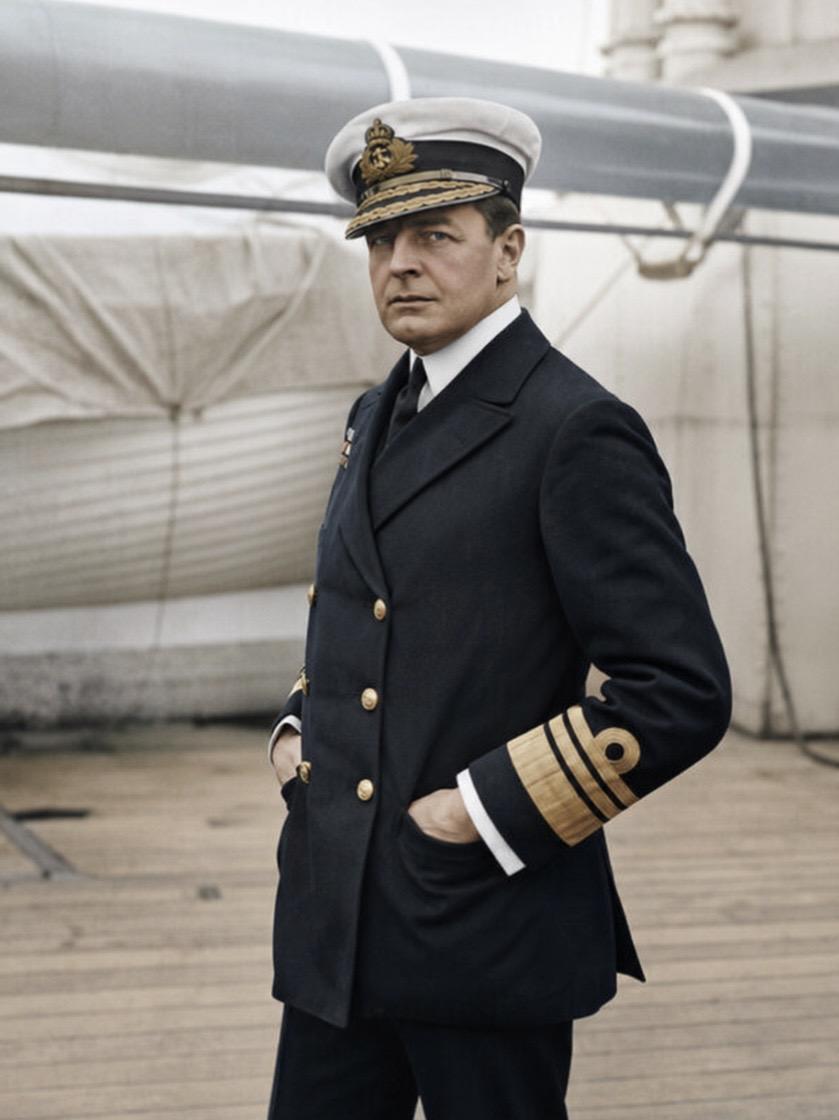
Admiral of the Fleet David Richard Beatty, 1st Earl Beatty, was one of the most striking naval figures Britain produced in the late nineteenth and early twentieth centuries. Dashing, ambitious, confident and sometimes controversial, he rose from a privileged but uncertain childhood to become one of the most famous officers of the Royal Navy. Although his name is often linked most closely with the Battle of Jutland, his story reaches far beyond that single day. His life was one of rapid advancement, powerful connections, personal courage, political skill and a long struggle to shape the Navy after the First World War.
He was born on 17 January 1871 at Howbeck Lodge, near Nantwich in Cheshire. His family background gave him advantages, though it was not without complications. His father, Captain David Longfield Beatty, had served in the army, while his mother, Katherine, came from a well-connected Irish family. He grew up in comfortable surroundings and was educated in a manner suited to a boy expected to enter public life or the services. From an early age he developed the confidence and social ease that would later help him move among senior officers, politicians and royalty.
He joined the Royal Navy as a cadet in 1884, when he was only thirteen years old. Like many young naval officers of his generation, he entered a service that was changing quickly. The old world of wooden ships and sail had almost vanished, replaced by steel warships, heavy guns, steam engines and new ideas about global naval power. Britain’s empire depended on control of the seas, and the Royal Navy stood at the centre of national pride. He entered this world with energy and ambition.
His training began aboard HMS Britannia, the usual starting point for young naval cadets. From the beginning he showed ability, but he was not simply a quiet or studious officer. He had a flair for leadership and a strong sense of his own destiny. He was physically brave, socially polished and determined to stand out. These qualities helped him, though they also sometimes made him appear impatient or overconfident.
After his early training, he served in several ships and began the steady process of learning naval life. Promotion in the Navy was usually slow, and many officers spent years waiting for advancement. He moved more quickly than most. His early career took him to the Mediterranean and then to active service in colonial campaigns, where he gained valuable experience and a reputation for courage.
One of the key moments in his early rise came during the Nile campaign in the Sudan in the late 1890s. He served with naval forces supporting British and Egyptian operations against the Mahdist state. This was not the grand fleet warfare for which he later became known, but it was dangerous and demanding work. River operations required initiative, nerve and the ability to act under difficult conditions. His conduct impressed senior officers and helped bring him to wider attention.
Service in the Sudan earned him distinction and accelerated his career. He was promoted to commander at an unusually young age. This was an important step, because in the Royal Navy rank meant not only authority but access to future opportunity. His reputation was now that of a brave and promising officer, a man who seemed destined for higher command.
The next major stage came during the Boxer Rebellion in China in 1900. He took part in operations connected with the international effort to relieve foreign legations and protect foreign interests during the uprising. During this campaign he was wounded, but once again his conduct strengthened his standing. He had shown courage under fire and continued to build the image of a fighting officer who could be trusted in dangerous situations.
His wounds and service in China added to the heroic aura that surrounded him. At a time when Britain valued imperial military success, this record made him stand out from officers whose careers had been spent mainly in routine shipboard duties. He had seen action, been wounded and proved himself. This mattered greatly in a Navy where many officers were competent but few had the chance to display personal bravery in war.
Promotion to captain came in 1900, when he was still only twenty-nine. This was exceptionally young. In a service where seniority usually counted heavily, such rapid advancement was remarkable. It caused admiration in some quarters and envy in others. Supporters saw a brilliant young officer; critics believed he had benefited from luck, social connections and patronage as much as from ability. Both views contain some truth. He was certainly talented and brave, but he was also skilled at moving in the right circles and making powerful friends.
His marriage in 1901 to Ethel Tree, the wealthy daughter of an American businessman and the former wife of Arthur Tree, greatly improved his social position. Ethel brought immense wealth and influence into his life. Their marriage gave him access to a world of aristocratic homes, political friendships and royal connections. He was already ambitious, but his new circumstances gave him the means to live on a grand scale and to mix with people who mattered.
This social position did not replace naval ability, but it helped enormously. In Edwardian Britain, personal connections could influence careers, especially at the highest levels. He became known not only as a naval officer but as a glamorous public figure. He dressed well, rode well, entertained well and carried himself with confidence. He seemed to represent a new, modern type of naval leader: energetic, stylish and aggressive.
During the years before the First World War, he held a series of commands and continued to rise. He commanded cruisers and then moved into more senior appointments. He also served as Naval Secretary to the First Lord of the Admiralty, a role that brought him into close contact with the political leadership of the Navy. This was particularly important because it placed him near Winston Churchill, who became First Lord of the Admiralty in 1911.
Churchill admired boldness and energy, and the young admiral possessed both. Their relationship helped his career, though it also fed the belief among some officers that he was favoured beyond his seniority. He was promoted to rear-admiral in 1910 at the age of thirty-nine, again unusually young. By this stage he had become one of the most talked-about officers in the Navy.
His great opportunity came with the rise of the battlecruiser. These ships were fast and heavily armed, designed to scout ahead of the main battle fleet, hunt enemy cruisers and use speed as a form of protection. They were impressive vessels, but they also carried risks. Their armour was lighter than that of battleships, which made them vulnerable in a heavy gun action. He became closely associated with this type of ship and with the aggressive spirit it represented.
In 1913 he was given command of the Battlecruiser Squadron. This placed him in charge of some of the fastest and most powerful ships in the Royal Navy. When the First World War broke out in August 1914, he was already in a position of great importance. Britain’s naval strategy depended on controlling the North Sea and containing the German High Seas Fleet. His battlecruisers were expected to act as the striking arm of the Grand Fleet.
Early in the war, he won public fame at the Battle of Heligoland Bight in August 1914. British light forces had entered waters near the German coast, and when the action became dangerous, the battlecruisers intervened with decisive effect. Several German ships were sunk, and the action was celebrated in Britain as an early naval success. His reputation soared. He appeared to be exactly the kind of commander the nation wanted: bold, fast-moving and victorious.
In January 1915, he again commanded British battlecruisers at the Battle of Dogger Bank. The British force intercepted German ships in the North Sea, and the German armoured cruiser Blücher was sunk. Yet the battle also revealed problems. Confused signalling and imperfect communication meant that the British failed to destroy the whole German force. He was frustrated by this missed opportunity, but his standing remained high. To the public he was still the Navy’s fighting admiral.
By 1916 he had been promoted to vice-admiral and was commanding the Battlecruiser Fleet. His ships were based at Rosyth, while the main Grand Fleet under Admiral Sir John Jellicoe was based farther north at Scapa Flow. His role was to find and engage the enemy, then draw them toward the main British fleet if a major action developed.
At Jutland on 31 May 1916, his battlecruisers met the German battlecruisers under Admiral Franz von Hipper. The early part of the battle went badly for the British battlecruisers. HMS Indefatigable and HMS Queen Mary were lost in catastrophic explosions, and later HMS Invincible was also destroyed. He famously remarked that there seemed to be something wrong with the British ships that day. The battle then widened as the main fleets came into contact. Since Jutland belongs to a separate account, it is enough here to say that he survived the battle with his reputation both enhanced and questioned. Many admired his courage and aggression, while others criticised his tactics, signalling and the handling of his battlecruisers.
After Jutland, his career did not collapse. In fact, it advanced. Later in 1916, he succeeded Jellicoe as Commander-in-Chief of the Grand Fleet. This was one of the most powerful naval commands in the world. He now had responsibility for the main British battle fleet during the final years of the war. Although there was no second Jutland, the Grand Fleet remained the central force preventing Germany from breaking British control of the seas.
His style as Commander-in-Chief was different from Jellicoe’s. Jellicoe was cautious, methodical and deeply aware that Britain could lose the war in an afternoon if the Grand Fleet were destroyed. The new commander was more aggressive and more willing to seek battle. This difference has shaped historical debate ever since. Admirers saw him as a fighting leader held back by circumstances; critics saw a man whose dash sometimes outran his judgement.
When the German fleet surrendered in November 1918, he was present to witness one of the most symbolic moments in British naval history. The High Seas Fleet steamed into internment under the eyes of the Royal Navy. For him, it was a personal triumph. Whatever the arguments about Jutland, the war had ended with Britain still dominant at sea and Germany’s fleet defeated as a strategic force.
After the war, he received great honours. He was created Earl Beatty, Viscount Borodale and Baron Beatty of the North Sea and Brooksby. These titles reflected the nation’s gratitude and his place among the most celebrated commanders of the war. He had risen from cadet to one of the highest-ranking naval officers in the empire, and he had become a national figure.
His military career did not simply end with the armistice. In 1919, he became First Sea Lord, the professional head of the Royal Navy. This role was very different from commanding ships at sea. It required political judgement, administrative skill and the ability to defend the Navy’s interests in a time of financial pressure. Britain after the First World War was exhausted, heavily indebted and eager to reduce military spending. He now had to fight not the German fleet, but budget cuts, changing technology and political arguments about the future of sea power.
As First Sea Lord, he worked to preserve the Royal Navy’s strength and status. He believed deeply that Britain’s security and empire depended on naval power. Yet he faced a difficult world. The United States and Japan were now major naval powers, and international efforts were being made to limit battleship construction. The Washington Naval Conference of 1921–22 led to agreements that restricted the size and number of capital ships among the leading naval nations. He disliked anything that weakened British naval supremacy, but he had to operate within political realities.
He remained First Sea Lord until 1927, an unusually long period in the post. During that time he defended the Navy with determination. He argued for modern ships, proper funding and recognition that Britain’s worldwide commitments required a powerful fleet. He also had to deal with the growing importance of submarines and aircraft, both of which were changing naval warfare. He belonged emotionally to the age of great surface fleets, but he was not blind to change. His challenge was to preserve the battle fleet while adapting to a new era.
After leaving office, he lived as a senior public figure rather than a forgotten retired officer. He sat in the House of Lords, attended ceremonies and remained a symbol of Britain’s naval tradition. His appearance helped preserve the legend. With his beard, decorations and air of command, he looked like the public expected a great admiral to look. He was admired by many, though among naval historians and officers his record continued to provoke debate.
His later years were quieter but not free from strain. His health declined, and his personal life had its difficulties. His marriage to Ethel had brought wealth and status, but it was not always peaceful. Even so, she had played a major part in his rise, and together they had occupied a prominent place in British society.
He died on 11 March 1936, aged sixty-five. He was given a place of honour in national memory and was buried in St Paul’s Cathedral, close to other great naval figures. This was a fitting resting place for a man who had become one of the best-known admirals of his age.
His career is best understood as a mixture of brilliance, courage, ambition and controversy. He was not a quiet administrator who rose by patience alone. He was a forceful personality who seized opportunity, cultivated influence and inspired strong opinions. Supporters saw him as the bold commander the Royal Navy needed; critics believed his confidence sometimes led him into danger. Both views help explain him.
From his early years as a cadet, through active service in the Sudan and China, to command of the battlecruisers and then the Grand Fleet, his life stood at the centre of Britain’s naval story. After the war, as First Sea Lord, he fought to protect the Navy in a changing and uncertain world. His influence did not end when the guns fell silent. He remained a guardian of naval tradition and a reminder of the age when Britain’s power rested upon the sea.