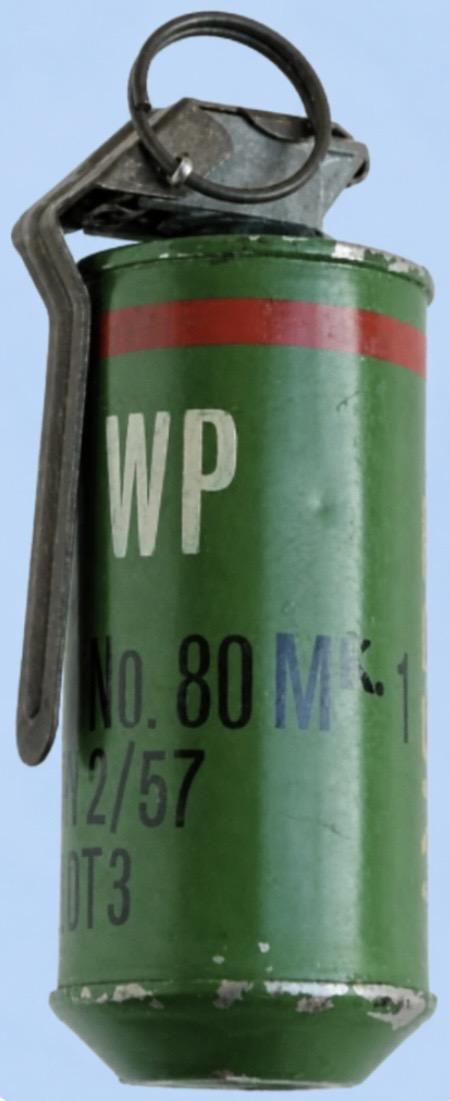
80 MK 1 Phos Grenade
The British white phosphorus grenades associated with the Falklands War were not exotic new weapons made specially for the South Atlantic campaign; they were part of a long British tradition of phosphorus smoke and incendiary munitions. The type most often connected with the period is the British No. 80 Mk 1 white-phosphorus smoke hand grenade, a service smoke grenade that dispersed white phosphorus after functioning and produced an immediate dense white smoke cloud. Specialist ordnance references identify the No. 80 Mk 1 as a British white-phosphorus smoke, striker-release, carrier hand grenade, and note that it was also manufactured in the Netherlands.
White phosphorus had been in British service in one form or another since the First World War. Britain introduced factory-made white-phosphorus grenades in 1916, initially because WP was extremely useful for rapid smoke generation and concealment, but soldiers quickly understood that the same material also had severe incendiary and anti-personnel effects. In the Second World War, British phosphorus weapons included the No. 77 WP grenade and the improvised No. 76 “special incendiary phosphorus” grenade, associated with Albright and Wilson, the major British phosphorus chemical firm. By the post-war era the more modern No. 80 family had become the relevant British WP hand-smoke grenade, later replaced in British service by red-phosphorus L84-series smoke grenades.
The exact manufacturer of every Falklands-issued No. 80 grenade is difficult to state confidently from open public sources. The design was a British government service pattern rather than a private commercial invention, and surviving ordnance records and museum examples show British and allied manufacture. The No. 80 was a British service pattern, and examples also show Dutch manufacture and wider Commonwealth use. Later British red-phosphorus smoke grenades, such as the L84 series, belong to the replacement story rather than to the Falklands fighting itself.
British troops used white phosphorus in significant numbers during the Falklands campaign. In December 1982, the Ministry of Defence told Parliament that over 8,000 white-phosphorus bombs and grenades, and about 65,000 high-explosive bombs and grenades, had been used by British troops in the war. That figure is important because it shows WP was not a marginal curiosity. It was a regular battlefield tool in the campaign, used alongside high explosive, artillery, naval gunfire, mortars, small arms, and normal fragmentation grenades.
The reason white phosphorus was particularly useful in the Falklands was the ground. Much of the fighting around places such as Mount Longdon, Two Sisters, Wireless Ridge and Tumbledown took place in bleak, wet, rocky, peat-covered terrain. Argentine positions were often dug into soft peat, scraped into rocky slopes, or built into sangars and shallow defensive works. A normal fragmentation grenade depends heavily on blast and metal fragments travelling through open air. In soft, wet peat, a grenade could sink, be partly muffled, or throw much of its fragmentation into the ground rather than across the position. The peat acted like a natural shock and fragment absorber. That did not make high-explosive grenades useless, but it reduced their effect in some of the exact places where British infantry needed them most.
White phosphorus worked differently. Its effect did not depend only on casing fragments. When dispersed, WP burns on exposure to air and produces intense heat, bright flame, acrid smoke, and dense white screening smoke. In a peaty slit trench or rock-and-peat sangar, that meant the weapon could create heat, smoke, flame, and choking contamination in a confined position even when soft ground reduced the normal fragmentation effect. In that specific environment, it could be more reliable for forcing defenders out of cover than a conventional grenade whose blast might be swallowed by the wet ground.
The peat itself made the Falklands unusually difficult infantry country. Wet peat, exposed rock, boggy slopes, darkness, cold, wind, and poor visibility all shaped the fighting. British troops often had to advance on foot over long distances carrying heavy loads, then attack uphill into prepared Argentine defensive lines. In such conditions, a weapon that could rapidly obscure vision, ignite material, and make a trench or sangar temporarily unbearable had obvious tactical value. White phosphorus could blind a position with smoke, mark an enemy location, force movement, start fires in combustible material, and create immediate psychological shock.
Its psychological effect should not be underestimated. White phosphorus burns fiercely and is difficult to ignore. It produces an unmistakable flash, flame, and smoke. Against troops in exposed, cold, dark, confined mountain positions, the sudden appearance of burning phosphorus in or near a position could be terrifying. In close combat, morale and shock mattered. British infantry assaults in the Falklands often came down to small groups moving from rock to rock and trench to trench. Anything that made defenders lift their heads, abandon cover, or hesitate could change the local fight.
This does not mean white phosphorus was simply a “better grenade” in every way. It was dangerous, unpleasant, and controversial. It could cause severe burns and fires, and fragments of burning phosphorus could continue burning while exposed to oxygen. Its military classification was usually as a smoke or screening grenade, but on the battlefield smoke weapons can also have incendiary and anti-personnel consequences. That dual character is one reason WP has always attracted moral and legal scrutiny. It is not a chemical weapon in the ordinary legal sense, because its primary military action is thermal and smoke-producing rather than poisonous, but its use near personnel is still highly sensitive because of the injuries it can cause.
The Falklands War also showed how old-fashioned infantry weapons could still matter in a modern conflict. The campaign is often remembered for Exocet missiles, Sea Harriers, naval losses, air attacks, and amphibious operations, but the final battles for the high ground around Stanley were infantry fights in harsh terrain. Bayonets, mortars, machine guns, naval gunfire, high-explosive grenades, and phosphorus smoke all played their parts. White phosphorus grenades belonged to that brutal close-quarter end of the war, where British troops had to clear rocks, trenches, bunkers, and sangars under difficult conditions.
The British No. 80 WP grenade was eventually superseded because white phosphorus posed storage, safety, training, environmental, and humanitarian concerns. Later British smoke grenades moved toward red phosphorus formulations, such as the L84 series, which still produce smoke but avoid some of the particular hazards associated with white phosphorus. The L84 red-phosphorus grenade became the standard British hand-thrown smoke grenade family, with later variants improving safety and performance.
White phosphorus itself has not disappeared from modern warfare. Various armed forces still possess or have used WP munitions for smoke screening, marking, illumination-related effects, and incendiary purposes. However, many militaries are more cautious about its use, especially in populated areas, because of the risk of severe burns and fires. Modern British infantry smoke grenades are generally associated with red phosphorus rather than the older No. 80 white-phosphorus type, so the specific Falklands-era WP hand grenade should be regarded as obsolete in British front-line service.