
The 3rd Canadian Infantry Division in France, 1944
By early 1944, the military situation in Europe had changed considerably. France, Belgium and the Netherlands remained under German occupation, but on the Eastern Front the Germans had lost the initiative. Soviet armies were advancing westwards, while British, American and other Allied troops were fighting in Italy. In Britain, preparations were underway for Operation Overlord, the invasion of German-occupied France. Canada had been at war with Germany since September 1939 and contributed soldiers, warships, aircraft and large quantities of military equipment to the Allied war effort. One of the Canadian formations selected for the invasion was the 3rd Canadian Infantry Division.
The original 3rd Canadian Division had been formed in late 1915 and fought in several major battles of the First World War, including Vimy Ridge and Passchendaele. After being disbanded following the war, a new division was raised in May 1940. Its soldiers wore a rectangular French grey divisional patch, continuing a tradition from the First World War. At full strength, a Canadian infantry division consisted of approximately 18,000 men. The 3rd Division contained the 7th, 8th and 9th Canadian Infantry Brigades, each consisting of three infantry battalions. These were supported by artillery, engineers, reconnaissance troops, machine-gun units and medical and transport services. The division moved to Britain during the summer of 1941 and eventually came under the command of Major-General Rod Keller. Although its soldiers spent several years training, the division had not yet fought as a formation. From the summer of 1943, preparations increasingly concentrated on amphibious warfare. In Scotland and southern England, soldiers practised landing from assault craft, clearing obstacles and attacking fortified positions. In May 1944, the division participated in Exercise Fabius III, one of the final large-scale rehearsals for the Normandy landings.
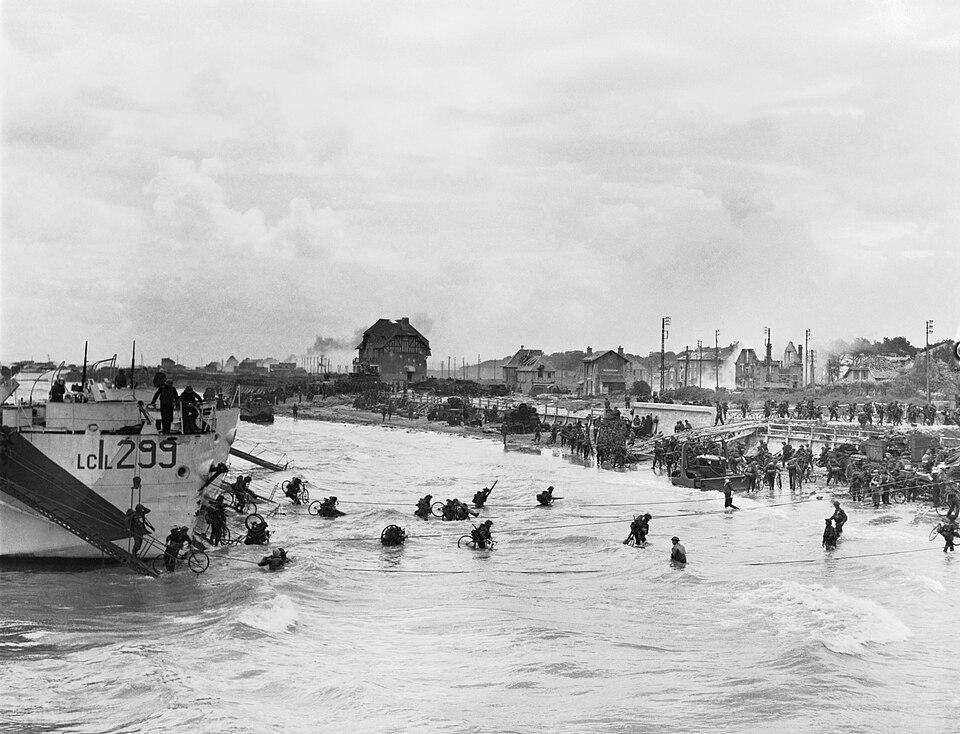
On 6 June 1944, Allied troops landed on five beaches along the Normandy coast. American forces landed at Utah and Omaha, British forces at Gold and Sword, and the Canadians at Juno Beach. The Canadian assault was conducted under the command of the British I Corps. The division was to capture the coastal villages, advance towards the high ground west of Caen and establish contact with the neighbouring British divisions. Approximately 14,000 Canadian soldiers landed at Juno Beach that day. The German coastal defences were mainly occupied by the 716th Infantry Division. Concrete bunkers, minefields, seawalls, machine-gun positions and anti-tank guns protected the approaches to the villages. The Canadians were supported by naval bombardments, specialised British armoured vehicles and Sherman tanks of the 2nd Canadian Armoured Brigade. Some Shermans were equipped with flotation screens and propellers, allowing them to travel through the water independently. However, the rough sea made their deployment difficult. Delays also meant that the rising tide concealed many of the German beach obstacles, making it dangerous for landing craft to approach the shore.
The 7th Canadian Infantry Brigade landed around Courseulles-sur-Mer, while the 8th Brigade attacked Bernières-sur-Mer and Saint-Aubin-sur-Mer. Among the units involved were the Royal Winnipeg Rifles, the Regina Rifle Regiment, the Queen’s Own Rifles of Canada and the North Shore (New Brunswick) Regiment. Many German positions had survived the preliminary bombardment, leaving the infantry exposed to heavy fire. Once the beach defences had been overcome, fighting continued between the houses of the coastal villages. The 9th Brigade subsequently landed and continued the advance inland. By the end of the day, the Canadians had established a substantial bridgehead, although their final objectives around Carpiquet remained beyond their reach. Canadian losses at Juno and during the subsequent inland advance amounted to 340 killed, 574 wounded and 47 taken prisoner, according to figures published by the Juno Beach Centre.
The Germans responded with counterattacks intended to drive the Canadians back towards the coast. On 7 June, elements of the 12th SS Panzer Division Hitlerjugend attacked Canadian troops around Authie and Buron. The North Nova Scotia Highlanders suffered heavily, while further fighting took place around Putot-en-Bessin and Bretteville-l’Orgueilleuse. The Canadians managed to retain their bridgehead, but the German resistance prevented a rapid advance towards Caen. During these battles, members of the Waffen-SS also murdered Canadian prisoners of war. One of the documented sites of these war crimes was the Abbaye d’Ardenne, where captured Canadian soldiers were executed during June 1944. Over the following weeks, the fighting increasingly developed into a struggle for individual villages and defensive positions. German troops made use of the Normandy countryside, where hedgerows, orchards and stone buildings provided cover and made enemy positions difficult to identify.
Caen remained an important objective because of its road connections and the relatively open countryside to its south. On 4 July, the Canadians launched Operation Windsor to capture the village of Carpiquet and its heavily defended airfield. The 8th Brigade secured the village, but German resistance prevented the capture of the entire airfield. Another attempt to break the German defences came on 8 July with Operation Charnwood. The 3rd Canadian Infantry Division attacked alongside the British 3rd and 59th Infantry Divisions. Buron and Authie were recaptured, and by 9 July the northern part of Caen and Carpiquet airfield were in Allied hands. The capture of northern Caen did not remove the German positions south of the River Orne. On 18 July, II Canadian Corps launched Operation Atlantic in conjunction with the British Operation Goodwood. The 3rd Canadian Infantry Division advanced from the east and helped clear the southern suburbs of Caen. However, the Germans retained important defensive positions on the higher ground further south. German artillery and anti-tank guns made advancing across the open fields particularly costly.
The situation changed in late July when American forces broke through the German lines in western Normandy. The Canadians now advanced towards Falaise as part of an increasingly large Allied attempt to encircle the German armies. During Operation Totalize, which began on the night of 7–8 August, American aircraft accidentally bombed Canadian and Polish positions. Among the wounded was Major-General Keller. The 8th Canadian Infantry Brigade subsequently encountered strong resistance around Quesnay Wood, and the offensive ended before Falaise was reached. A renewed offensive, Operation Tractable, began on 14 August. The 3rd Division helped break through German positions along the River Laison and capture the high ground north of Falaise. While the 2nd Canadian Infantry Division captured Falaise itself, other Canadian and Polish formations advanced towards Trun and Chambois. Men of the 9th Canadian Infantry Brigade helped secure the area around the remaining German escape routes. By 21 August, the Falaise Pocket had been closed. Although many Germans had escaped, enormous quantities of equipment had been abandoned or destroyed.
Under its new commander, Major-General Daniel Spry, the 3rd Canadian Infantry Division advanced across the Seine and towards the French Channel coast. As the Allied armies moved further into France, supplying them from Normandy became increasingly difficult. The capture of additional ports was therefore essential. Hitler, however, had ordered the German garrisons to defend several fortified ports even after the surrounding countryside had been liberated. On 17 September, the 8th and 9th Canadian Infantry Brigades began Operation Wellhit, the attack on Boulogne. Despite extensive aerial and artillery bombardments, many German fortifications remained intact. British specialised armour assisted the Canadian infantry in overcoming minefields and concrete defences. Boulogne’s last defenders surrendered on 22 September, but extensive German demolitions prevented the immediate use of the harbour.
Operation Undergo, the attack on Calais, began on 25 September. Like Boulogne, Calais was protected by extensive fortifications that had been constructed or strengthened during the German occupation. While fighting continued around the port, the 9th Brigade attacked the coastal batteries at Cap Gris-Nez on 29 September. These guns had threatened shipping in the English Channel and periodically bombarded the Dover area since 1940. Their capture ended that threat. The German commander at Calais surrendered on 30 September, and the remaining resistance ceased the following morning. With this, the division’s campaign in France came to an end.
In less than four months, the 3rd Canadian Infantry Division had gone from an inexperienced formation to one accustomed to sustained frontline fighting. In October, the division was deployed to the Scheldt, where fighting across flooded terrain earned its soldiers the nickname ‘Water Rats’. Further operations in the Netherlands and Germany followed before the war in Europe ended in May 1945.
Author: Tom Dankers, Historian - Arnhems Oorlogsmuseum 40-45
Photo: Canadian Official photographer, Public domain, via Wikimedia Commons