
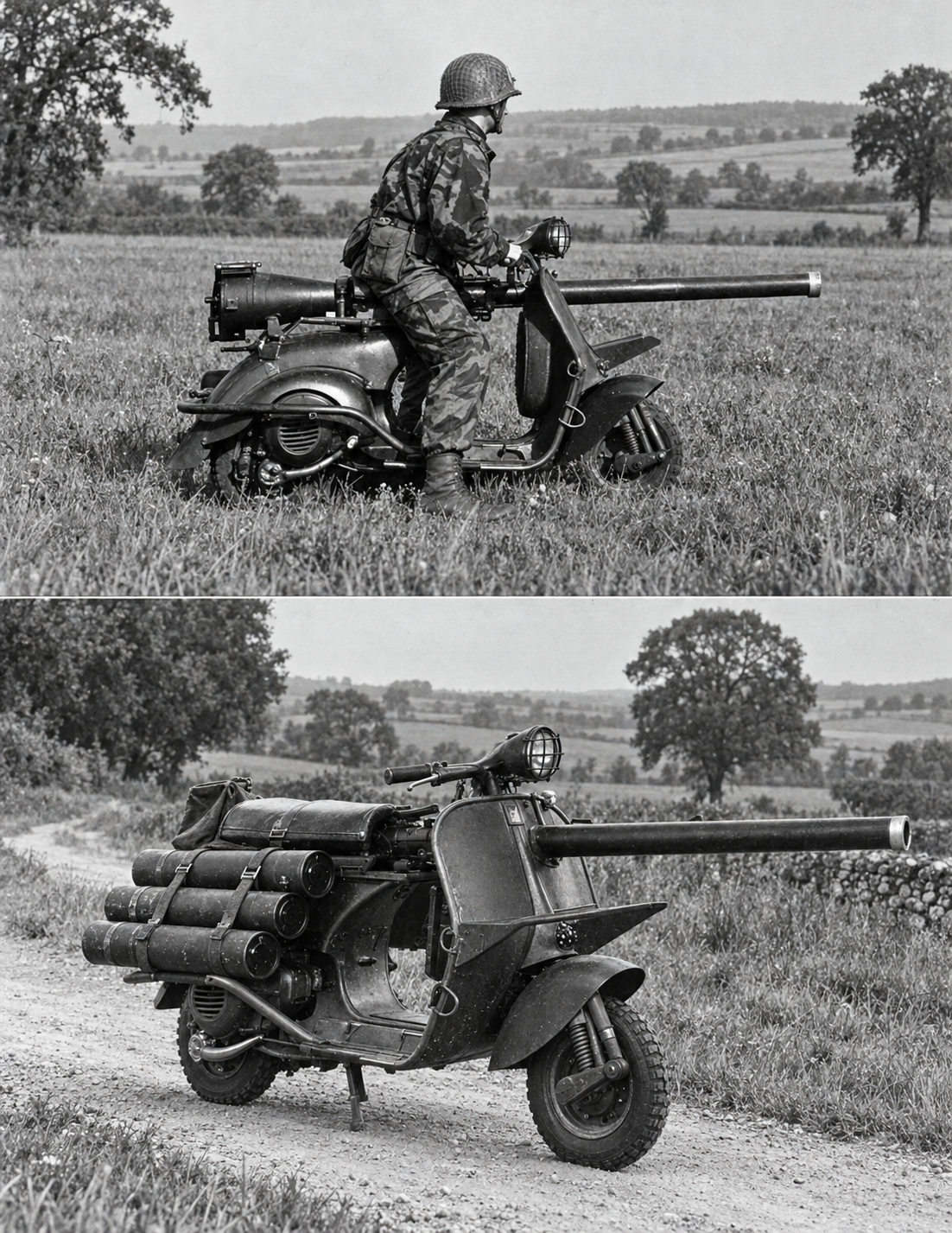
Vespa 150 TAP
The Vespa 150 TAP — A Scooter Built for the Airborne
A Vespa scooter might seem an unlikely choice for military service, especially one carrying a gun with a barrel extending well beyond its front wheel. Yet the Vespa 150 TAP was developed to meet a practical need: helping French airborne troops move heavy weapons and ammunition once they had landed.
During the 1950s, the French Ministry of Defence commissioned ACMA, Piaggio’s licensed manufacturer in France, to produce a military version of the familiar scooter. Around 600 were built between 1956 and 1959 for use by French paratroopers and the Foreign Legion. The initials TAP stood for Troupes Aéroportées, meaning airborne troops.
For soldiers arriving by parachute, landing was only the beginning. Weapons, ammunition and supplies still had to be collected and moved from the dropping zone to wherever they were needed. A small vehicle that could also be delivered by parachute offered a useful way of reducing the load carried on foot.
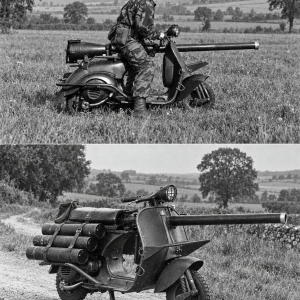
The Vespa’s most striking feature was its American-made M20 75mm recoilless rifle. Mounted lengthways along the scooter, the weapon passed through an opening in the front leg shield, giving the machine its unmistakable appearance. Ammunition containers secured alongside the bodywork added to an already unusual sight.
Although photographs can give the impression that the rider could simply stop and fire from the saddle, the scooter was intended to carry the weapon to a firing position. The gun would then be removed and placed on a tripod. Accounts describe the scooters being dropped in pairs, with the weapon, ammunition and equipment divided between them.
Beneath its military equipment, the machine retained much of the simplicity of a civilian Vespa. Its single-cylinder, two-stroke engine had a capacity of 145.2cc, with the Piaggio Museum quoting a maximum speed of around 66km/h and a range of approximately 200km. The frame was reinforced, while a tubular structure around the body provided protection and support for the ammunition carriers.
There were practical limits, of course. Small wheels and modest ground clearance could make difficult ground a challenge, particularly when carrying a heavy load. Even so, the idea was straightforward: use a compact, relatively simple machine to give an airborne gun team greater mobility.
The Vespa 150 TAP went on to serve during the Algerian War. An example in the collection of the Musée-Mémorial des Parachutistes is identified by the French Army’s heritage publication as having been deployed during that conflict.
It remains one of the more unusual vehicles associated with airborne forces. Its appearance attracts attention, but the thinking behind it will be familiar to anyone who has carried military equipment over distance. Getting a weapon onto the ground is one task; getting it to where it is needed is another. For a time, the French answer came on two small wheels.
The accompanying images are AI-generated historical recreations, rather than original archive photographs.