Swiss Alpenflage Camo
Swiss Alpenflage is one of the most instantly recognisable camouflage patterns ever worn by a European army. With its extraordinary mixture of red, green, black, brown, beige and small pale flecks, it appears almost too colourful to have been designed for concealment. Yet when placed amongst autumn leaves, broken woodland, rocks and the varied vegetation of Switzerland, the strange combination begins to make considerably more sense. Today it has become a favourite among military collectors and outdoor enthusiasts, although “Alpenflage” was never originally the formal Swiss military name for the camouflage.
The origins of the design can be traced back to the final months of the Second World War and the German camouflage known as Leibermuster. Introduced in extremely limited quantities in 1945, Leibermuster was intended as a more universal camouflage capable of working across different terrain rather than being restricted to one particular season. The original German design is generally associated with the Leiber brothers, whose name became attached to the pattern. It used irregular black, green and brown shapes over a lighter background and represented one of the last developments in German wartime camouflage clothing.
Following the war the Swiss developed their own camouflage drawing which was heavily influenced by this late German pattern. It should therefore not really be said that one individual “designed Alpenflage”. The basic ancestry belonged to the German Leibermuster concept, while the distinctive Swiss version was developed for the Swiss Army through its own military clothing and procurement system. The resulting camouflage was sufficiently different in colour and appearance that it became a recognisable Swiss pattern in its own right.
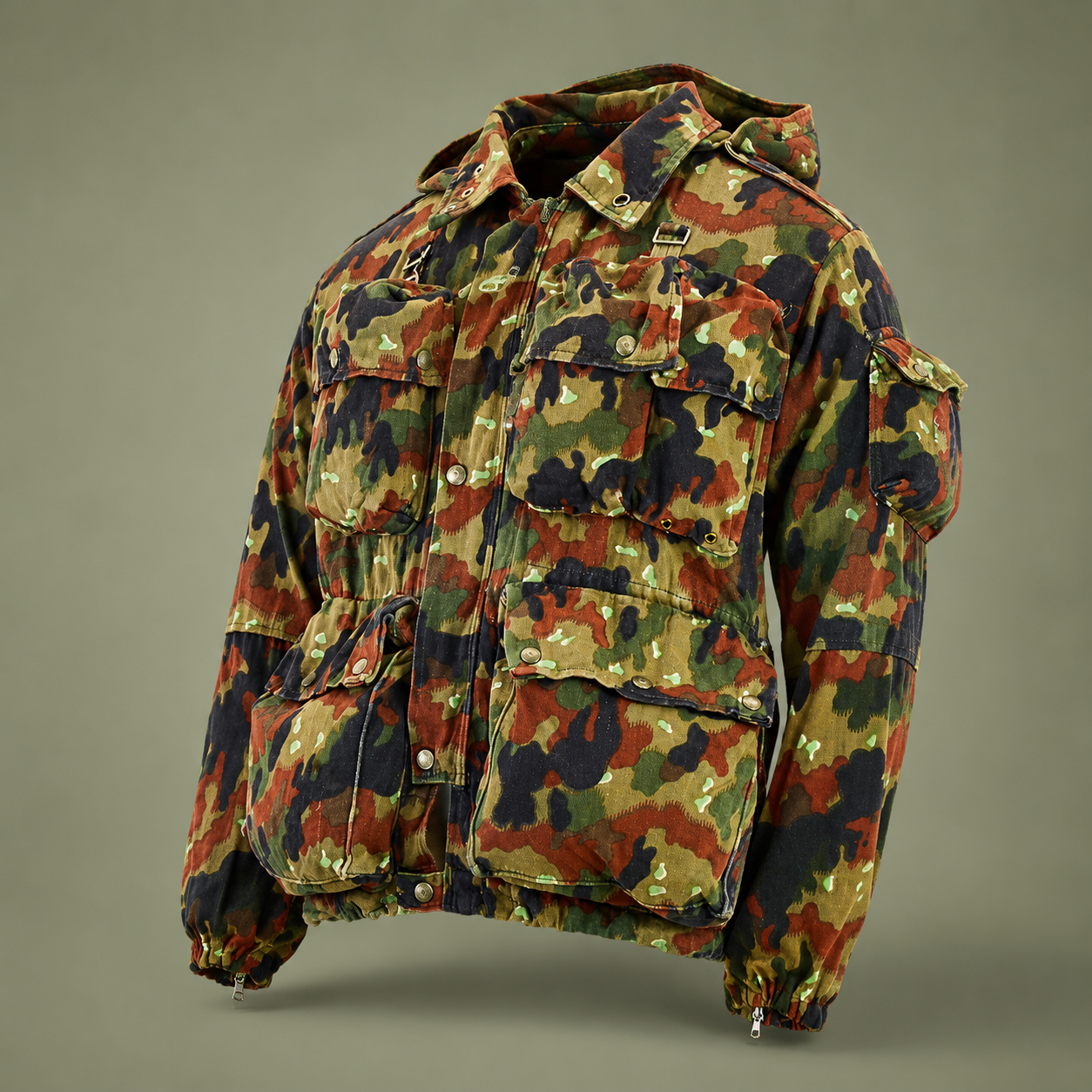
The first Swiss combat clothing associated with the pattern appeared during the late 1950s. What collectors often call TAZ 57 was used on the Swiss Kampfanzug, or combat suit, and the camouflage continued through later versions including the famous Kampfanzug Modell 70. The Modell 70 consisted of jacket, trousers and rucksack, with a hood and numerous pockets. The enormous number of pockets was partly connected with the introduction of the Stgw 57 service rifle, as soldiers needed to carry substantial quantities of ammunition and equipment without relying entirely upon separate webbing.
The result was one of the most unusual combat jackets ever issued. The heavy jacket effectively combined clothing and load-carrying equipment, with large pockets distributed around the body. Matching trousers, helmet covers, armoured-vehicle crew clothing, rain garments, shelter sheets and other equipment were also produced in variations of the camouflage. Tank crews were issued a one-piece camouflage overall incorporating features intended to assist in extracting an injured crewman from a vehicle.
Perhaps the most remarkable feature is the red. Most camouflage designers normally avoid such an obvious colour, yet considerable areas of reddish brown or almost crimson appear throughout the Swiss material. These are mixed with light and darker greens, beige or tan, black shapes and small pale markings. From a few feet away the uniform can look remarkably loud, but amongst reddish vegetation, dead leaves, shadows and broken woodland it disrupts the human outline surprisingly effectively. The black areas create deep artificial shadows while the lighter patches break up the larger coloured shapes.
Swiss troops themselves were well aware of the extraordinary appearance. The Kampfanzug acquired the humorous nickname “Vierfrucht-Pyjama”, usually translated as “four-fruit pyjamas”, a reference to its colourful mixture of shades. Much later, military surplus dealers and collectors began calling it “Alpenflage”, combining the Alps with camouflage. The name became especially common after large quantities of Swiss camouflage clothing entered the international surplus market during the 1990s.
Another commonly used collector nickname is “pizza camouflage”. It is not difficult to see why. The red, green, black and cream-coloured shapes scattered across the material can resemble the toppings on a pizza, particularly after decades of washing have softened the original colours.
In 1983 the Swiss Army introduced a considerably lighter and simpler uniform known officially as Tarnanzug 83, normally abbreviated to TAZ 83, or TASS 83 in French. Although people often use TAZ 83 as the name for the entire family of red Swiss camouflage, strictly speaking the earlier Kampfanzug clothing and the lighter 1983 uniform were different garments. The TAZ 83 was particularly associated with support and non-combat personnel, while the heavier Kampfanzug remained available to combat troops.
The lighter 1983 clothing looked much more like a conventional shirt-and-trouser combat uniform. It abandoned much of the enormous integrated load-carrying arrangement of the earlier jacket, making it considerably easier and more comfortable to wear. The camouflage nevertheless retained the extraordinary family resemblance that today makes almost any piece of Swiss red camouflage immediately identifiable.
Manufacture was undertaken for the Swiss government by a number of clothing and textile contractors rather than by one famous manufacturer responsible for the entire pattern. Surviving uniforms can consequently carry different contractor markings and production dates. Alpenflage was essentially a Swiss military specification rather than the commercial creation of one clothing company.
The wider Alpenflage family remained in Swiss service from the late 1950s into the early 1990s. TAZ 83 itself appeared in 1983 and continued until the transition to the new generation of Swiss camouflage during the early 1990s. Its successor was TAZ 90, which dispensed with the striking red appearance in favour of considerably more conventional greens, browns, black and subdued background shades. TAZ 90 began replacing the older clothing around 1990 and became the standard Swiss camouflage uniform during the following years.
Interestingly, the replacement did not entirely abandon the visual heritage of the older camouflage. The Swiss continued to develop irregular disruptive drawings suited to their own environment, but the later pattern was toned down considerably and better matched the colours normally associated with modern European military camouflage.
Alpenflage also appeared on Switzerland’s famous Militärblachen, the extremely useful military shelter sheets carried by generations of soldiers. These rugged sheets could provide rain protection, form part of a bivouac or tent and be used for concealing equipment. Their hard-wearing construction meant that examples survived long after many uniforms had disappeared from frontline use.
One intriguing aspect of the pattern’s history is its relationship with infrared observation. Late-war German camouflage development was already attempting to consider how uniforms appeared through early infrared equipment, rather than designing solely for the human eye. The Swiss pattern inherited some of the visual ideas associated with Leibermuster, although claims that every piece of Alpenflage possessed sophisticated infrared properties should be treated cautiously because production materials and dyes changed considerably across several decades.
The camouflage was designed primarily around the conditions in which Swiss soldiers might actually fight. Switzerland offered a remarkable mixture of alpine terrain, dense woodland, villages, agricultural areas, exposed rock and rapidly changing seasonal colours. A pattern that appeared bizarre on a barrack-room floor could behave quite differently when surrounded by vegetation and shadow. This helps explain why the Swiss retained such an unconventional design for more than thirty years.
Another reason Alpenflage has survived so strongly in popular memory is the quality and practicality of the clothing itself. The heavy Kampfanzug jackets were famously tough, generously supplied with pockets and capable of carrying an extraordinary amount of equipment. Once thousands entered the European and American surplus markets during the 1990s they became inexpensive jackets for hunters, campers, airsoft players, fishermen and outdoor workers. The distinctive colours also meant that they were increasingly bought simply because they looked different from almost every other camouflage uniform.
Original garments today can vary greatly in appearance. Repeated washing fades some of the darker colours, and black areas can develop a bluish appearance while red and green become noticeably softer. Different production periods, fabrics and contractors can also produce variations, meaning two genuine jackets placed beside one another do not necessarily have identical shades.
Alpenflage therefore represents considerably more than an eccentric red camouflage. Its story begins with experiments undertaken during the closing stages of the Second World War, continues through Switzerland’s Cold War preparations and eventually finishes with the adoption of TAZ 90 in the early 1990s. What began as a practical military attempt to conceal soldiers in Switzerland’s complicated landscape eventually became one of the most distinctive uniforms of the Cold War.
More than thirty years after it largely disappeared from Swiss Army service, its combination of red, green, beige and black remains instantly recognisable. Few camouflage patterns have managed to look simultaneously so unsuitable when viewed indoors and so surprisingly effective when placed in the right countryside. That contradiction is perhaps the greatest reason why Swiss Alpenflage remains one of the most fascinating and attractive military camouflage patterns ever produced.