RAF Escape Axe
The RAF escape axe was one of those pieces of wartime equipment that was rarely noticed until the moment it was desperately needed. Compact enough to be carried inside an aircraft yet strong enough to hack through aluminium skin, timber, Perspex and internal fittings, it was designed to give trapped aircrew one final means of escape from a wrecked or burning aircraft. During the Second World War it became an important item of emergency equipment aboard many RAF bombers, larger aircraft and troop-carrying gliders, and surviving wartime examples are now highly recognisable pieces of British aviation history.
Its purpose was brutally simple. When an aircraft crash-landed the fuselage could twist, buckle or collapse around the crew. Escape hatches might jam, frames could distort, electrical wiring could remain live and fuel might begin leaking through the wreckage. Fire was one of the greatest dangers facing surviving airmen after a crash and every second spent trying to escape mattered. The escape axe provided a compact but extremely strong tool with which a crewman could cut or smash another way out.
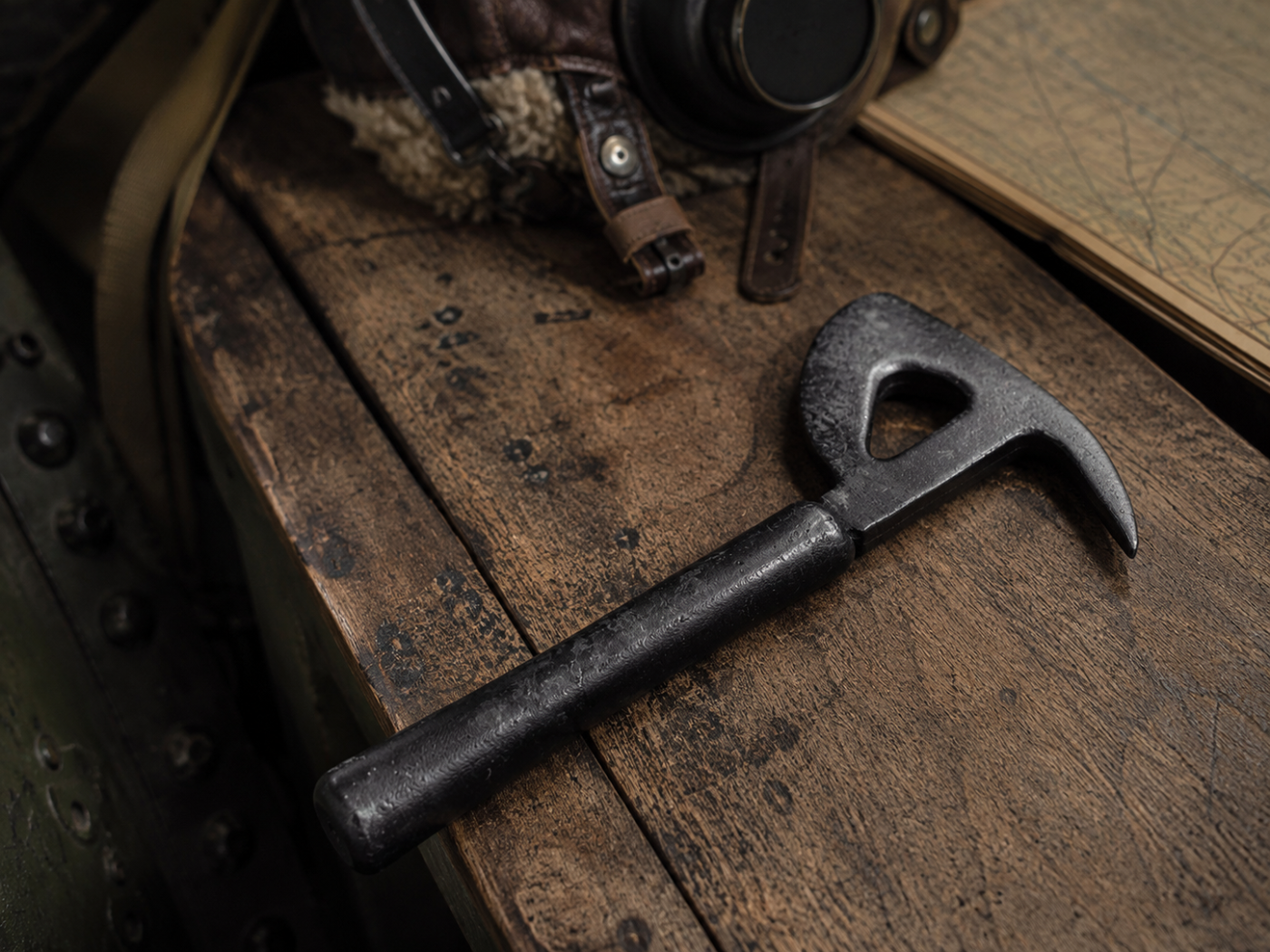
The unusual shape of the axe was specifically designed for the job. One side of the forged steel head formed a cutting edge that could be used against thin aircraft skin, internal structure and timber, while the opposite end formed a curved spike or pick. This could be driven through Perspex glazing, panels and other obstructions before being used to rip the material away. A large opening through the centre of the head helped reduce unnecessary weight while still retaining considerable strength. Wartime examples are generally around 40 centimetres long, making them far easier to swing inside the cramped interior of an aircraft than a conventional fire axe.
One of its most distinctive and important features was the heavy insulated rubber-covered handle. Wartime aircraft contained extensive electrical wiring and there was always the possibility that an airman attempting to chop his way free could strike a live cable. Surviving examples can be found with grips carrying markings such as “TESTED 20,000 VOLTS” or “TESTED 15,000 VOLTS”. The insulated handle was therefore intended to provide a degree of protection from electrical shock as well as giving the user a firm grip in conditions that might involve smoke, fuel, oil, water and blood.
One of the best-known wartime manufacturers was Elwell, a long-established British maker of edge tools. Original wartime axes are known bearing the Elwell name together with production dates, Air Ministry markings and British government ownership stamps. Examples survive from the opening year of the war through to 1944 and 1945, showing how long the basic design remained in service.
Elwell was not the only manufacturer associated with the axe. Early RAF examples were also produced by the Chillington Tool Company of Wolverhampton. Chillington was already manufacturing the closely related ARPAX rescue axe for Britain’s Air Raid Precautions organisation and its design shared many of the same features. Early aircraft axes carrying Chillington markings and Air Ministry identification are known, although Elwell appears to have become one of the most commonly encountered wartime makers.
This similarity between RAF escape axes and civilian rescue axes can cause confusion among collectors. The wartime ARPAX used by Air Raid Precautions personnel, rescue parties and the Auxiliary Fire Service had a similar blade-and-spike arrangement and often carried an insulated handle. The markings are therefore extremely important when identifying an original RAF example. Genuine aircraft axes can carry the Air Ministry crown and letters “AM”, together with stores references, dates, maker’s marks and the British government Broad Arrow. Civil Defence examples are more likely to carry ARPAX, AFS or related civilian rescue markings.
One RAF stores number commonly encountered on wartime axes is 21F/1, while other British service examples can be found with different stores references. Variations existed throughout wartime production and the identification of an axe should always be based on the combination of manufacturer, date, Air Ministry markings and stores number rather than relying on one stamp alone. On heavily used examples these markings can be faint because of corrosion, repeated handling or later cleaning.
The escape axe is most closely associated with RAF bombers and other multi-crew aircraft. It could be encountered aboard major Bomber Command types such as the Avro Lancaster, Handley Page Halifax, Vickers Wellington and Short Stirling, together with other larger RAF aircraft where there was a real danger of crews becoming trapped after a crash.
The Lancaster is perhaps the aircraft most commonly associated with the escape axe in the collecting world. Its large fuselage contained a crew of seven and, after a heavy crash landing, normal exits could become almost impossible to use if the aircraft structure distorted. Emergency equipment was therefore positioned so that crewmen had some chance of reaching it quickly. The Halifax presented similar problems, while the Wellington’s unusual geodetic construction could also leave airmen trapped within twisted internal structure following a severe impact.
The de Havilland Mosquito also carried a crash axe as part of its emergency equipment. On some versions it was positioned behind the pilot’s seat, showing just how close to hand the tool was intended to be. A crew fighting their way out of a burning aircraft could not afford to spend precious seconds searching through lockers or storage compartments.
Escape axes were also carried aboard British military gliders. Aircraft such as the Airspeed Horsa and General Aircraft Hotspur presented an obvious requirement for this type of equipment because their largely wooden structures could splinter, collapse and jam normal exits during a violent landing. An axe could be used to break through damaged timber, cut away internal structure or smash open another route for troops and aircrew.
This connection with wartime gliders has made surviving examples particularly attractive to Airborne collectors. Once a glider had landed in enemy territory the axe could continue to be extremely useful. Airborne troops needed tools for breaking open crates, cutting timber, removing obstacles, preparing defensive positions and forcing entry into buildings. It is therefore entirely believable that some troops removed escape axes from abandoned gliders rather than leaving such a useful piece of equipment behind.
Axes recovered from areas associated with major Airborne operations have attracted particular interest, especially examples linked with Normandy and Arnhem. However, as with almost all wartime militaria, provenance is extremely important. An axe carrying genuine Air Ministry markings may unquestionably be an RAF item, but that does not automatically prove that it came from a particular Lancaster, Horsa glider, squadron or battle.
Claims of specific aircraft provenance should therefore be treated carefully. An escape axe said to have come from a famous bomber, fighter or D-Day glider can command a substantial premium, but ideally there should be supporting paperwork, period photographs, veteran history, aircraft records or a reliable chain of ownership. A story added decades after the war can be interesting, but without supporting evidence it should not be valued in the same way as documented provenance.
Despite their unmistakable appearance and dramatic purpose, ordinary RAF escape axes are not generally among the most expensive pieces of wartime aviation equipment. They were produced in useful numbers and their extremely strong construction meant that many survived. Basic examples with weaker markings or considerable wear can still sometimes be found for around £30 to £50.
Better examples tend to sit higher. A clearly dated Elwell axe with good Air Ministry markings, an intact insulated grip and an attractive untouched wartime finish might reasonably fall somewhere around the £60 to £100 range, depending on condition and demand. Particularly desirable examples with strong markings, unusual dates or convincing glider associations can move beyond this, with specialist examples sometimes appearing around £100 to £150 or more.
As always, provenance can alter the value dramatically. An ordinary Air Ministry axe may sell for relatively modest money, while an example genuinely documented to a particular aircraft, wartime crew or famous operation could be worth considerably more because the historical association becomes as important as the axe itself.
Condition is one of the biggest factors affecting collector value. Original black or dark wartime finishes are generally preferred, together with clearly visible manufacturer and date markings, Air Ministry stamps, Broad Arrows and stores numbers. Heavy wire brushing, polishing or repainting can actually reduce desirability because original finish, patina and faint inspection marks may be destroyed in the process.
The rubber-covered handle deserves particular attention. These axes are now more than eighty years old and the rubber can crack, split, shrink or perish. An example retaining a complete original grip with clear voltage-test or patent markings is therefore considerably more attractive than one with severe damage or a replaced handle. Patent number 515767 is sometimes encountered on original insulated grips and is another detail collectors look for when examining an axe.
Collectors also need to be careful of incorrectly identified Civil Defence and fire-service axes. The Chillington ARPAX is an interesting wartime object in its own right, but it should not automatically be described as an RAF aircraft escape axe simply because the shape is similar. In the same way, an axe carrying only civilian rescue markings should not suddenly acquire a Lancaster or glider history unless there is genuine evidence to support the claim.
Perhaps the most fascinating thing about the RAF escape axe is how simple it was compared with the technology surrounding it. Britain could build Merlin engines, radar equipment, automatic gun turrets and four-engined bombers capable of striking targets deep inside occupied Europe, yet when one of those aircraft crashed and the exits jammed, survival might ultimately depend on a frightened airman swinging a short piece of forged steel.
For the crews of Lancasters, Halifaxes, Wellingtons, Mosquitos, Stirlings and other wartime aircraft, the escape axe was there for the worst possible moment. The aircraft might be upside down, the fuselage twisted, smoke filling the interior and fuel spreading through the wreckage while normal escape routes were blocked. In those circumstances the rubber-covered handle, heavy cutting edge and vicious curved spike were not simply another piece of aircraft equipment. They represented one final chance to get out alive.