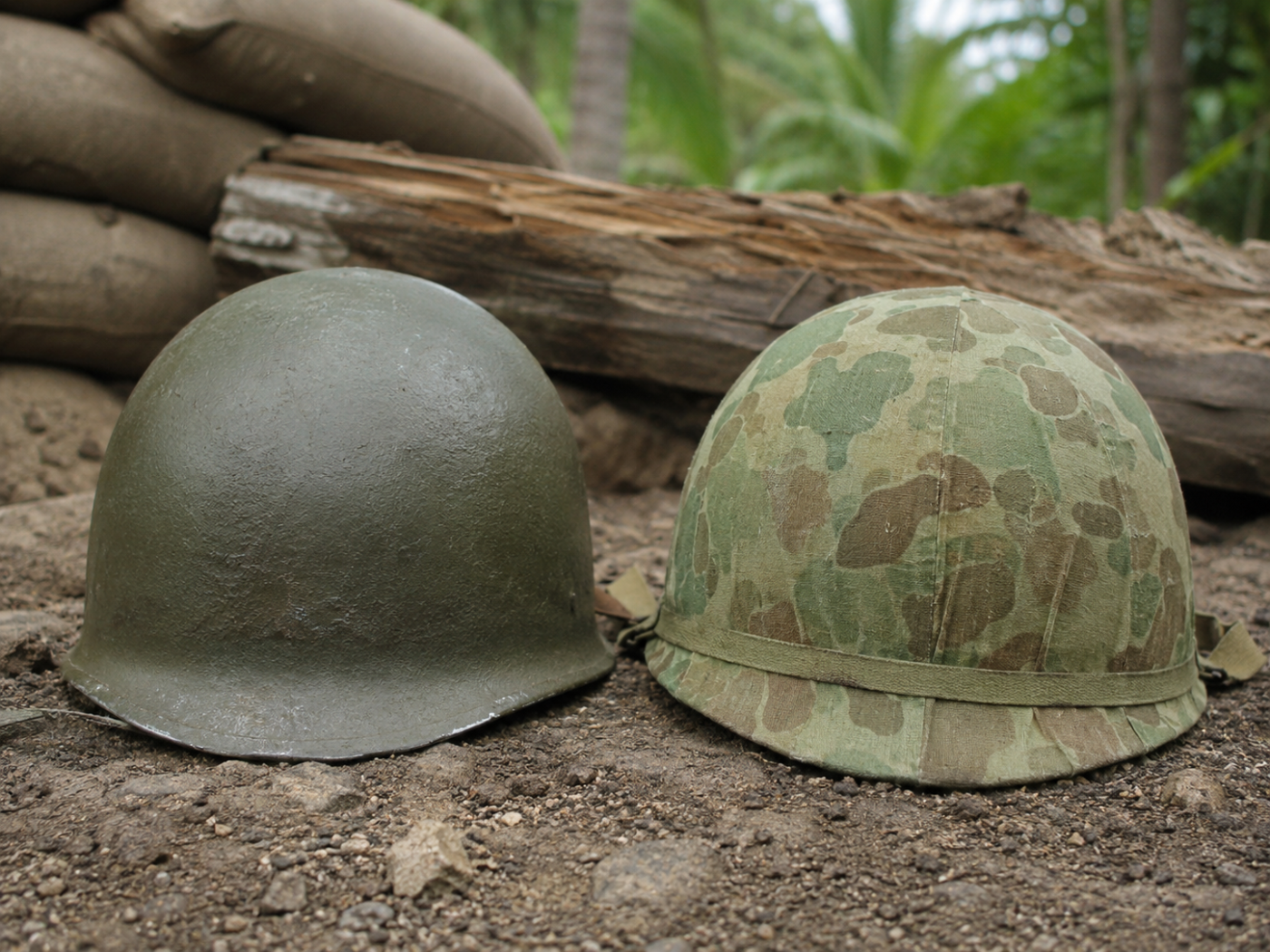
M1 pea green Helmet
Of all the helmets worn by American forces during the Second World War, few have a more distinctive appearance than the pale green M1 helmet associated with the Pacific campaigns. When left uncovered, its unusual light olive or “pea-green” shade stood apart from the darker helmets more commonly seen in Europe. When fitted with the reversible camouflage cover issued to the United States Marine Corps, it created the unmistakable appearance seen in photographs from Tarawa, Saipan, Peleliu, Iwo Jima and Okinawa.
The description “pea green” was not an official American military colour designation. It is a term now commonly used by collectors to describe certain M1 helmet shells whose original olive-drab paint appears noticeably lighter, yellower or greener than the darker brown-olive finish normally associated with wartime American helmets.
Some examples appear almost apple green, while others have a pale yellow-green or grey-green appearance. This variation was not necessarily intentional. It resulted from differences between paint batches, pigment mixtures, production dates, factory application, exposure to tropical sunlight and more than eighty years of ageing.
The helmet itself was the M1, adopted by the United States in 1941 to replace the M1917A1 helmet. The earlier helmet had been developed from the British First World War Brodie design and was often called the “Kelly helmet” by American servicemen. Its wide brim offered good protection from fragments falling from above, but it provided comparatively little protection to the sides and back of the head.
Experience in the First World War and the changing nature of modern warfare encouraged the United States Army to seek a deeper helmet offering greater all-round protection. The resulting M1 had a broad front peak, rounded crown and a deep skirt extending around the sides and rear of the head. It became one of the most successful and recognisable military helmet designs ever produced.
The M1 was not a single helmet but a two-part system. The outer component was a tough steel shell, commonly known as the steel pot. Inside it sat a separate moulded liner containing the suspension system that actually supported the helmet on the wearer’s head.
This arrangement offered several advantages. The suspension prevented the steel shell from resting directly against the skull, created space to absorb some of the force of an impact and allowed one basic shell size to fit most servicemen. The liner could also be removed and worn separately during training, military police duties and other situations where the full steel helmet was unnecessary.
The outer shell was manufactured from non-magnetic Hadfield manganese steel. Rather than being formed from mild steel, which could crack or distort unpredictably, the manganese alloy produced a shell that was hard, tough and resistant to fragmentation.
The M1 was principally intended to protect against shell splinters, flying debris and glancing impacts. It was never designed to guarantee protection against a direct rifle or machine-gun bullet, although there are recorded occasions when the curved shell deflected or stopped projectiles under favourable circumstances.
Manufacturing an M1 shell was a demanding industrial process. Circular steel blanks were repeatedly pressed through a series of dies until the familiar deep helmet shape had been created. The edges were trimmed, a separate rim was fitted around the base and loops were attached for the web chinstrap.
On early wartime M1 helmets the stainless-steel rim joined at the front. These helmets are known to collectors as front-seam helmets. From late 1944 the seam was moved to the rear, partly to prevent the front joint from catching and separating during use.
The earliest shells also had fixed rectangular chinstrap loops, usually called fixed bales. These could break when subjected to rough handling, so movable or swivel bales were introduced during 1943. Both fixed-bale and swivel-bale helmets saw extensive service in the Pacific.
Only two companies manufactured complete M1 steel shells for the United States during the Second World War. The overwhelming majority were made by the McCord Radiator and Manufacturing Company of Detroit, Michigan. McCord began production in 1941 and produced approximately twenty million wartime shells.
The second manufacturer was the Schlueter Manufacturing Company of St Louis, Missouri. Schlueter entered production during 1943 after the enormous wartime demand made a second source necessary. It manufactured approximately two million shells, making genuine wartime Schlueter helmets considerably less common today.
Schlueter shells can normally be identified by a stamped letter S near the heat or lot number inside the front of the helmet. McCord shells generally carry a lot number without the large Schlueter S. There are also slight differences in the shape of the brim and sides, although these can be difficult to recognise without comparing the two types together.
The removable liners were made separately by several companies. Wartime high-pressure liner manufacturers included Westinghouse Electric and Manufacturing Company, Firestone Tire and Rubber Company, CAPAC Manufacturing, Inland Manufacturing, Mine Safety Appliances, Seaman Paper Company and International Molded Plastics.
The first M1 liners were made from layers of fibre material impregnated with resin, but these early Hawley-type liners did not withstand hard service and tropical moisture particularly well. They were gradually replaced by stronger high-pressure liners made by compressing resin-treated cotton fabric into a rigid shell.
The liners can often be identified by small moulded manufacturer marks inside their crowns. Westinghouse used a distinctive W, Firestone used an F within a shield, while other manufacturers applied their own symbols. Because shells and liners were produced separately, an original helmet might contain a McCord shell with a Westinghouse liner, or a Schlueter shell with a Firestone liner. This was entirely normal.
The colour normally specified for the M1 shell was a matt olive drab. The outside paint contained finely ground cork, producing the rough, stippled texture that helped reduce glare and prevented the helmet’s smooth surface from reflecting sunlight. Wartime cork texture is one of the characteristics collectors examine when attempting to distinguish original Second World War paint from later refinishing.
Although the official intention was to produce a uniform olive-drab finish, wartime manufacturing on such an enormous scale inevitably created variations. Paint was produced in huge quantities by different suppliers. Pigments could vary slightly, mixtures were not always identical and one production batch might dry lighter or greener than another.
The steel shell beneath the paint could also affect the finished appearance. Differences in primer, the amount of cork added, the thickness of the paint and the temperature or humidity during application could all influence its final colour.
The pale shade now called pea green is therefore best understood as a genuine wartime variation rather than a completely separate official helmet colour. It could appear on helmets intended for any theatre, but surviving photographs and original examples have made it particularly associated with American Marines and sailors serving in the Pacific.
The tropical environment could exaggerate the effect. Strong sunlight gradually faded exposed paint, while salt water, coral dust, rain, sweat and constant handling wore away or altered the surface. A helmet that began as standard olive drab could develop a lighter green appearance after months of campaigning.
At the same time, surviving helmets have continued to change since 1945. Paint can yellow or fade with age, while storage in sunlight, damp buildings, garages or lofts can affect the colour. Consequently, not every light green M1 necessarily left the factory looking exactly as it does today.
Collectors should also be cautious because many post-war M1 helmets were painted in lighter green shades. Korean War and later shells can sometimes resemble the pea-green appearance of a faded wartime helmet. The colour alone cannot confirm age.
A genuine wartime example should be judged from a combination of characteristics, including the shell’s front or rear seam, fixed or swivel chinstrap loops, heat stamp, manufacturer markings, cork texture, rim material, chinstraps and liner construction.
The reversible camouflage helmet cover became especially important in creating the classic Pacific appearance. It was developed for the United States Marine Corps as part of a wider attempt to provide camouflage suitable for the varied vegetation, beaches and volcanic islands across the Pacific.
The cover was manufactured from cotton herringbone twill, usually abbreviated to HBT. It was made in sections stitched together to form a dome that fitted over the M1 shell. The cover’s lower edges were folded underneath the steel shell, after which the liner was pushed into place, trapping the cloth securely between the shell and liner.
One side carried a predominantly green camouflage pattern intended for jungle and heavily vegetated terrain. The reverse used a brown, tan and reddish pattern intended for beaches, coral islands, dry ground and areas where the surrounding vegetation had been destroyed.
The green side is often described as the jungle or forest side, while the brown side is known as the beach, coral-island or autumn side. The overall camouflage family is commonly called frogskin or duck-hunter camouflage by modern collectors, although wartime Marines would not necessarily have used those exact names.
The pattern consisted of irregular, overlapping shapes intended to break up the smooth outline of the helmet. Black or very dark areas were combined with lighter greens on the jungle side, while the reverse contained browns, tans and reddish shades.
In theory, the cover could be reversed according to the terrain. Marines might be ordered to wear it “green side out” when moving through jungle or “brown side out” on beaches, dry hills or exposed coral ground. In practice, local conditions could change rapidly, and Marines did not always stop to reverse their covers every time they moved between terrain types.
The US Marine Corps began using the reversible cover during late 1942. It became increasingly visible during the campaigns of 1943 and 1944, although issue was not immediately universal and many Marines continued to wear bare M1 helmets.
Early examples of the cover were generally constructed without the later rows of buttonholes or foliage slits. Subsequent versions included stitched openings through which grass, leaves, strips of cloth or other natural camouflage could be inserted.
These slots also created the distinctive appearance of small stitched lines across the surface of the cover. Marines could add local vegetation to break up the helmet’s rounded shape, although foliage quickly wilted in tropical heat and required frequent replacement.
The cover performed more than one useful function. It reduced the glare of the painted steel, disrupted the helmet’s recognisable outline and provided some insulation against a shell heated by the Pacific sun. It also reduced the sound caused when branches, equipment or small stones struck the bare steel.
However, the cover could hold water, mud and sweat. In humid conditions it remained damp and became stained, faded and torn. Salt water could leave pale marks across the cloth, while coral dust worked into the fibres and changed the original colours.
This hard use helped create the faded appearance now associated with wartime Marine helmets. Fresh covers could be surprisingly vivid, but repeated exposure to sunlight and weather softened the pattern. Greens faded towards grey or pale olive, while the brown side could become dusty tan or pinkish brown.
The cover was often held more firmly in place by fitting an additional band around the outside. Marines improvised these bands from inner tubes, rubber strips or other available material. The band could also hold foliage, first-aid packets, small personal items or insect repellent.
It is important not to confuse the Second World War Marine camouflage cover with the later Mitchell-pattern cover used extensively during the Vietnam War. The Mitchell cover was also reversible, but it had a different printed pattern, with green leaves and vines on one side and a brown cloud-like design on the reverse.
Because both types are reversible and both are widely associated with the M1 helmet, they are frequently confused in reproductions, films and incorrectly assembled collector helmets. A Vietnam-era Mitchell cover does not belong on a helmet represented as a wartime Pacific Marine example.
The wartime reversible cover was primarily associated with the Marine Corps. United States Army soldiers in the Pacific more commonly wore their helmets uncovered or fitted with netting, although equipment could cross service boundaries and exceptions certainly occurred.
Navy corpsmen serving with Marine units also wore the Marine camouflage cover. These sailors lived and fought alongside the Marines and often used much of the same field equipment. Corpsmen sometimes added medical markings, although highly visible insignia could make them targets and were not applied consistently.
In combat photographs, the pea-green shell is often only partly visible beneath the cover. The exposed rim, chipped edges and underside contrast with the mottled camouflage fabric. When the cover was pushed back, damaged or badly fitted, larger areas of the pale green shell could show through.
This combination produced a particularly distinctive appearance: a rough, faded green steel rim beneath a reversible cover whose loose edges, stitched foliage slots and irregular camouflage pattern gave each helmet an individual look.
Some covers were carefully fitted, while others sat unevenly or formed folds across the crown. Wearers occasionally cut or modified them, and repeated removal of the liner could stretch the cloth. Dirt, salt, sweat and repairs meant that two helmets rarely looked exactly alike after several months in the field.
The M1 helmet soon became inseparable from the image of the American serviceman. In Europe it was commonly seen bare, netted or marked with unit insignia. In the Pacific, the reversible Marine cover gave it a markedly different appearance suited to an environment of dense jungle, dazzling beaches, coral dust and volcanic ash.
On islands such as Tarawa, Marines crossed open beaches where the brown side of the cover blended more naturally with sand and coral. Further inland the green side offered better concealment among palms, scrub and dense vegetation. On Iwo Jima, where the ground was dominated by dark volcanic sand and blasted terrain, either side might become rapidly stained by ash and dust.
By the battle for Okinawa in 1945, the covered M1 had become an established symbol of the Pacific Marine. Yet photographs still show a mixture of covered and uncovered helmets, different camouflage sides, improvised bands and varying amounts of added foliage.
The pea-green helmet should therefore not be treated as a special Pacific-only model. It was an M1 manufactured to normal wartime requirements whose particular paint mixture, factory finish, fading or ageing gave it the lighter shade now valued by collectors.
Likewise, the reversible cover was not permanently attached to the helmet. It was a removable piece of Marine camouflage equipment that could be fitted to either a McCord or Schlueter shell and used with liners made by any of the recognised wartime manufacturers.
Today, an original pea-green M1 shell paired with a genuine wartime reversible Marine cover represents one of the most desirable American helmet combinations of the Second World War. Unfortunately, it is also one of the most frequently reproduced and incorrectly assembled.
Original covers are now scarce because they were made from cloth and were exposed to exceptionally harsh conditions. Many were worn out, discarded, reused during training or altered after the war. Surviving examples may show fading, frayed stitching, small tears, salt staining or handwritten names.
Collectors must be particularly careful of artificially aged reproductions. A newly manufactured cover can be faded, rubbed with dirt or stained to imitate Pacific service. Genuine wear normally appears naturally across raised areas, folds, seams and exposed edges rather than as an evenly applied coating of dirt.
The shell and liner should also be examined independently. A genuine wartime shell and a genuine wartime liner do not prove that they were together during the war, while an original cover added recently does not create a fully untouched wartime set.
The most convincing examples have consistent wear. Areas of the shell protected by the cover may retain darker paint, while the rim and exposed underside show natural handling. The cover may have wear corresponding to the helmet’s edges, and the liner may display age and use consistent with the rest of the set.
Despite these difficulties, the pea-green M1 remains an important and visually striking piece of American military history. It represents the enormous industrial effort required to equip millions of servicemen, the constant adaptation of equipment to different environments and the particularly demanding conditions faced by Marines and sailors in the Pacific.
Its colour was not the product of a special elite issue or a secret camouflage experiment. It emerged from ordinary wartime production, variations in olive-drab paint, tropical exposure and the slow effects of ageing. Yet when combined with the reversible Marine camouflage cover, it created one of the most unique and instantly recognisable helmet appearances of the entire Second World War.