Hotspur Glider
When Britain began creating its airborne forces during the Second World War, one of the first major problems was how soldiers could be delivered directly onto a battlefield with heavier equipment than could easily be carried by parachute. The Germans had already demonstrated the potential of assault gliders in May 1940, when DFS 230 gliders landed troops almost directly on top of the Belgian fortress of Eben-Emael. Britain very quickly realised that it needed its own military glider force, and the aircraft chosen to begin that programme was the General Aircraft GAL.48 Hotspur.
The Hotspur holds an important place in British airborne history because it was the first British military glider ordered in significant numbers during the Second World War. Although it would eventually be overshadowed by the much larger Airspeed Horsa and General Aircraft Hamilcar, it provided Britain with the aircraft needed to begin developing the skills, techniques and training system upon which later glider forces were built.
The programme moved remarkably quickly. In June 1940, only weeks after the German victories in Western Europe, the Ministry of Aircraft Production instructed General Aircraft Limited to develop a military assault glider. Based at Hanworth in Middlesex, the company already had experience with aircraft and glider construction.
The new machine was developed to Air Ministry Specification X.10/40. The design team, led by F. F. Crocombe, drew heavily on the German DFS 230 concept. Britain initially wanted a compact assault glider capable of carrying a small group of armed soldiers and placing them close to a tactical objective.
Speed was essential. Britain was building an airborne force almost from nothing and could not wait years for a new aircraft programme to mature.
An initial order for 400 was placed in September 1940, before the prototype had even flown.
The first aircraft took to the air on 5 November 1940, only months after the requirement had been issued. This rapid progression from specification to flight reflected the urgency of wartime production.
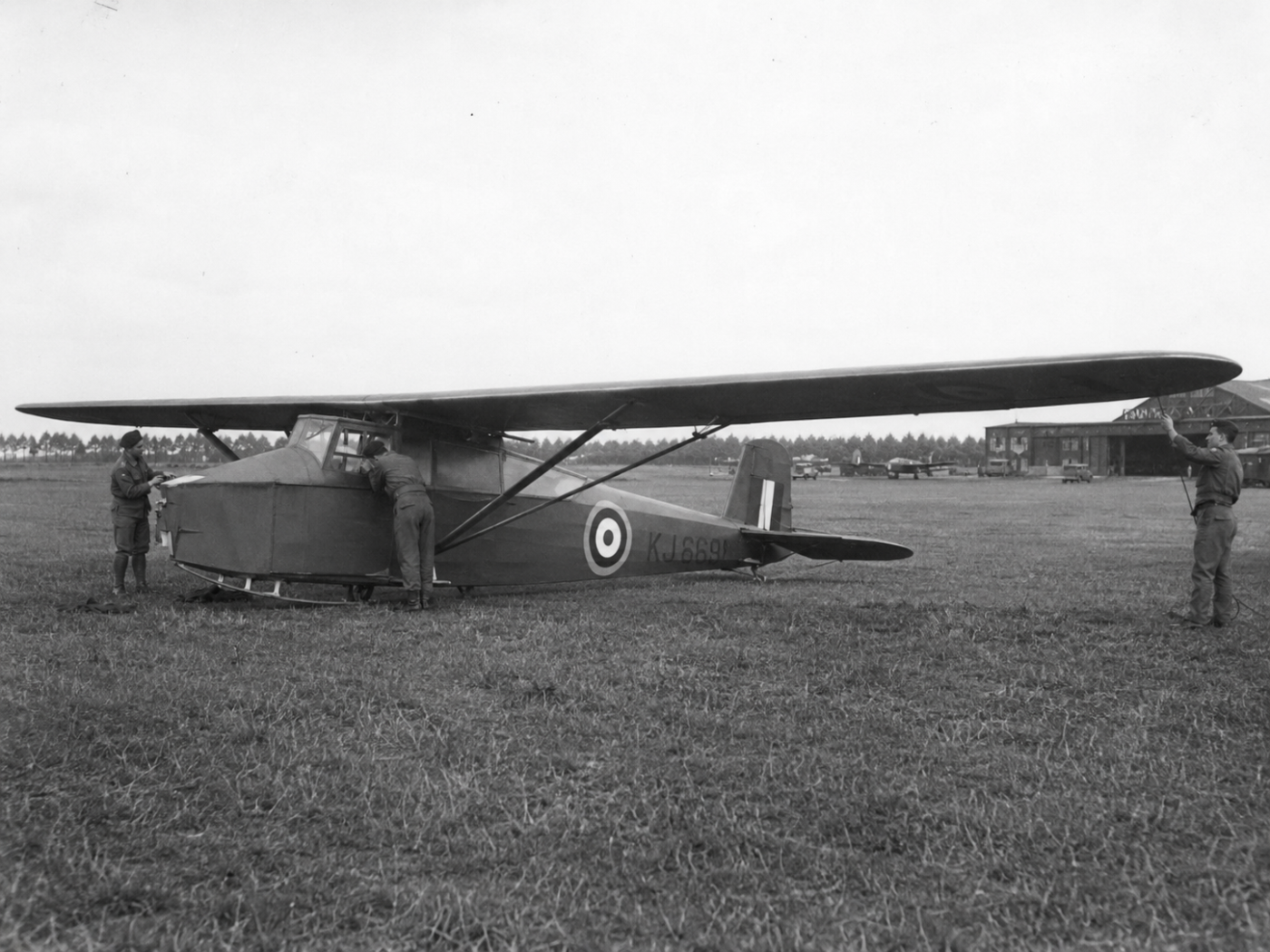
The design was relatively small compared with later types, measuring about 39 feet in length with a wingspan of around 62 feet. Construction relied heavily on wood, plywood and fabric, materials that avoided competition with strategic metals needed for fighters and bombers.
Inside was room for two pilots and up to eight airborne soldiers. A powered aircraft would tow it towards the target, where it would be released for an unpowered landing. With no engine, there could be no second attempt.
Its small size meant it was never intended to carry heavy battlefield equipment. The load was purely infantry, with a fully loaded weight of about 3,600 pounds and limited payload capacity.
At first this seemed sufficient, but airborne doctrine quickly evolved. Commanders realised that larger gliders carrying more troops or even vehicles would be far more effective. As a result, the aircraft’s future as a frontline assault type was soon in doubt.
It was at this point that its most unusual industrial story began. General Aircraft designed the type, but Britain needed production far beyond what a specialist manufacturer could provide, so the government turned to civilian industry.
The main producer became Harris Lebus, one of Britain’s largest furniture manufacturers. Its Tottenham works in north London had previously been known for wardrobes, cabinets, tables and chairs rather than aircraft.
Yet the skills of cabinet makers proved highly suitable for wooden airframes. The structure depended on timber, plywood, glued joints and fabric covering rather than metal airframe construction. Workers already understood how wood behaved and how to shape it accurately in volume.
The factory was rapidly absorbed into wartime production. At its peak it employed around 6,000 people and also contributed to other military projects, including later glider types. It became a target for air raids due to its importance.
Inside, furniture production gave way to aircraft manufacture. Building the glider resembled precision cabinet work: timber selection, jig-based assembly, plywood skinning and fabric finishing. Every component had to be consistent, since structural failure in flight or landing would be fatal.
Jigs and templates ensured standardisation, while metal fittings reinforced high-stress points. Despite its simplicity, the structure still had to withstand towing loads and heavy landing impacts.
This method allowed Britain to avoid diverting skilled metal-aircraft workers from fighter and bomber production. Instead, civilian woodworking industries supplied much of the output, a model later used more widely in glider production.
Only a small number were built by General Aircraft itself, along with a few by Slingsby. The vast majority came from Harris Lebus, which produced nearly a thousand units, bringing total production to just over 1,000 aircraft.
During production the design evolved. Later versions included structural changes and revised internal layouts. The crew sat in a glazed cockpit at the front, with troops behind and side doors for rapid exit after landing.
The simplicity of the design made it suitable for non-traditional factories, but glider operations themselves remained complex. Early ideas even considered towing multiple aircraft in trains, but this proved impractical.
As production increased, its role shifted away from combat use. It became primarily a training aircraft.
This was crucial. Britain had almost no experienced glider pilots, and flying such aircraft required entirely new skills. Pilots had to manage energy carefully, fly in tow, and land accurately without power in confined areas.
Around fifty were converted into dual-control trainers, allowing instructors and trainees to fly together. These aircraft formed the foundation of the Glider Pilot Regiment, preparing crews for later operations in larger types.
An experimental twin-fuselage version was also tested, intended to carry more troops, but it never entered production due to handling issues and the arrival of superior designs.
By the time larger gliders such as the Horsa and Hamilcar entered service, the original type was already obsolete for frontline assault use. These newer aircraft could carry vehicles, artillery and far larger troop loads.
Nevertheless, its importance remained significant. It provided Britain with its first practical experience of military glider design, production and operation, and trained the pilots who would later take part in major airborne operations in Normandy, Arnhem and beyond.
Its greatest legacy lay in industry. It demonstrated that aircraft production could be successfully carried out outside traditional aerospace factories. Furniture makers became aircraft manufacturers, contributing directly to the airborne war effort.
By 1944, it had largely disappeared from combat roles, replaced by larger and more capable designs. But the knowledge gained from it underpinned Britain’s entire glider programme.
Of more than 1,000 built, almost all came from a furniture factory in Tottenham. That fact alone captures its unusual place in wartime history.
It never achieved the fame of later aircraft, but it played a foundational role in creating Britain’s airborne forces.