On this day in military history…
On 29 August 1944, a rebellion erupted in the heart of Nazi-dominated Europe as tens of thousands of Slovak soldiers and resistance fighters turned their weapons against Germany and the collaborationist Slovak government. Known as the Slovak National Uprising, it became one of the largest armed revolts against Nazi rule during the Second World War. For almost two months, regular soldiers, partisans and civilian volunteers fought German troops across the mountains and towns of central Slovakia, centred on the city of Banská Bystrica. Although ultimately crushed as a conventional military operation, the uprising demonstrated that a considerable part of Slovakia was prepared to fight against Nazi Germany rather than remain associated with Hitler's regime.
Slovakia had existed as a separate state since the break-up of Czechoslovakia in March 1939. Led by the Catholic priest Jozef Tiso, the Slovak Republic became closely aligned with Nazi Germany and participated in Germany's invasion of the Soviet Union. Yet opposition to Tiso's government gradually developed among Slovak Army officers, democrats, communists and other resistance groups. By 1943 and 1944, as German military fortunes deteriorated dramatically, these different organisations increasingly began preparing for the moment when Slovakia could break away from Germany and assist the advancing Allies. The underground Slovak National Council attempted to unite the principal resistance movements, while sympathetic officers inside the Slovak Army secretly prepared troops, weapons and supplies for an eventual armed revolt.
One of the key military figures was Lieutenant Colonel Ján Golian, who helped organise resistance within the Slovak armed forces. The original plan was ambitious. Slovak troops were expected to secure important routes through the Carpathian Mountains so that the advancing Soviet Red Army and Czechoslovak forces approaching from the east could enter Slovakia more easily. If carefully coordinated, the Slovak Army could potentially turn against its former German ally at the same moment Soviet forces crossed the frontier. Events, however, moved more rapidly than the conspirators intended.
By the summer of 1944 partisan activity had increased substantially. Soviet-backed partisan groups were operating inside Slovakia alongside domestic resistance fighters, attacking German interests, disrupting communications and provoking an increasingly nervous reaction from Berlin. Hitler's government no longer trusted the Slovak authorities to maintain control. When Germany decided to send troops into the country to restore order and secure strategically important territory, the resistance leadership faced a choice: rise immediately or risk being disarmed and destroyed before its preparations were complete.
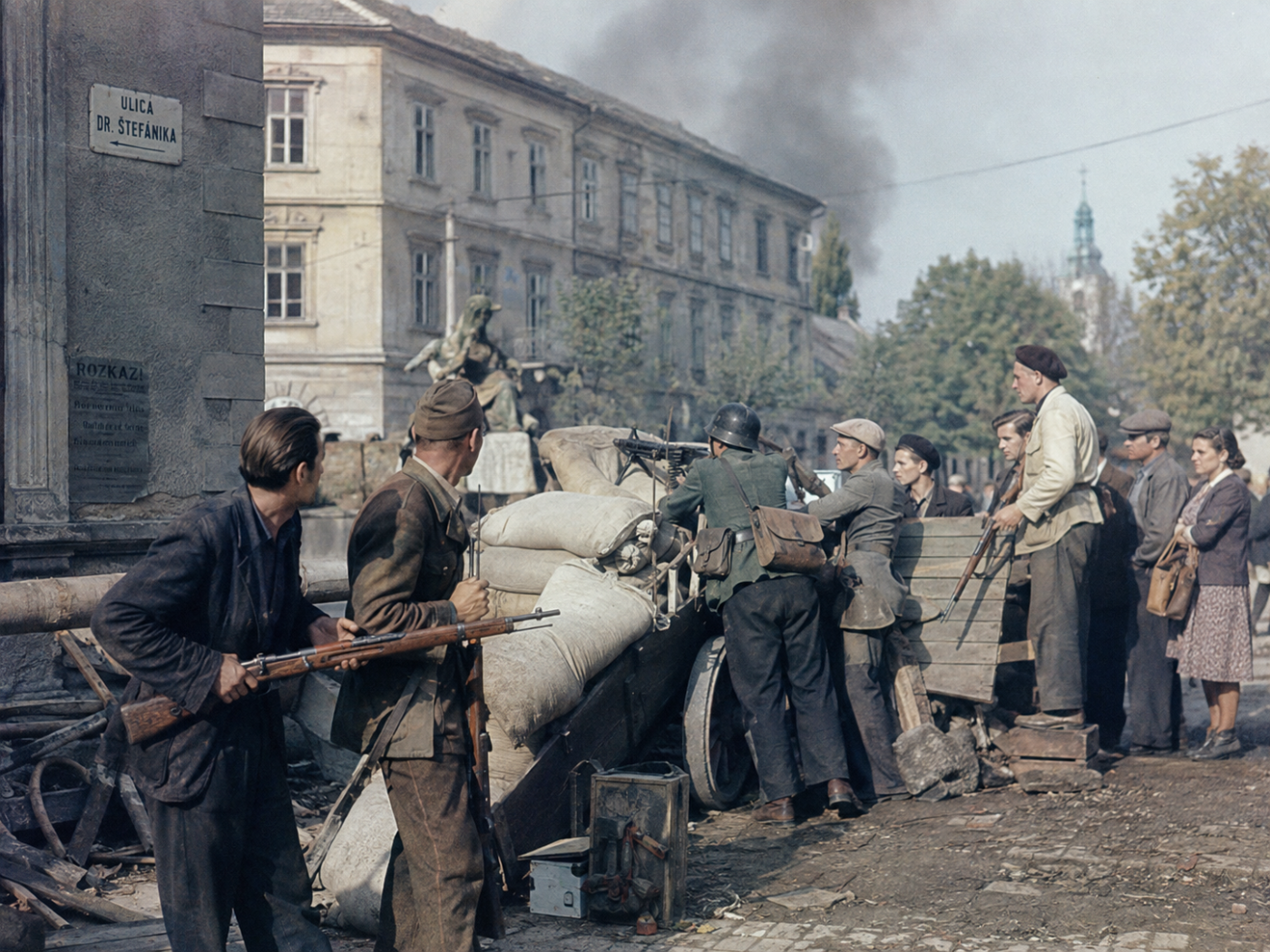
German forces began entering Slovakia on 29 August 1944. That evening the order for armed resistance was given. Slovak military units loyal to the uprising began mobilising, and Banská Bystrica in central Slovakia emerged as the rebellion's headquarters. From there the insurgents announced their opposition to the Tiso regime and German occupation. The uprising was not merely a collection of isolated partisan attacks. A substantial organised army emerged, eventually officially known as the 1st Czechoslovak Army in Slovakia, fighting alongside partisan formations and volunteers. At its height the armed resistance involved tens of thousands of men and controlled a significant area of central Slovakia.
The rebels possessed rifles, machine guns, artillery, armoured vehicles and even a small air force, but their position was extremely difficult from the beginning. Some Slovak formations that were expected to join the uprising were disarmed by German troops before they could act, depriving the resistance of thousands of soldiers and valuable equipment. Communications between different formations were poor, supplies were limited and the revolt had begun before the Soviet armies were in a position to provide the immediate support its planners had hoped for. Germany, meanwhile, reacted rapidly, bringing experienced troops into Slovakia from several directions.
Fighting soon spread through the mountainous centre of the country. The terrain provided excellent defensive positions and later proved ideal for guerrilla warfare, but it also made the movement of heavy weapons and supplies extremely difficult. German columns pushed towards the insurgent territory while Slovak troops attempted to block roads, passes and valleys. Towns changed hands and resistance positions came under artillery and air attack. Banská Bystrica became both the political and military heart of the rebellion, with radio broadcasts calling on the population to resist the Germans and support the uprising.
The resistance was remarkably diverse. Regular Slovak soldiers fought beside civilian partisans, communists, democrats, Czechoslovak loyalists and escaped prisoners. Foreign volunteers also joined the struggle, while Jewish fighters participated both individually and in organised resistance groups. For Jewish Slovaks the stakes were particularly desperate. Slovakia's collaborationist government had already been involved in the deportation of tens of thousands of Jews earlier in the war. Once German forces occupied the country during the uprising, SS and security units intensified arrests, executions and deportations. From September 1944 approximately 12,600 Slovak Jews were deported to Auschwitz, Theresienstadt and other camps as German security forces attempted to destroy those who had previously escaped deportation.
The Allies attempted to assist the rebellion, although geography made substantial support extremely difficult. Soviet aircraft delivered weapons, ammunition and personnel, while Allied aircraft also flew missions into insurgent-held territory. The Soviet Union launched the Carpathian-Dukla offensive in September in an attempt to break through the heavily defended mountain passes from Poland into Slovakia. The fighting became extraordinarily costly, and the rapid breakthrough hoped for by the insurgents failed to materialise. Instead of quickly linking up with the Red Army, the Slovak resistance was forced to fight largely on its own while increasingly powerful German forces tightened the ring around it.
As September became October, German pressure increased. The insurgents were steadily driven backwards despite fierce resistance. Ammunition, fuel, food and medical supplies became increasingly difficult to obtain, and German forces gradually captured important roads and settlements. The uprising had surprised Berlin, but once German reinforcements arrived the imbalance in military strength became overwhelming. The resistance could field large numbers of men, but it lacked the armour, heavy artillery, communications and logistical support required to defeat a determined German counter-offensive.
By late October the Germans were closing on Banská Bystrica. The city was evacuated by the insurgent leadership and German troops entered it on 27 October. The following day organised conventional resistance effectively came to an end. The uprising had lasted roughly two months. Its defeat, however, did not mean that the resistance had surrendered. Thousands of surviving soldiers and partisans withdrew into the mountains, abandoning conventional warfare for small-unit guerrilla operations. From hidden bases they continued attacking German troops, communications and supply routes throughout the winter of 1944–45.
German reprisals following the uprising were savage. Security forces, SS formations and collaborating units conducted executions and anti-partisan operations against suspected resistance supporters. Villages were destroyed, civilians were murdered and thousands of people were arrested or deported. Einsatzgruppe H accompanied the German occupation forces and played a major role in pursuing Jews and political opponents. The suppression of the uprising therefore became closely connected with one of the final phases of the Holocaust in Slovakia.
The uprising also had its darker aspects. Violence was not restricted solely to the German side, and killings of suspected collaborators and members of Slovakia's ethnic German population occurred within insurgent-held territory. The campaign therefore reflected the increasingly brutal character of warfare and occupation in Central and Eastern Europe during the final year of the conflict. What began as a military revolt became entangled with resistance, civil conflict, political revenge and Nazi racial persecution.
During the winter the Red Army continued advancing westwards. Soviet, Romanian and Czechoslovak forces gradually fought their way into Slovakia, and partisan groups began cooperating more closely with the advancing armies. By the spring of 1945 German forces were retreating from the country, and Slovakia was eventually liberated from German control. Many of the men who had escaped into the mountains after the collapse of Banská Bystrica emerged to join the final battles.
Militarily, the Slovak National Uprising failed to achieve its immediate objective. It did not hold Slovakia until the arrival of the Red Army, it could not prevent German occupation and it was unable to overthrow the Tiso government by its own strength. Yet its importance extended far beyond the territory gained or lost during those two months. The revolt demonstrated that the wartime Slovak state did not represent the views of the entire population and that thousands of Slovaks had been willing to fight and die against Nazi Germany. It also helped reconnect Slovakia with the wider Czechoslovak resistance movement and became an important element in the restoration of Czechoslovakia after the war.
The uprising's memory later became politically contested. Under communist rule after 1948, official histories placed particular emphasis on communist and Soviet involvement while often reducing the prominence of democratic resistance organisations and professional Slovak Army officers. After the fall of communism in 1989, historians were able to present a broader picture showing that the revolt had brought together people with very different political beliefs who shared the immediate objective of fighting Nazi domination.
Today, 29 August is commemorated in Slovakia as the anniversary of the Slovak National Uprising. Banská Bystrica, once the headquarters of the rebellion, is home to the Museum of the Slovak National Uprising and remains closely associated with the events of 1944.
The men who rose on 29 August 1944 knew that Germany still possessed enough military strength to destroy them and that Allied armies remained some distance away. Nevertheless, they chose to fight. For sixty desperate days an organised resistance army held territory in the centre of Slovakia against German forces before being driven into the mountains. The battlefield was lost, but the revolt ensured that Slovakia's wartime story would not be remembered solely through its alliance with Nazi Germany. The Slovak National Uprising became instead one of Europe's most significant armed acts of resistance during the final year of the Second World War.