On this day in military history…
On 4 August 1914 Britain entered a war that would change the country forever. By the time darkness fell over London that evening, German troops had crossed into Belgium, the British Government had issued an ultimatum to Berlin, the Royal Navy was already prepared for action and thousands of British soldiers and reservists were beginning to respond to mobilisation orders. At 11 o’clock that night the British ultimatum expired and, with no satisfactory German reply, a state of war existed between Britain and Germany.
There is sometimes an impression that at 11 p.m. a government minister went before a microphone and announced to the British people that the country was at war. In 1914 there was no national radio service capable of doing this. The moment was instead the result of a series of political, diplomatic and royal actions. Prime Minister Herbert Henry Asquith had addressed the House of Commons during 4 August and explained that Britain had demanded an assurance from Germany that Belgian neutrality would be respected. The deadline was midnight in Berlin, which was 11 p.m. in London.
The man who had done perhaps more than anyone in government to explain why Britain might have to fight was Foreign Secretary Sir Edward Grey. On 3 August he had delivered a major speech to a packed House of Commons setting out the European crisis and Britain's responsibilities. Grey argued that Britain could not simply stand aside while France was threatened and the neutrality of Belgium was endangered. Germany's invasion of Belgium the following morning transformed the political situation. Britain had been one of the powers associated with the international agreements guaranteeing Belgian neutrality, and the invasion gave the government a cause around which much of Parliament and the public could unite.
During 4 August events moved with extraordinary speed. At around 2 p.m. Grey sent Britain's ultimatum to Berlin demanding assurances that Germany would respect Belgian neutrality. No satisfactory assurance was received. Shortly before 11 p.m. King George V met members of the Privy Council at Buckingham Palace. The King was deeply troubled by what was happening and described the situation as a terrible catastrophe. The constitutional machinery was put in place for Britain to enter the conflict, while Foreign Office officials prepared the formal notification for the German Government.
When the deadline passed at 11 p.m., Britain regarded itself as being at war with Germany. The formal government notice subsequently recorded that Germany had failed to provide the assurance demanded and that Britain had notified the German Government that a state of war existed between the two countries from 11 p.m. on 4 August. Shortly afterwards British officials delivered the notification to the German Embassy in London.
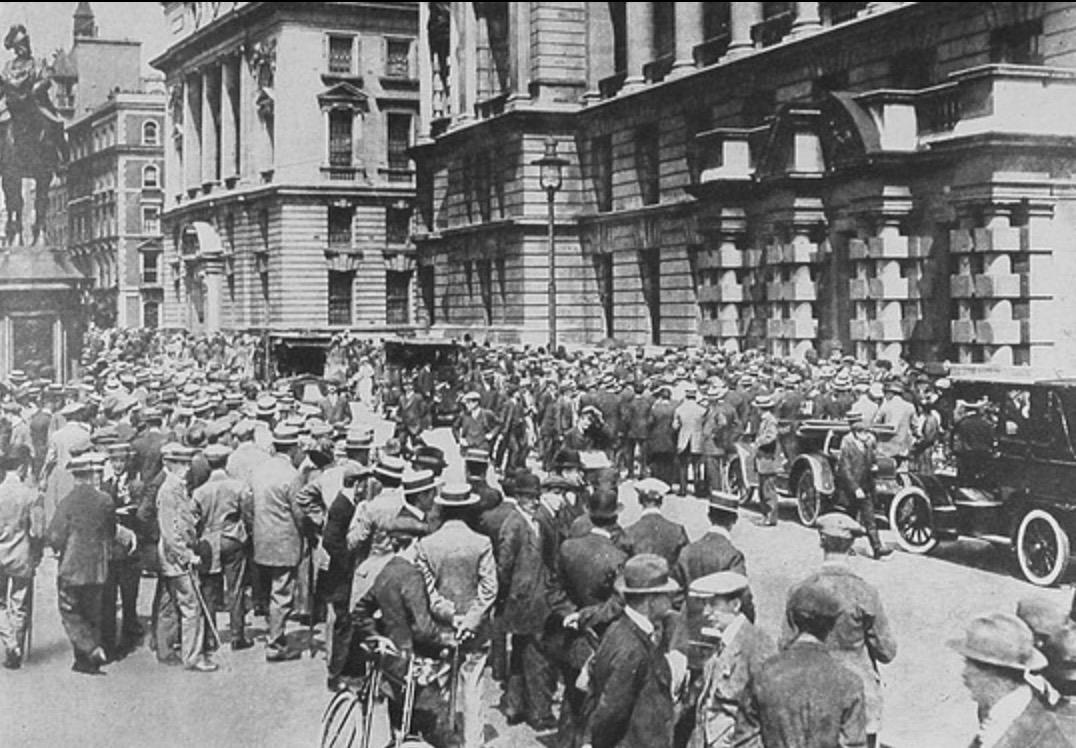
For ordinary people there was therefore no single voice announcing the outbreak of war to the entire nation. Instead the news swept through Britain by newspaper editions, telegrams, telephone messages, notices and word of mouth. Newspaper offices produced special editions and newsboys shouted the latest developments through crowded streets. In London thousands of people had gathered around Whitehall, Trafalgar Square and Buckingham Palace waiting for news. When it became known that the ultimatum had expired and Britain was at war, enormous cheers broke out among sections of the crowd.
One eyewitness described extraordinary scenes around central London, with cheering echoing from Trafalgar Square towards Westminster and Buckingham Palace. Thousands gathered outside the Palace hoping to see the King. Sir Courtenay Ilbert, Clerk of the House of Commons, recorded simply that war with Germany had been declared at 11 p.m. and that there was great shouting in the streets.
The cheering, however, should not be taken to mean that the whole British population regarded war as an adventure. The national reaction was far more complicated. There was patriotism and excitement, particularly among some younger people and in the large crowds gathered in city centres, but there was also fear, uncertainty and disbelief. Families with husbands and sons serving in the Regular Army or Naval Reserve immediately understood that mobilisation could mean separation and death. People worried about food prices, employment, shipping, the safety of Britain and whether the German Army might eventually threaten the country itself.
Many Britons nevertheless believed that Germany's invasion of Belgium had made intervention unavoidable. Belgium was a small neutral country and reports of German troops crossing its frontier gave the British Government a powerful moral argument for war. The defence of Belgium rapidly became one of the central themes of recruitment propaganda. The National Army Museum records that although there was shock and fear, the outbreak of war was widely greeted with public support and many people saw Britain as entering the conflict for a just cause.
Behind the crowds and newspaper headlines, an enormous military operation was already beginning. Britain entered the war in a very different position from Germany or France. Britain did not have a huge conscript army. Its military strength rested upon a comparatively small professional Regular Army, backed by Army Reservists, the Special Reserve and the Territorial Force.
On the eve of war the British Army contained just over 250,000 Regular soldiers. Alongside them were roughly 200,000 reservists and about 250,000 members of the Territorial Force. Taken together Britain had approximately 700,000 trained soldiers available in these different categories, although they could not simply all be placed into one field army and sent immediately to France. Many Regular units were stationed throughout the British Empire, Territorial units had different obligations, and large numbers of men were required for coastal defence, garrisons, training, administration and reinforcement duties.
Germany and France, by comparison, possessed systems capable of putting armies numbering in the millions into the field through conscription and reserves. Britain therefore intended initially to contribute a comparatively small but exceptionally well-trained expeditionary force to the fighting in France.
Preparations had begun even before the declaration. As the July Crisis worsened, Army leave was cancelled, units were placed on alert and reservists began to be called back. The Royal Navy had an especially important advantage because much of the Fleet had recently assembled for exercises and was therefore able to remain concentrated rather than dispersing. Britain's first response to the European crisis was consequently not the sudden creation of a new army on the night of 4 August, but the activation of mobilisation plans that had been prepared in advance.
For Army reservists, mobilisation meant reporting to their designated depots. Men who only days earlier had been working in factories, mines, railways, workshops or other civilian occupations received instructions requiring them to return to the colours. At railway stations across Britain soldiers carrying kitbags began travelling towards regimental depots and mobilisation centres. Uniforms, rifles, ammunition, horses, transport and equipment had to be issued while units were brought up to their wartime establishments.
The railway system was crucial. Britain's mobilisation plans depended on detailed timetables that could move men and equipment from depots and barracks to concentration areas and then towards the ports. Trains carrying troops began running across the country with military movements given priority. Horses were requisitioned for cavalry, artillery and transport because the Army of 1914 remained enormously dependent upon animal power.
The force intended for the Continent became known as the British Expeditionary Force, or BEF, commanded by Field Marshal Sir John French. Pre-war planning had envisaged a force of six infantry divisions and a cavalry division, although the government initially decided to send four infantry divisions, with other formations following. The original force sent to France in August amounted to roughly 90,000 men in its early fighting strength and was tiny beside the mass armies moving across continental Europe.
What Britain lacked in numbers, however, its Regular Army possessed in professionalism. Many soldiers had years of service behind them. Some officers and men had combat experience from the South African War and numerous colonial campaigns. The reforms that followed the Boer War had also improved organisation, training and mobilisation. British infantry placed particular emphasis upon rapid and accurate rifle fire, and the professional soldiers who crossed to France during August 1914 would soon earn a formidable reputation.
The first major problem was getting this army across the English Channel without interference. Troops were concentrated and moved towards ports including Southampton. Ships were assembled to carry soldiers, horses, guns, ammunition and stores to France. The Royal Navy protected the Channel crossings and the German Navy made no serious attempt to intercept the movement. Within days of the declaration, elements of the BEF were sailing for France.
But the government knew almost immediately that the existing Regular Army would not be enough. One of the most significant appointments made during the crisis was that of Field Marshal Lord Kitchener as Secretary of State for War. Unlike many people who expected the conflict to be short, Kitchener believed Britain was facing a long war requiring armies vastly larger than anything the country then possessed.
On 7 August, only three days after Britain entered the war, Kitchener appealed for an additional 100,000 volunteers. This became the beginning of the famous New Armies, later commonly called Kitchener's Army. Men were asked to enlist for the duration of the war rather than for the traditional terms of Regular Army service.
The response was extraordinary. Recruiting offices began filling with men. Queues formed outside military offices, town halls and improvised recruiting centres. Some volunteers arrived with friends from the same workplace, street, football club or social organisation. The rush eventually became so great that the Army struggled to process, clothe, house and equip everyone arriving.
By the end of August around 30,000 men a day were joining at the height of the recruiting surge, and within the first eight weeks almost three-quarters of a million men had enlisted. By the end of 1914 more than one million volunteers had come forward.
The speed of expansion created enormous difficulties. Britain could find willing men more quickly than it could provide uniforms, rifles, barracks and trained instructors. Some recruits trained in civilian clothing while waiting for uniforms. Accommodation was improvised in camps and public buildings, and shortages became widespread. In some training establishments there were insufficient service rifles, forcing men to drill without weapons or use substitutes while industry increased production.
The Territorial Force was mobilised as well. Territorial soldiers had originally been intended principally for home defence and were not automatically required to serve overseas. They were asked to volunteer for foreign service and the overwhelming majority agreed. This allowed Territorial units eventually to reinforce the Regular Army abroad while others took over duties in Britain and throughout the Empire. Special Reserve battalions meanwhile became vital sources of trained replacements for Regular battalions suffering casualties overseas.
For the civilian population, signs of mobilisation appeared everywhere. Railway platforms filled with uniformed men. Horses disappeared from businesses and farms into military service. Reservists suddenly left employment. Territorial drill halls became centres of intense activity. Ports filled with troops and supplies. Posters appeared calling upon men to enlist. Families watched husbands, sons and brothers leave home without knowing where they were going or when they might return.
There was still a widespread belief that the war might be finished quickly. The later expression that it would all be “over by Christmas” captured the optimism felt by many, although it was never a universally held view. Kitchener was one of those who emphatically did not share it. He believed Britain needed to prepare for years rather than months and that the small professional Army sent to France would only be the beginning.
The first British troops arriving in France were greeted enthusiastically by French civilians. From their assembly areas the BEF moved north towards Belgium, where the German armies were advancing in enormous strength. On 23 August the British Army fought its first major battle against Germany at Mons. The professional soldiers who had been mobilising in Britain only weeks earlier now found themselves facing one of the largest military machines in Europe.
The story of Britain's entry into the First World War therefore began not with a radio broadcast but with diplomatic messages, parliamentary statements, a royal decision and an ultimatum that expired at 11 p.m. on 4 August 1914. Prime Minister Asquith had explained Britain's demands to Parliament, Sir Edward Grey had set out the political case for intervention, King George V carried out his constitutional role, and British diplomats formally notified Germany that a state of war existed.
Outside, newsboys and crowds carried the message through the streets. Some people cheered, others stood frightened or silent, while thousands of families began preparing for loved ones to leave. Within hours one of the world's great industrial and imperial powers was converting itself to war.
Britain entered the conflict with only a little over 250,000 Regular soldiers and approximately 700,000 trained Regulars, Reservists and Territorials altogether. Its immediate striking force on the Continent would initially number only around 90,000 men. Yet behind them an unprecedented mobilisation was beginning. Reservists returned to their regiments, Territorials went on full-time service, trains carried troops towards the ports and Kitchener began creating a new volunteer army numbering hundreds of thousands.
At 11 p.m. on that summer night the cheering outside Buckingham Palace could not reveal what lay ahead. Few among the crowd could have imagined the Somme, Ypres, Gallipoli or Passchendaele, nor that the war would continue until November 1918 and consume millions of lives. Britain had entered the conflict with a small professional army. Four years later it would emerge after mobilising millions of men and transforming almost every aspect of national life. The expiry of that ultimatum at 11 p.m. on 4 August 1914 marked the moment when Britain crossed the boundary from European crisis into total war.