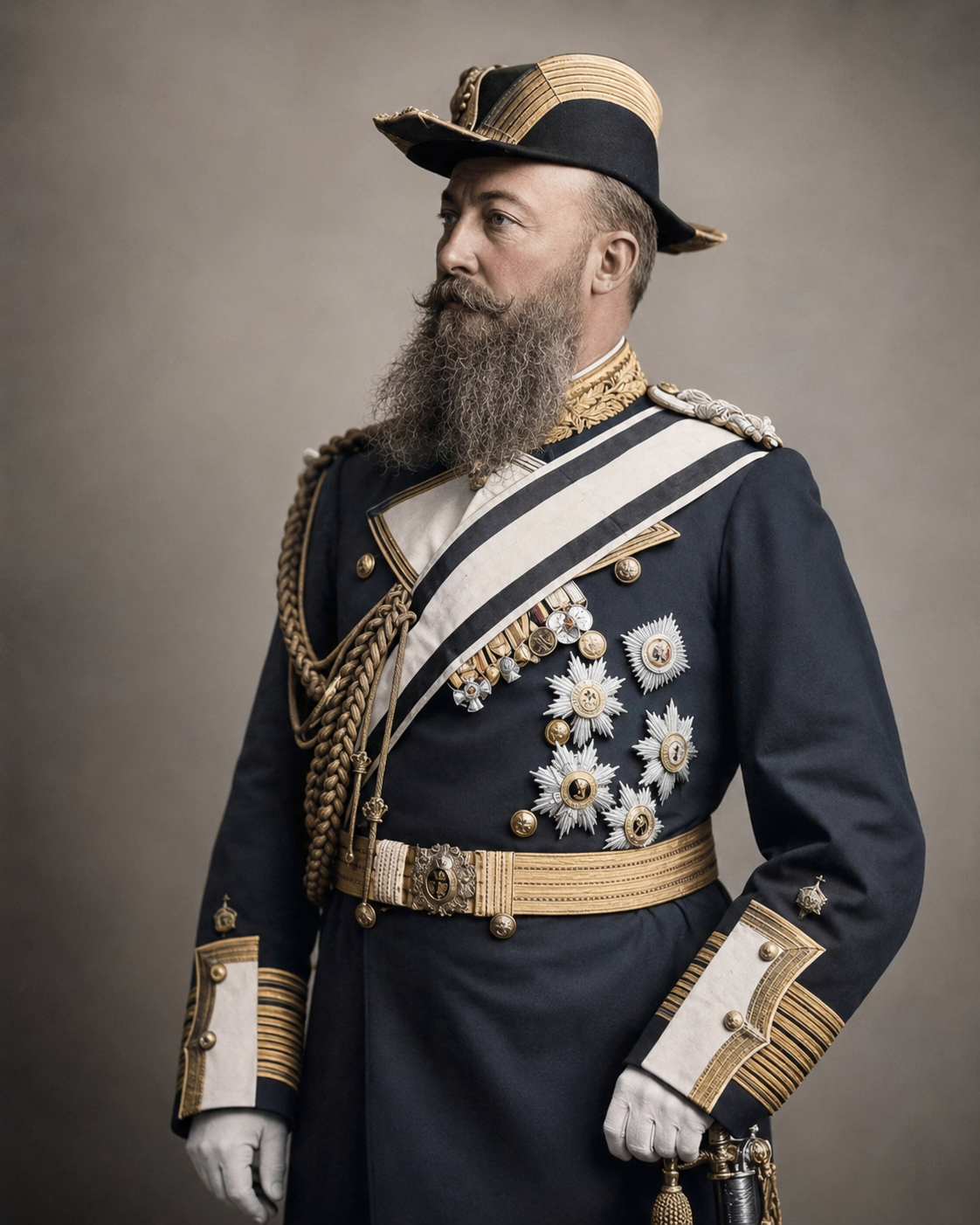
Admiral Alfred Von Tirpitz
Alfred von Tirpitz was one of the most influential naval figures in modern German history and the man more than any other responsible for transforming Imperial Germany from a relatively modest maritime power into the owner of one of the most formidable battle fleets in the world. Although he never commanded Germany’s High Seas Fleet in a great wartime battle, his policies shaped the German Navy that fought Britain during the First World War, and his determination to challenge British naval supremacy helped create the Anglo-German naval rivalry that dominated the years before 1914.
Alfred Peter Friedrich Tirpitz was born on 19 March 1849 at Küstrin in Brandenburg, then part of the Kingdom of Prussia. He grew up largely in Frankfurt an der Oder in a comfortable middle-class family rather than in the traditional Prussian military aristocracy. His father was a senior civil servant and lawyer, and there was nothing inevitable about the young Tirpitz eventually becoming one of Germany's most powerful military figures.
At the age of sixteen he entered the Prussian Navy in 1865 as a naval cadet. At that time Prussia was overwhelmingly regarded as a land power. Its army, rather than its small navy, was the instrument through which Otto von Bismarck and King Wilhelm I were transforming the political map of Europe. The navy possessed little of the prestige enjoyed by the Prussian Army, but Tirpitz entered the service at exactly the moment when German political and industrial power was beginning its enormous expansion. Following German unification in 1871, the Prussian naval service became part of the Imperial German Navy.
The young officer served aboard a variety of warships and steadily developed a reputation as an intelligent, energetic and highly organised professional. Rather than making his name through spectacular combat actions, his early career was marked by technical ability and an unusual talent for administration. These qualities would ultimately prove far more important than traditional shipboard heroics.
One of the most significant areas of his early career was the development of the torpedo. During the 1870s and 1880s the self-propelled torpedo was emerging as a revolutionary naval weapon capable of allowing relatively small vessels to threaten much larger warships. Tirpitz became heavily involved in organising Germany's torpedo service and helped develop the torpedo arm into an effective and professionally organised branch of the navy.
His work brought him increasingly to the attention of senior naval officers. Tirpitz was not simply interested in the weapon itself. He studied how ships should operate together tactically and how an entire fleet should be organised for battle. These ideas gradually moved him away from the concept of a navy primarily intended for coastal defence and towards the idea of a powerful concentrated battle fleet.
By 1890 he had become Chief of Staff of the Baltic naval station, and in 1892 he was appointed Chief of Staff of the Naval High Command. His promotion demonstrated how rapidly his influence was increasing. He was promoted to rear admiral in 1895 and the following year was sent to East Asian waters to command Germany's cruiser division.
His period in East Asia was important because Germany, like the other major European powers, was seeking overseas bases and colonies. Tirpitz recognised that a global navy required secure harbours where ships could refuel, repair and resupply. During his time there he was involved in preparations connected with Germany's acquisition of Kiautschou Bay and the development of Tsingtao in China as a German naval base.
The decisive moment of his career came in 1897 when Kaiser Wilhelm II appointed him Secretary of State of the Imperial Naval Office. He would remain in that position until 1916. It gave him enormous influence over shipbuilding, naval expenditure and the long-term direction of German maritime policy.
Wilhelm II was fascinated by naval power and believed a great empire required a great fleet. Tirpitz provided the Kaiser with the organisational ability needed to turn that ambition into reality.
His strategy became associated with what historians commonly call the risk theory. Germany did not necessarily need to possess a fleet larger than Britain's Royal Navy. Instead, Tirpitz believed it needed a battle fleet powerful enough that Britain could not attack it without suffering losses so serious that Britain's worldwide naval supremacy would subsequently be endangered by other powers.
The theory rested upon the idea that the German fleet could become such a dangerous opponent that Britain would eventually have to respect Germany as an equal and perhaps reach some form of political accommodation with Berlin.
To create this force Tirpitz required enormous amounts of government money. His great political achievement was persuading the Reichstag to approve a series of Naval Laws. The first major Naval Law was passed in 1898, followed by the much more ambitious law of 1900 and later amendments and expansions.
The Naval Laws established long-term shipbuilding programmes rather than forcing the navy to seek parliamentary approval for individual vessels. Battleships, armoured cruisers, later battlecruisers, cruisers, destroyers and supporting vessels were constructed in increasing numbers.
Tirpitz was also an extremely capable political campaigner. Naval expansion was promoted to the German public as a symbol of national prestige, industrial achievement and Germany's emergence as a world power. Naval organisations and patriotic groups generated widespread enthusiasm for the fleet.
The results were remarkable. Within little more than a decade Germany possessed the second most powerful navy in the world, surpassed only by the Royal Navy. Germany's shipyards at Kiel, Wilhelmshaven, Hamburg and elsewhere produced increasingly sophisticated warships, while companies such as Krupp supplied enormous naval guns and armour plate.
Yet Tirpitz's great achievement also created one of Germany's most serious strategic problems.
Britain had traditionally depended upon its navy for national survival. The appearance of a powerful German battle fleet only a relatively short distance across the North Sea was therefore viewed in London very differently from comparable naval expansion by more distant countries.
The launching of HMS Dreadnought in 1906 intensified the competition. The revolutionary British battleship rendered many existing battleships obsolete almost overnight, creating a new race in dreadnought construction.
Germany responded by building its own dreadnought battleships and battlecruisers. The Nassau, Helgoland, Kaiser and König classes represented a huge increase in German naval capability. Battlecruisers such as SMS Von der Tann, Moltke, Seydlitz and Derfflinger also became among the best-known German warships of the period.
The naval race consumed enormous financial resources. Britain responded to German construction by accelerating its own programme, and Germany never succeeded in overtaking the Royal Navy. Rather than intimidating Britain into political accommodation, the fleet encouraged Britain to view Germany as an increasingly dangerous strategic rival.
Tirpitz nevertheless rose to the highest levels of German society. He became vice admiral in 1899, full admiral in 1903 and eventually Grand Admiral in 1911, one of the highest ranks available in the Imperial German Navy.
When the First World War began Tirpitz therefore found himself presiding over the naval machine he had spent nearly two decades constructing.
Yet the war developed in a manner deeply frustrating to him.
Germany's High Seas Fleet was extremely powerful but remained substantially smaller than Britain's Grand Fleet. The Royal Navy also enjoyed favourable geography. By controlling exits from the North Sea and maintaining distant blockade positions, the British could restrict Germany's access to the Atlantic without necessarily risking their entire fleet close to German bases.
This produced a strategic dilemma. Tirpitz had built the German fleet around the expectation that Britain's main battle fleet might eventually be confronted under circumstances favourable to Germany. Instead, the British generally refused to provide the decisive opportunity Germany wanted.
German battlecruisers conducted raids against the British coast, including attacks on Scarborough, Hartlepool and Whitby in December 1914. German naval forces also achieved important tactical successes.
One of the most dramatic occurred at the Battle of Coronel on 1 November 1914, when Vice Admiral Maximilian von Spee's East Asia Squadron defeated a British force off the coast of Chile. The armoured cruisers Scharnhorst and Gneisenau helped destroy HMS Good Hope and HMS Monmouth. It was one of Britain's most serious naval defeats for generations, although Spee's squadron was itself largely destroyed at the Battle of the Falkland Islands the following month.
German naval forces also fought at the Battle of Dogger Bank in January 1915. The action ended with the loss of the German armoured cruiser Blücher and exposed weaknesses in German signalling and command arrangements, but German heavy ships continued to demonstrate their ability to survive considerable damage.
Tirpitz himself cannot properly be credited as the battlefield commander of these actions because he was primarily a naval administrator and political strategist rather than the operational commander directing ships at sea. His historical significance lies instead in the fact that the vessels, naval infrastructure and doctrine behind Germany's wartime naval power were largely products of the system he had created.
Perhaps the most successful aspect of that system was the quality and survivability of many German capital ships. German battleships and battlecruisers generally possessed strong internal subdivision, armour protection and damage-control arrangements. During major engagements they repeatedly survived punishment that might have destroyed less robust vessels.
Submarines increasingly became the weapon through which Tirpitz believed Britain could actually be defeated.
Britain depended heavily upon imported food, fuel, raw materials and military supplies carried by merchant shipping. Tirpitz became a forceful advocate of using Germany's U-boats to attack the maritime trade sustaining the British war effort.
Germany declared waters around Britain a war zone in February 1915 and began an intensified submarine campaign.
The sinking of the British liner Lusitania by U-20 on 7 May 1915 demonstrated both the extraordinary power and the enormous political danger of submarine warfare. Nearly 1,200 people died, including more than 100 Americans. The incident caused international outrage, particularly in the United States.
Chancellor Theobald von Bethmann Hollweg feared that unrestricted submarine attacks would eventually bring America into the war. Tirpitz took a much harder position. He argued that Britain could be economically strangled if Germany committed sufficiently large numbers of submarines and permitted their commanders to attack merchant shipping without the restrictions imposed by traditional prize rules.
This produced an increasingly bitter disagreement within the German leadership.
Tirpitz regarded restrictions upon submarine warfare as throwing away one of Germany's few realistic opportunities to defeat Britain. His opponents believed unrestricted attacks risked creating another powerful enemy at precisely the moment Germany could least afford it.
By early 1916 his relationship with the government had deteriorated badly. When the Kaiser and Chancellor refused to adopt the unrestricted campaign on the scale he demanded, Tirpitz resigned as Secretary of State of the Imperial Naval Office in March 1916. His nineteen-year domination of German naval policy was over.
Ironically, one of the greatest battles involving the fleet he had created occurred only weeks after his departure.
On 31 May and 1 June 1916 the German High Seas Fleet fought Britain's Grand Fleet at the Battle of Jutland. It was the largest clash of battleships of the First World War.
Tactically the Germans inflicted heavier losses. Britain lost fourteen ships and more than 6,000 men, while Germany lost eleven ships and roughly 2,500 men. German battlecruisers and battleships demonstrated impressive toughness, and the High Seas Fleet successfully escaped destruction despite twice encountering the overwhelmingly powerful British battle line.
Yet strategically Britain remained dominant. The Grand Fleet retained control of the North Sea, the blockade continued and the High Seas Fleet never again challenged it on a comparable scale.
Jutland therefore perfectly illustrated the contradiction at the heart of Tirpitz's naval programme. He had created a fleet capable of fighting the Royal Navy and inflicting serious punishment upon it, but not one large enough to remove British command of the seas.
Germany eventually adopted unrestricted submarine warfare on 1 February 1917, the policy Tirpitz had demanded earlier. U-boats initially achieved devastating results, sinking enormous quantities of Allied shipping.
For a period in the spring of 1917 it appeared possible that Britain could face a genuine maritime supply crisis.
However, the introduction of the convoy system, improved anti-submarine techniques and rapidly expanding Allied shipbuilding reduced the effectiveness of the campaign. More importantly, unrestricted submarine warfare contributed directly to the United States declaring war on Germany in April 1917.
After leaving office Tirpitz became increasingly involved in nationalist politics. In 1917 he helped establish the German Fatherland Party, which demanded a victorious peace, substantial territorial gains and continued prosecution of the war.
Germany instead collapsed in the autumn of 1918.
The High Seas Fleet that Tirpitz had spent much of his life creating experienced mutiny when its commanders attempted to send it into another major operation during the closing days of the war. The naval unrest at Wilhelmshaven and Kiel helped ignite the wider German Revolution that brought down the Imperial government and forced Kaiser Wilhelm II to abdicate.
Under the terms of the Armistice, much of the High Seas Fleet was interned at Scapa Flow in the Orkney Islands. On 21 June 1919 its crews scuttled the ships rather than allow them to be permanently handed over to the victorious Allies.
For Tirpitz, it was a bitter conclusion to decades devoted to building German maritime power.
He nevertheless remained politically active after the war. His memoirs appeared in 1919 and presented his interpretation of German naval policy and wartime decision-making. During the Weimar Republic he became associated with conservative nationalist politics and served in the Reichstag from 1924 until 1928.
Alfred von Tirpitz died on 6 March 1930 at Ebenhausen near Munich. He was eighty years old.
His legacy remains complicated.
There is no single great naval conquest or battlefield victory that can be attached to his name in the way that Trafalgar is attached to Nelson. Tirpitz was fundamentally a strategist, administrator and political architect.
His greatest achievement was the creation of the Imperial German battle fleet itself. When he entered naval service in 1865, Prussia possessed a comparatively insignificant navy. By the beginning of the First World War, Germany possessed the world's second most powerful naval establishment.
He promoted modern shipbuilding, strengthened Germany's torpedo forces, helped create the structure that produced the High Seas Fleet and recognised earlier than many senior leaders the enormous strategic potential of submarine warfare.
The ships created under his programme performed impressively in several First World War actions. German forces won a major victory at Coronel, inflicted severe losses on the Royal Navy at Jutland and conducted an extraordinary submarine campaign against Allied merchant shipping.
Yet the central strategic objective behind his naval policy failed.
Britain was not intimidated into friendship or neutrality. Instead, German naval expansion contributed to Britain's increasingly hostile perception of Imperial Germany. The Royal Navy remained stronger, Germany remained blockaded throughout much of the war, and the enormous High Seas Fleet spent long periods confined to its bases because risking its destruction could have been strategically disastrous.
Tirpitz therefore stands as both one of Imperial Germany's greatest military organisers and one of its most controversial strategists.
He did not conquer territory or personally command Germany's famous naval victories. His accomplishment was larger in another sense: he created the fleet that made those battles possible.
From a sixteen-year-old cadet entering an obscure Prussian naval service in 1865, Alfred von Tirpitz rose to become Grand Admiral and the principal architect of a navy powerful enough to challenge the greatest maritime empire on Earth. For almost two decades his policies drove German naval expansion, transformed shipyards and naval bases, produced some of the most advanced warships of their generation and forced Britain to take German sea power seriously.
The tragedy for Tirpitz was that the fleet he had devoted his career to building never achieved the decisive strategic victory for which it had been created. Germany's sailors fought with considerable skill and courage, but British maritime superiority survived the war.
His name consequently remains inseparable from the rise of the Imperial German Navy, the great Anglo-German naval arms race and the struggle for control of the North Sea during the First World War.