
On this day in military history…
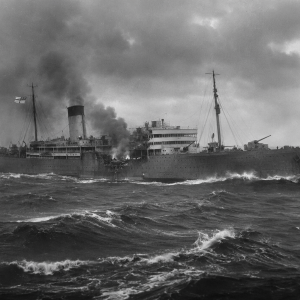
On the afternoon of 23 November 1939, a former British passenger liner patrolling the cold waters south-east of Iceland encountered an enemy she had little hope of surviving. HMS Rawalpindi carried guns, flew the White Ensign and served under a Royal Navy captain, but beneath her wartime conversion she remained a merchant ship. Facing her were Scharnhorst and Gneisenau, two of Germany’s most powerful warships. The action that followed would become one of the most moving British naval stories of the opening months of the Second World War.
Built by Harland & Wolff in Belfast and launched in 1925, Rawalpindi had spent her peacetime career carrying passengers and cargo for P&O. Her voyages linked Britain with India and the Far East. She belonged to a world of scheduled departures, passenger accommodation and long ocean passages, far removed from the demands of a battle fleet. In August 1939, with war approaching, the Admiralty requisitioned her for naval service.
Converted into an armed merchant cruiser, she received eight 6-inch guns and two smaller 3-inch weapons. These gave her the means to challenge merchant shipping, but fitting guns could not provide the armour, speed or internal protection of a purpose-built fighting ship. Her large hull offered an easy target, while the spaces designed for passengers and commercial cargo left her dangerously vulnerable to heavy shells.
Rawalpindi joined the Northern Patrol, helping to watch the sea routes between Britain, the Faroe Islands and Iceland. This was demanding work in waters where poor visibility and severe weather could conceal an approaching vessel. The patrol formed part of Britain’s effort to control maritime trade and intercept shipping attempting to reach Germany. Converted liners helped cover the enormous distances involved, allowing the Navy’s fighting ships to serve elsewhere.
Her commanding officer was Captain Edward Coverley Kennedy, a retired naval officer who had returned to service at the age of sixty. Like many of those serving in Britain’s improvised wartime fleet, he brought experience to a role that carried dangers far beyond the capabilities of his ship. His responsibility was to identify suspicious vessels, report enemy movements and keep his command operating in an increasingly hostile ocean.
When a German warship appeared on 23 November, Kennedy initially identified it as Deutschland. His wireless report alerted the British authorities, although the identification was mistaken. The vessel was Scharnhorst, operating with Gneisenau on a sweep into the northern patrol area. Kennedy attempted to escape and use the limited visibility to his advantage. Against faster opponents, however, the chances of breaking contact were slight.
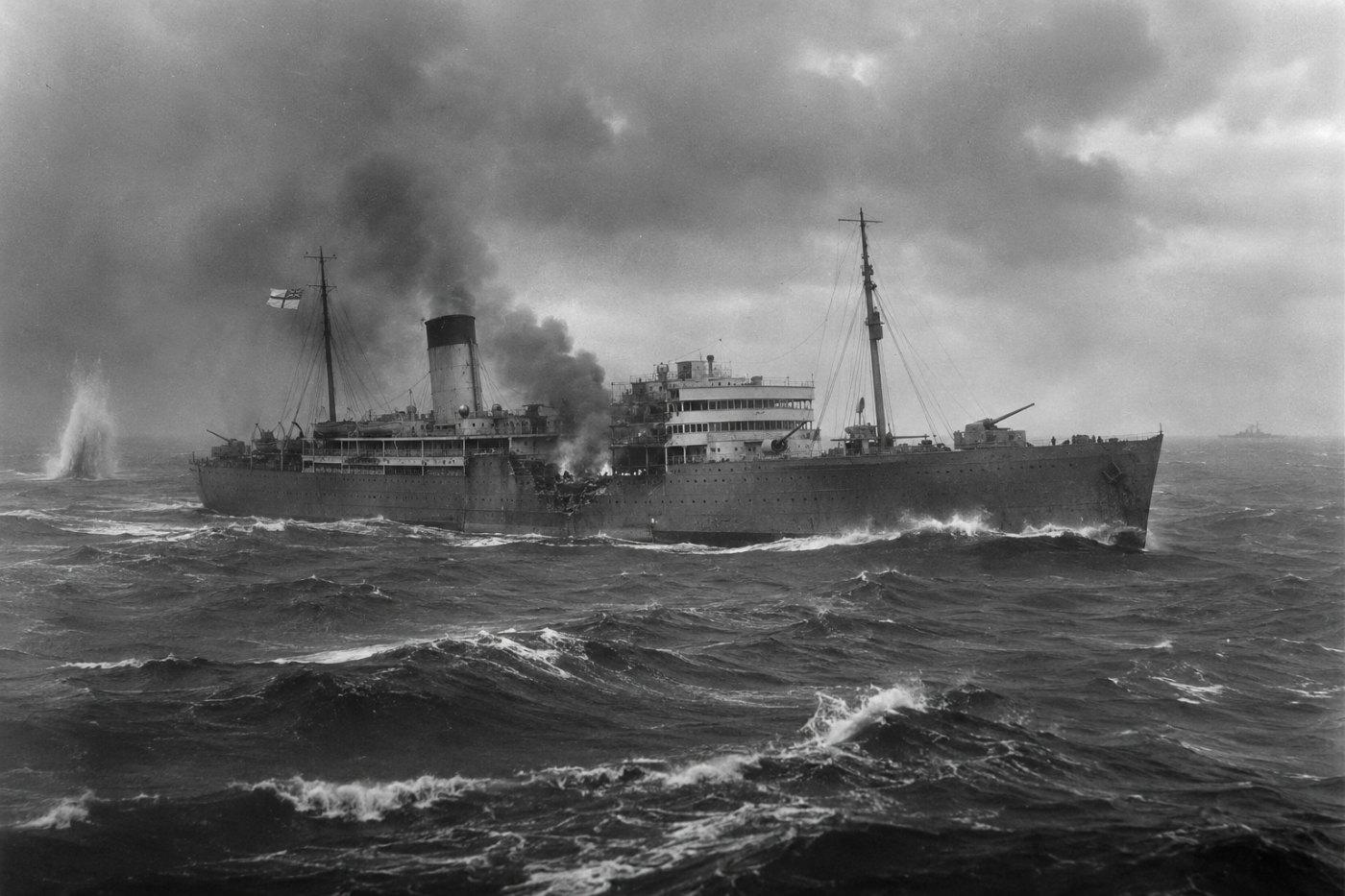
German demands to stop and surrender brought no submission. Rawalpindi went into action against an enemy whose heavy guns could destroy her at ranges where her own weapons offered little prospect of a decisive reply. The difference was devastating. German shells struck the converted liner, fires spread and damage rapidly crippled her ability to fight. Her gun crews nevertheless returned fire, and a British 6-inch shell hit Scharnhorst, causing minor damage.
That hit could not change the outcome. Rawalpindi’s resistance was overwhelmed in a short, violent engagement, leaving the ship burning and her surviving crew facing the struggle to get clear. Kennedy was killed. Men who had answered the call to serve aboard a requisitioned liner now found themselves abandoning a shattered vessel in the North Atlantic, with darkness approaching and rescue uncertain.
The end of the fighting was not the moment of the ship’s sinking. Rawalpindi remained afloat as a burning wreck before finally going down that evening. German sailors recovered survivors, while others were subsequently rescued by the British armed merchant cruiser HMS Chitral. More than two hundred men lost their lives. Behind that terrible figure were individual families, seafaring communities and homes that would never see their men return.
Rawalpindi’s warning had reached the Navy. HMS Newcastle closed towards the scene and sighted an enemy ship, while the Admiralty ordered a wider response. The German warships escaped the British search and returned home. Although Rawalpindi had been unable to stop them by gunfire, her report had exposed their presence in waters vital to Britain’s maritime defences.
Kennedy was posthumously Mentioned in Despatches. His name and that of his ship became associated with the determination shown by men serving in vessels hurriedly adapted for war. Their story also revealed the vulnerability of the merchant ships and reservists upon whom Britain depended to maintain its presence across immense stretches of ocean.
Remembering HMS Rawalpindi means remembering the people aboard her as well as the courage of her captain. They faced modern heavy warships from a passenger liner with limited protection and little chance of escape. On 23 November 1939, their brief and unequal battle ended in devastating loss, leaving a lasting place in the history of the Royal Navy and Britain’s wartime seafarers.