
On this day in military history…
On 29 October 1944, the people of Breda emerged from more than four years of German occupation to welcome soldiers of the Polish 1st Armoured Division. Commanded by General Stanisław Maczek, these men had fought their way across France and Belgium before reaching the southern Netherlands. Their victory at Breda became one of the division’s proudest achievements, remembered for both the liberation of its people and the care taken to preserve their city.
For many of the Polish soldiers, the road to Breda had begun with the invasion of their own country in September 1939. Maczek had commanded Poland’s 10th Motorised Cavalry Brigade during that campaign, earning a reputation for skilful leadership against the German advance. After Poland’s defeat, he continued the struggle in France and then Britain. The Polish 1st Armoured Division was formed in 1942 and trained in Scotland, preparing for the day it would return to the continent.
The division landed in Normandy in late July 1944 and entered combat in August. During the fighting around Falaise, its troops helped close the escape route of retreating German forces, establishing themselves as a formidable part of the Allied armies. They then advanced through northern France and Belgium into the Netherlands. Serving within the First Canadian Army, they brought years of training and hard battlefield experience to the campaign to liberate the southern Netherlands.
Breda was an important transport centre in North Brabant, with roads and railways valuable to the German defenders. Its capture formed part of Operation Pheasant, the Allied offensive launched in October to clear German troops from much of the province and push towards the River Maas. For Maczek, the task presented a difficult balance: he had to overcome a determined enemy while protecting a populated city whose streets and historic buildings could easily become a battlefield of ruins.
As the division approached, Polish troops captured surrounding positions and cut important routes. Rather than rely on a devastating preliminary bombardment of the city, Maczek used manoeuvre to unsettle the defence. His armoured and infantry formations attacked from different directions, placing the Germans under pressure and threatening their withdrawal routes. Speed, surprise and close cooperation between tanks and infantry offered a way to take Breda while limiting destruction.
This did not make the liberation bloodless. Polish soldiers still had to fight through defended approaches and streets, with some encounters taking place at close quarters. German resistance had to be overcome position by position, and civilians remained in danger. The achievement lay in avoiding the widespread devastation that a prolonged bombardment and siege might have caused.
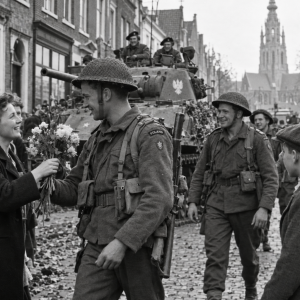
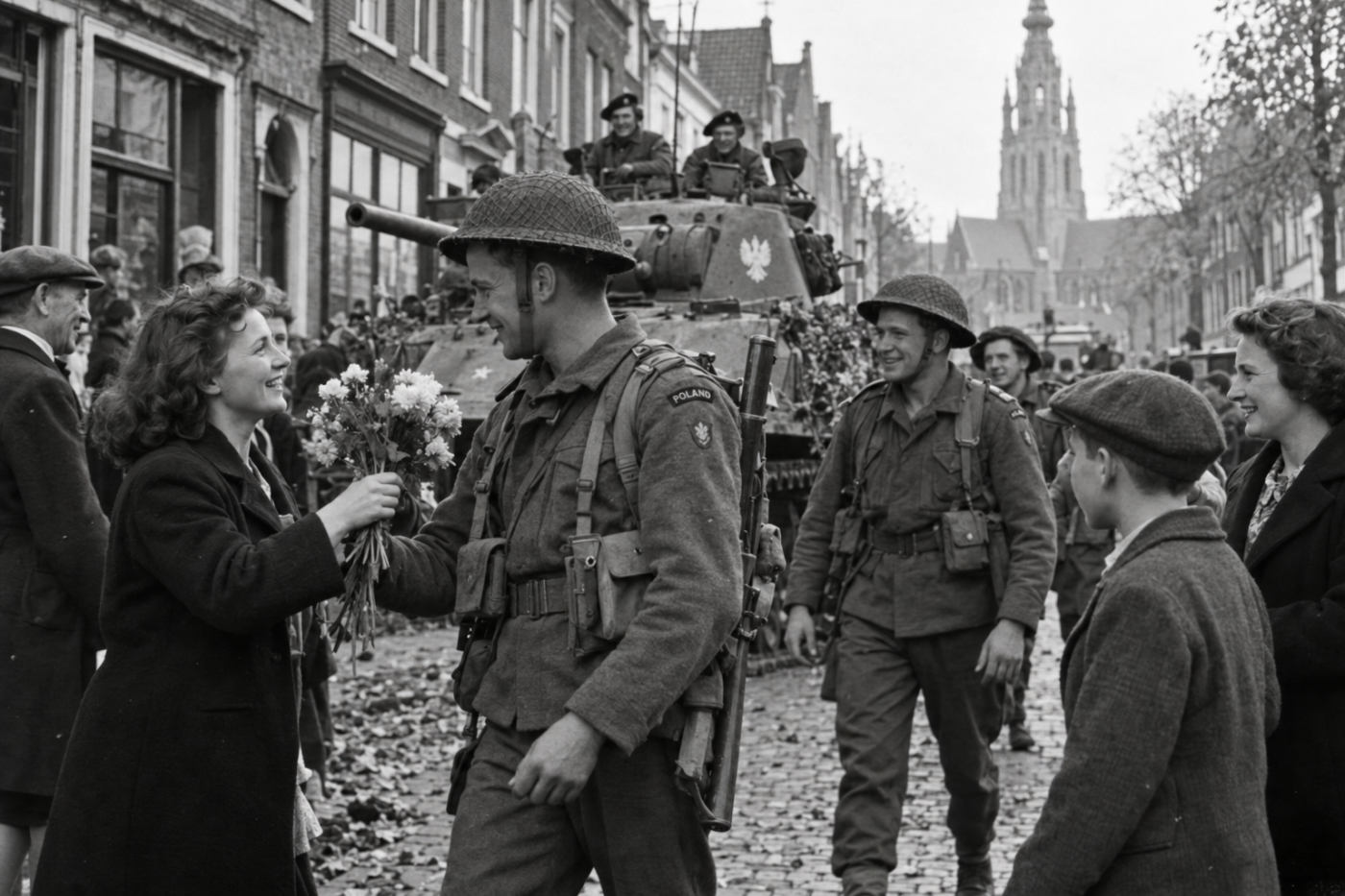
By 29 October, almost all of Breda was in Polish hands. The remaining German pockets of resistance were eliminated the following day, but it was the 29th that became the city’s official liberation date. As the fighting passed, residents filled the streets to greet their liberators. Flowers, cheering crowds and messages of thanks replaced the uncertainty of occupation. Signs appeared in shop windows bearing the words “Dziękujemy Wam, Polacy” — “Thank you, Poles.”
The welcome marked the beginning of a relationship that would outlast the war. Breda honoured the division with honorary citizenship, recognising the soldiers who had restored its freedom. After the fighting ended, some returned and settled there, building families and becoming part of the community they had helped to save. Their presence gave the story of liberation a lasting place in the everyday life of the city.
For Maczek and many of his men, however, victory brought a painful uncertainty. They had fought for the liberation of Europe, but the establishment of communist rule in Poland meant that returning home could carry serious risks. Maczek remained in Britain, settling in Edinburgh. The general who had commanded an armoured division later worked as a barman to help support his family, while continuing to hold a place of deep affection among his former soldiers and the people of Breda.
Maczek died in Edinburgh on 11 December 1994, aged 102. In accordance with his wishes, he was buried in the Polish military cemetery at Breda, alongside the soldiers he had led. His resting place gave a final, personal meaning to the bond between the commander, his men and the city they liberated.
Breda’s liberation remains a powerful chapter in the Polish contribution to Allied victory. Its soldiers brought courage and experience to the battle, while their commander recognised that saving a city meant protecting the lives and homes within it. For the people who welcomed them that October, the Polish uniforms represented the end of occupation. For the men who wore them, Breda became a place where their sacrifices were remembered, and where some would eventually find a home.