
On this day in military history…
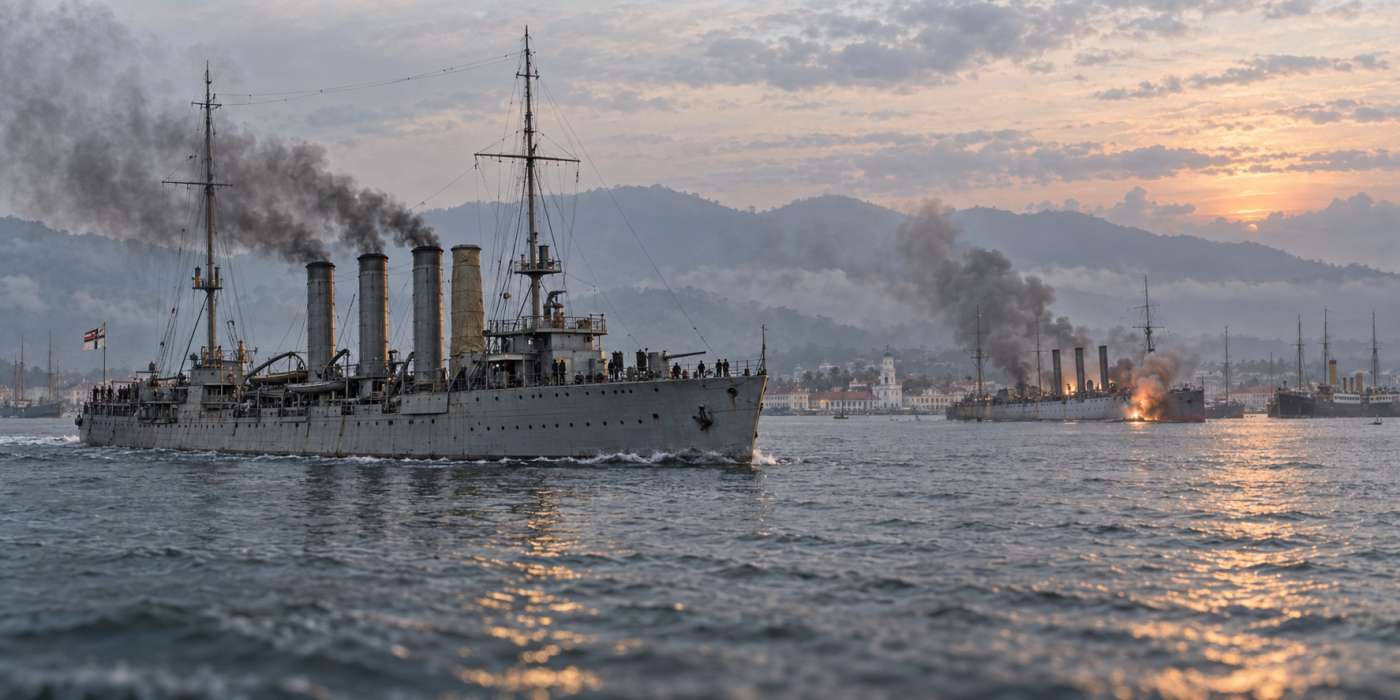
Before dawn on 28 October 1914, a cruiser approached Penang harbour in British Malaya. Her four funnels gave her the appearance of a British warship, and she entered without being challenged. Yet one of those funnels was a canvas dummy. The ship was the German light cruiser SMS Emden, and within minutes her guns and torpedoes would turn the quiet anchorage into a battlefield.
Commanded by Captain Karl von Müller, Emden had become a persistent threat to Allied shipping in the Indian Ocean. Detached from Germany’s East Asia Squadron, she operated independently, attacking merchant vessels and forcing the Allies to devote warships to hunting her. Her success depended on careful navigation, a reliable supply of coal and the ability to strike before an opponent understood what was happening. Penang offered an opportunity to take that approach directly into an enemy harbour.
The deception was remarkably simple. Emden normally had three funnels, an important identifying feature at a time when sailors recognised distant warships largely by their silhouettes. Adding a fourth made her resemble a British cruiser such as HMS Yarmouth, one of the vessels searching for her. In the uncertain light before sunrise, the disguise helped the raider pass through the harbour entrance without raising an immediate alarm.
At around five o’clock that morning, Müller found the Russian protected cruiser Zhemchug at anchor among the shipping. Her name meant “Pearl”, but she was about to become the principal victim of a disastrous failure in readiness. The cruiser was undergoing maintenance, her captain was ashore, and preparations to meet a sudden attack were inadequate. Although she possessed guns capable of damaging the German ship, having them aboard was very different from having them ready to fight.
Closing to only a few hundred yards, Emden attacked with a torpedo and opened fire. The first underwater explosion struck the Russian cruiser aft, while shells swept her upper works. Men scrambled towards their stations as the ship began taking on water. Some managed to return fire, but their hurried resistance failed to stop the attacker.
Müller then turned his cruiser and made another pass. A second torpedo struck Zhemchug, followed by a devastating internal explosion. The Russian warship broke apart and sank in the anchorage. In a matter of minutes, a ship that should have helped protect the harbour had been destroyed almost where she lay. The suddenness of the attack left little time for an organised defence or escape.
The loss was terrible, with 89 Russian sailors reported to have died. The disaster also brought consequences for the absent captain, who was subsequently stripped of his commission and imprisoned. For the harbour authorities, the wreck was a brutal demonstration that distance from the European battlefields offered no guarantee of safety.
Other French warships were present, but they were unable to intervene effectively before the German cruiser withdrew. Remaining inside the anchorage would have increased the danger to Emden, especially if torpedo craft managed to get under way. Müller had achieved surprise and destroyed his main target; his next concern was getting his ship back into open water.
Outside the harbour, however, the raid entered a second deadly phase. The French destroyer Mousquet, returning from patrol, encountered the German cruiser. The smaller vessel was heavily outmatched, and in the brief engagement that followed, German shellfire overwhelmed her. She sank, adding a second Allied warship to the morning’s losses.
Despite the risk of pursuit, Müller stopped to recover French survivors. German boats searched the water, bringing wounded and exhausted men aboard the ship that had just sunk their destroyer. They received medical attention, and two days later the surviving prisoners were transferred to the British steamer Newburn, which was sent towards Sabang in Sumatra. Another French destroyer followed the raider, but Emden eventually escaped in heavy rain.
Penang was a striking tactical success. One German cruiser had entered an Allied harbour, destroyed a Russian cruiser, sunk a French destroyer outside it and escaped without suffering casualties during the attack. More broadly, Emden’soperations disrupted trade and complicated the protection of troop transports. Uncertainty over her position helped delay the departure of the first Australian and New Zealand troop convoy, showing how much trouble a single independent warship could cause.
Her freedom lasted less than a fortnight longer. On 9 November 1914, Emden arrived at Direction Island in the Cocos Islands to attack the wireless station and communications cables. An urgent signal reached nearby Allied forces, and HMAS Sydney left her convoy escort duties to investigate. The Australian cruiser was faster and carried heavier guns. During the battle that followed, Emden suffered crippling damage, and Müller drove her onto the reef at North Keeling Island to save those of his crew who remained alive.
The raid on Penang remains one of the most audacious naval attacks of the First World War. Its success rested on a convincing disguise, a bold approach and an opponent caught unprepared. For the sailors aboard Zhemchug and Mousquet, those few hours brought death and destruction. For naval history, they left an enduring example of how surprise could allow one relatively small cruiser to strike far beyond the strength of her guns.