
On this day in military history…
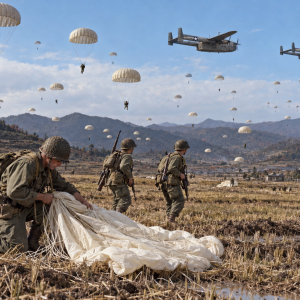
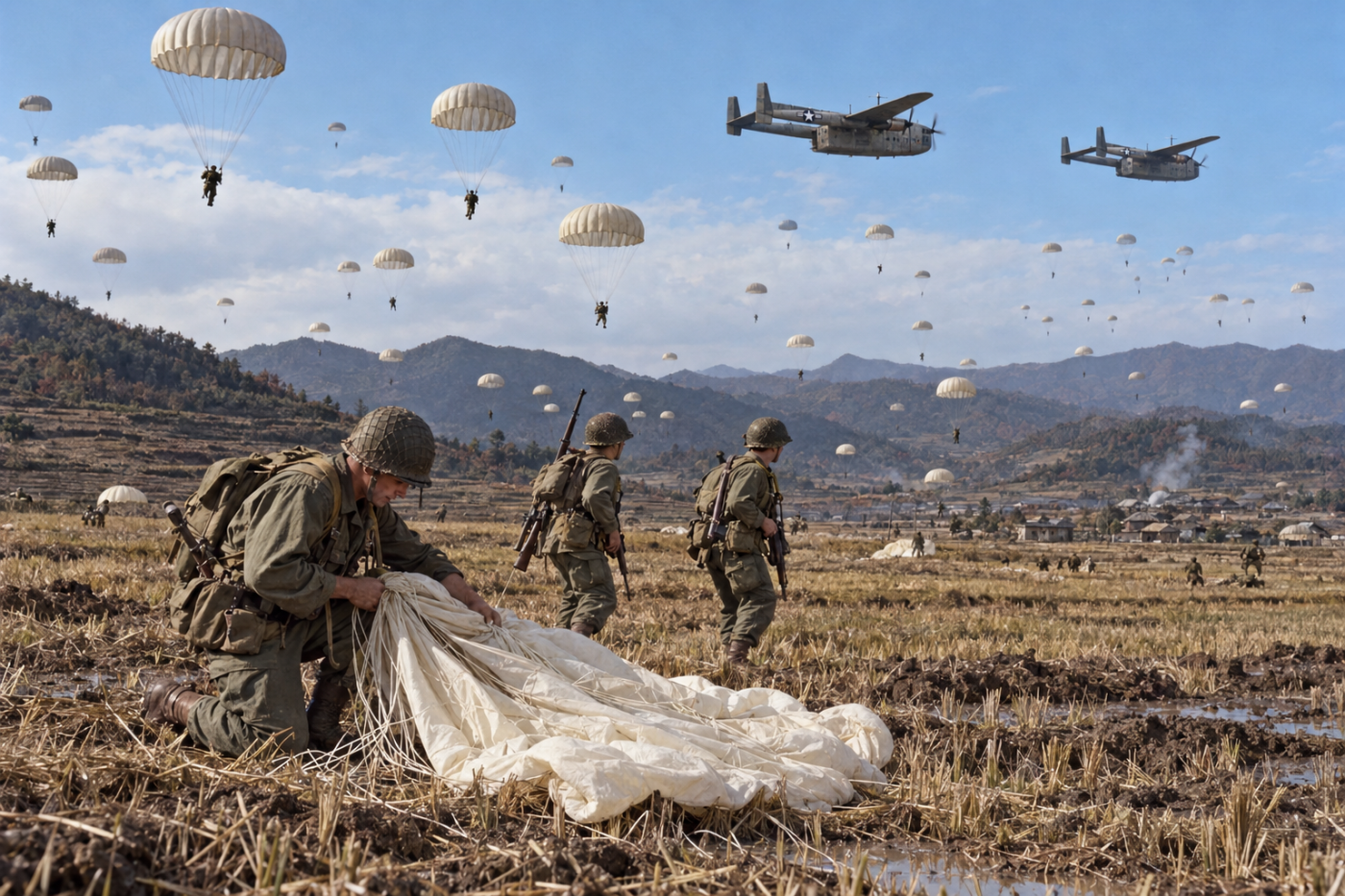
On 20 October 1950, American paratroopers descended over the fields around Sukchon and Sunchon in North Korea, carrying the United Nations offensive beyond the recently captured capital of Pyongyang. The men of the 187th Airborne Regimental Combat Team were attempting to block the enemy’s retreat and rescue prisoners being taken north. With vehicles, artillery and supplies following them by parachute, the operation demonstrated how an airborne force could arrive ready to fight far ahead of the main army. Only weeks earlier, United Nations troops had been fighting to survive inside the Pusan Perimeter in southern Korea. The landings at Inchon in September had helped reverse the campaign, allowing Seoul to be recaptured and the North Korean army to be driven back across the 38th parallel. By October, the pursuit was gathering speed. Thousands of enemy soldiers were surrendering, and the prospect of a decisive victory encouraged commanders to push deeper into the north.
The assault began during the afternoon, after poor weather delayed the start. Fighters and light bombers attacked potential enemy positions before the transport aircraft approached, and at about 2 pm parachutes began opening over Sukchon, with another drop following near Sunchon. General Douglas MacArthur watched the operation from an aircraft as the first waves reached the ground. The distinctive twin-boomed C-119 Flying Boxcar played a prominent role, delivering troops and helping bring the equipment needed to sustain them. Once down, the men assembled and secured the high ground overlooking their landing areas. Around 2,800 men were delivered in the initial assault, with subsequent drops bringing the force to approximately 4,000. More than 600 tons of equipment and supplies were delivered during the operation, giving the Americans ammunition, food and supporting weapons while they waited for the troops advancing from the south.
The relatively light resistance around the landing grounds did not last. As the paratroopers moved south, they encountered the North Korean 239th Infantry Regiment, a rear guard occupying strong positions near Yongyu. Fighting developed across the hills, roads and railway approaches, and the Americans called for assistance. The 27th British Commonwealth Brigade was approaching from Pyongyang, bringing together the Argyll and Sutherland Highlanders, the Middlesex Regiment and the 3rd Battalion, Royal Australian Regiment. Among the men caught in the fighting was Private First Class Richard G. Wilson, a medical aidman accompanying Company I near Opari on 21 October. When the company was ambushed, he moved through enemy fire to treat casualties and helped wounded men withdraw. After learning that a soldier believed dead was still alive, he returned unarmed to find him despite his comrades’ protests. A patrol later discovered Wilson beside the man he had tried to save, having been shot while attempting to protect and treat him. He received the Medal of Honor posthumously.
On 22 October, Australian infantry riding American Sherman tanks came under fire from an apple orchard north of Yongyu. Men of C Company dismounted, fixed bayonets and attacked, while other troops and the tanks supported their advance. The action helped break the enemy position and opened the way towards the paratroopers. British troops subsequently completed the link-up, bringing an end to the airborne force’s isolation. The fighting became known as the Battle of the Apple Orchard, the Australians’ first major engagement in Korea.
The attempt to rescue prisoners ended in a particularly bitter discovery. Near a railway tunnel northwest of Sunchon, investigators found American prisoners who had been murdered by their guards on the evening of 20 October. Survivors described being taken from their train in groups, supposedly to receive food, before being shot. Some lived by feigning death, but the airborne operation had been unable to reach them in time. The discovery exposed the terrible conditions faced by captives being moved north ahead of the advancing United Nations forces.
Although the regiment captured thousands of enemy soldiers, the larger trap envisaged by MacArthur failed to close around the main North Korean army, much of which had already escaped north. The operation nevertheless showed the value of airborne troops in seizing routes ahead of an advancing army, and the importance of support from the ground forces coming to meet them. Its story combines a striking parachute assault with fierce infantry fighting, Commonwealth cooperation and a rescue mission overshadowed by the prisoners who could not be saved.