
On this day in military history…
On 15 October 1944, Hungary attempted to break away from Nazi Germany and bring its involvement in the Second World War to an end. With Soviet troops advancing into the country, Regent Admiral Miklós Horthy announced that he was seeking an armistice. For a brief moment, there was hope that Hungary might escape further destruction. Within hours, however, German intervention, betrayal within the Hungarian military and confused orders had wrecked the attempt. By the following day, Horthy had been forced from power, leaving his country trapped in the final, devastating months of the war.
Hungary’s alliance with Germany had grown partly from its determination to recover territory lost after the First World War. German support helped secure territorial gains, and in November 1940 Hungary formally joined the Axis. Its leaders believed the arrangement would strengthen their country, but as Germany’s military fortunes deteriorated, the alliance became increasingly dangerous. Horthy’s government also bore responsibility for persecution at home, introducing antisemitic laws and subjecting Jewish men to a brutal military labour service. His later attempt to leave the war did not erase that record.
By 1944, Hitler feared that Hungary would seek a separate peace. On 19 March, German forces occupied the country in Operation Margarethe. Horthy remained regent, but his freedom to act was severely restricted and a government sympathetic to Berlin took office. During the following months, German and Hungarian authorities organised the deportation of approximately 437,000 Jews, most to Auschwitz-Birkenau. Horthy halted the main deportations in July, but by then much of Hungary’s provincial Jewish population had already been destroyed.
As the front approached, Horthy resumed efforts to find a way out. Romania’s change of sides in August demonstrated how quickly Germany’s position in the region could collapse. Despite his deep hostility towards communism, he accepted that an agreement would have to be reached with Moscow. On 11 October, a Hungarian delegation signed preliminary armistice terms. Turning that agreement into action required the army to obey its regent, communications to remain secure and German forces to be confronted. None of those conditions could be guaranteed.
The Germans were already preparing their response. SS commando leader Otto Skorzeny, known for his role in the rescue of Benito Mussolini in 1943, had been sent to Budapest to help prevent Hungary’s defection. On the morning of 15 October, his men ambushed Horthy’s son, Miklós Horthy junior, during a meeting arranged through supposed contacts with Yugoslav resistance representatives. After a brief gunfight, he was seized, bundled into a carpet and taken away to be flown out of Hungary. Subsequently imprisoned at Mauthausen concentration camp, he became a hostage whose life could be used against his father.
Despite the kidnapping, Horthy proceeded with his announcement. His proclamation was broadcast over Hungarian radio, explaining that Germany had lost the war and that Hungary was seeking an armistice. Yet it did not produce a coordinated military withdrawal. Orders were delayed, undermined or contradicted, while officers sympathetic to Germany obstructed the plan. Some commanders lacked clear instructions; others were unwilling to turn against their former allies. German-backed broadcasts soon told soldiers to continue fighting the Soviets, while German troops and Arrow Cross supporters secured important positions in Budapest.
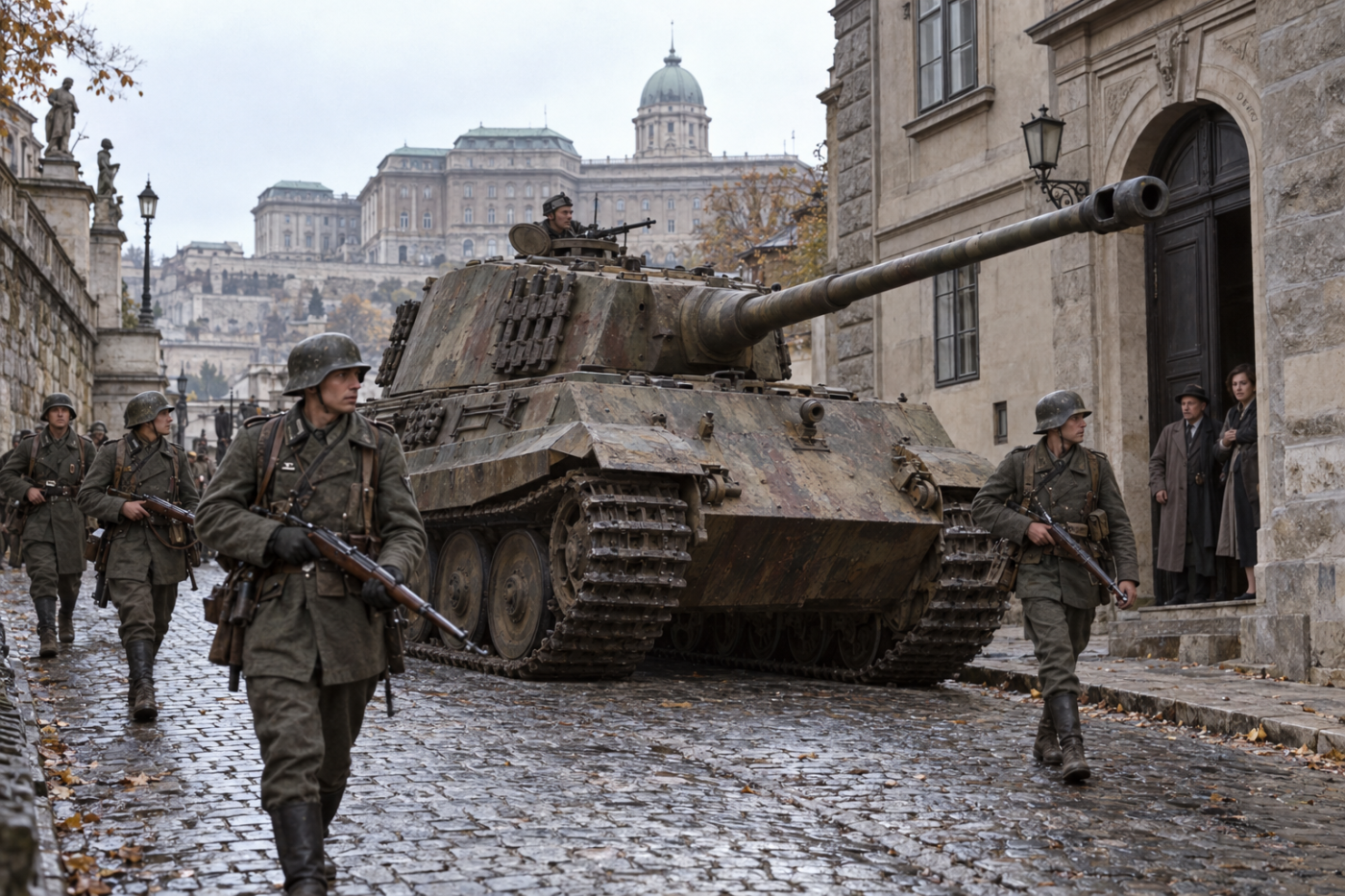
The operation known as Panzerfaust brought the crisis to its conclusion. On 16 October, German forces supported by tanks moved against the Castle Hill district, where Horthy’s residence stood. There was limited resistance, but no organised defence capable of defeating the takeover. Military pressure and the threat to his son’s life left the regent trapped. Under coercion, he signed documents relinquishing power and appointing Ferenc Szálasi, leader of the fascist Arrow Cross Party, as prime minister. Horthy later maintained that his signature had been extracted under duress.
The consequences were catastrophic. Szálasi’s regime kept Hungary fighting alongside Germany and unleashed renewed terror against the surviving Jews of Budapest. Arrow Cross gangs murdered people on the banks of the Danube, while thousands more were driven into forced labour and deadly marches towards Austria. As Soviet forces closed around the capital, German and Hungarian troops continued its defence, bringing prolonged fighting into the city itself.
Hungary’s escape attempt failed because a political declaration was never supported by effective control of the armed forces. German preparations, divided loyalties, unreliable communications and Horthy’s hesitation allowed Berlin to seize the initiative. The kidnapping of his son added a cruel personal weapon to that military advantage. What might have shortened Hungary’s war instead ended in a coup, leaving its people to endure further persecution, invasion and the destruction of their capital.