
On this day in military history…
On 13 October 1943, Italy formally declared war on Germany, turning against the country with which it had fought for more than three years. The announcement marked one of the most dramatic reversals of the Second World War, but it came after weeks of German occupation, armed resistance and bloodshed. For many Italian soldiers, their former allies had already become their enemies. Mussolini had taken Italy into the war on 10 June 1940, believing Germany’s victories would allow him to share in the spoils of a short conflict. Instead, the country became trapped in campaigns it lacked the resources to sustain. Defeats in Greece and North Africa exposed serious weaknesses, while the destruction of Italian formations on the Eastern Front brought further suffering. German assistance increasingly became essential to keeping Italy in the war. At home, shortages, bombing and the growing loss of sons, husbands and fathers steadily undermined confidence in the dictatorship.
By the summer of 1943, the situation was becoming desperate. Axis forces had surrendered in Tunisia in May, ending their campaign in North Africa, and Allied troops landed in Sicily on 10 July. The war had reached Italian soil. When Rome was bombed on 19 July, the sense that Mussolini had led the country towards disaster became harder to ignore. Opposition spread beyond his longstanding enemies to include senior figures within the Fascist establishment itself. During the night of 24–25 July, the Fascist Grand Council voted against his leadership. Later on 25 July, King Victor Emmanuel III dismissed him and had him arrested, appointing Marshal Pietro Badoglio as prime minister. Many Italians celebrated, believing that the fall of the dictator would bring peace. Badoglio, however, publicly announced that the war would continue. His government feared the reaction of German forces already stationed in Italy, while privately seeking a way out through negotiations with the Allies.
An armistice was signed secretly at Cassibile in Sicily on 3 September and announced publicly on 8 September. Italy had agreed to cease fighting the Allies, but the announcement left much of its armed forces without clear instructions about what to do next. Units were scattered across Italy, France, the Balkans and the Greek islands, often alongside German troops. The king and government fled Rome, eventually reaching Brindisi in the south. Their departure preserved the royal government but left soldiers and civilians feeling abandoned at the moment they most needed leadership. Hitler had anticipated an Italian withdrawal and prepared Operation Achse to seize control of the country and disarm its forces. German troops occupied much of Italy and moved against Italian formations abroad. Some surrendered, some dispersed and others fought back. Resistance could bring brutal punishment. On the Greek island of Cephalonia, soldiers of the Acqui Division who resisted German demands to disarm were subsequently subjected to mass executions. Men who had served beside the Germans were now treated as traitors.
Hundreds of thousands of Italian servicemen were captured and deported into German captivity. Germany designated many of them “military internees”, using the classification to deny protections associated with prisoner-of-war status. They endured hunger, harsh treatment and forced labour supporting the German war economy. Offered opportunities to leave captivity by joining German forces or Mussolini’s new army, most refused. Their decision became remembered as a form of resistance without arms: men choosing continued imprisonment rather than renewed service for the Axis. Italy’s break with Germany also divided the country politically. On 12 September, German troops rescued Mussolini from imprisonment at the mountain hotel on the Gran Sasso. He was subsequently installed at the head of the Italian Social Republic in the German-controlled north, where his authority depended on German military power. The royal government operated in the south, while Fascist forces continued fighting alongside Germany and anti-Fascist resistance groups organised against them. Italy was now facing occupation, an Allied campaign and an increasingly bitter civil war.
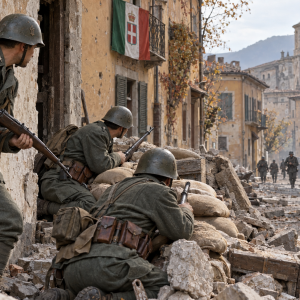
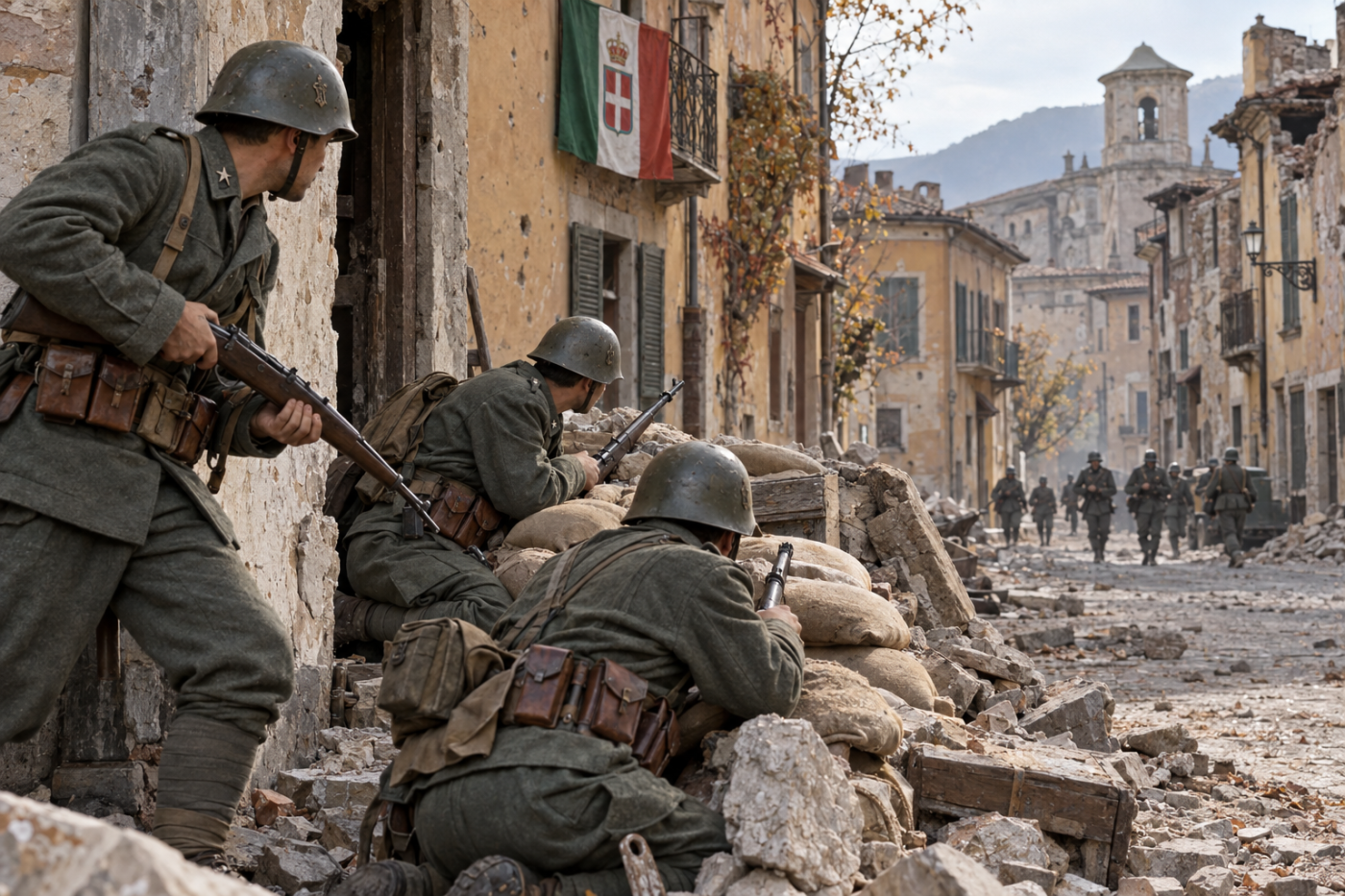
Against this background, the royal government declared war on Germany on 13 October. The declaration was communicated through the Italian embassy in Madrid, and Badoglio announced that German forces had to be driven from Italian territory. Britain, the United States and the Soviet Union accepted Italy as a co-belligerent. This meant that it was fighting a common enemy alongside them, while remaining bound by the armistice terms. Its change of sides did not erase its earlier aggression or make it an equal Allied partner. Italian servicemen subsequently contributed to the struggle against Germany, while partisans fought in occupied towns, countryside and mountains. For civilians, the consequences remained terrible. German occupation brought reprisals, persecution and deportations, including the rounding up of Jewish families. Meanwhile, Allied armies fought their way north through strongly defended terrain. Italy’s surrender had failed to bring the swift peace so many had hoped for.
The fighting continued until the German surrender in Italy became effective on 2 May 1945. Mussolini had been captured and executed by partisans on 28 April, bringing his dictatorship to its final end. The declaration of 13 October 1943 remains a defining moment in Italy’s wartime history: the formal rejection of an alliance that had helped bring the country to ruin, and the beginning of its recognised participation in the war against Germany. For its people, however, the road from that declaration to peace would take another eighteen months of suffering and sacrifice.