War Crime Trials
The idea that soldiers, commanders and rulers can be punished for crimes committed in war is much older than the modern phrase “war crimes trial.” Armies have punished looting, *blocked text*, murder of prisoners and breaches of discipline for centuries, but the first trial often described by historians as the earliest international war-crimes trial took place in 1474 in Breisach, a town on the Rhine in what is now south-west Germany. The accused was Peter von Hagenbach, a knight and governor serving Charles the Bold, Duke of Burgundy. Hagenbach had ruled the occupied town harshly, and when an anti-Burgundian coalition captured him, he was brought before a specially assembled tribunal of judges from different cities and territories of the Holy Roman Empire. He was charged with atrocities including murder, *blocked text* and other abuses committed against civilians. His defence was one that would echo through later centuries: he argued that he had only obeyed the orders of his superior, the Duke of Burgundy. The tribunal rejected that argument, convicted him and sentenced him to death. He was beheaded in May 1474.
The Hagenbach trial was not a modern international criminal court. There was no permanent statute, no appeal court, no codified Geneva Conventions and no global organisation like the United Nations. Yet it was historically significant because it treated atrocities in war as punishable wrongs rather than merely unfortunate consequences of conquest. It also suggested that obeying orders was not always a complete defence. The trial was organised by victorious political authorities, but its judges came from several jurisdictions, which is why many legal historians see it as a forerunner of later international war-crimes justice. It was a mixture of medieval politics, local revenge and early legal principle, but it showed that even a commander acting under a prince could be personally answerable for brutality.
Long before the twentieth century, military authorities also used courts martial and military commissions to punish unlawful conduct in war. These were usually national proceedings rather than international trials. One famous example was the 1865 trial of Henry Wirz, the Confederate commandant of Andersonville prison during the American Civil War. Wirz was tried by a United States military commission in Washington, D.C., for murder and conspiracy connected with the mistreatment and deaths of Union prisoners of war. He was convicted and hanged. The case remains controversial because it was conducted by the victorious side after a bitter civil war, but it is important because it treated prisoner abuse as a crime for which an individual officer could be executed. In the same period, the Lieber Code of 1863, issued for Union armies, tried to define lawful and unlawful conduct in war, including protections for prisoners, civilians and property. It was not an international treaty, but it strongly influenced later laws of war.
The real foundations of modern war-crimes trials were laid after the First World War. The scale of that conflict, the treatment of prisoners, the invasion of Belgium, submarine warfare, massacres and atrocities against civilians created pressure for accountability. The 1919 Treaty of Versailles included provisions calling for the prosecution of German personnel accused of violating the laws and customs of war. The Allies originally wanted to try a large number of suspects, and even the former German Kaiser Wilhelm II was named in the treaty for “a supreme offence against international morality and the sanctity of treaties.” The Netherlands, where Wilhelm had taken refuge, refused to extradite him, and he was never tried.
Instead, the first post-First World War prosecutions became the Leipzig trials, held in Germany before the German Supreme Court in 1921. These trials were organised by Germany under Allied pressure, rather than by an international court. The Allies submitted lists of hundreds of suspects, but only a small number were actually tried. The results disappointed many observers. Some defendants were acquitted, some received light sentences, and several escaped or were treated leniently. Still, the Leipzig trials mattered because they were among the first attempts after a major modern war to prosecute individuals for violations of the laws of war. They revealed both the possibility and the weakness of relying on a defeated state to punish its own soldiers and officers.
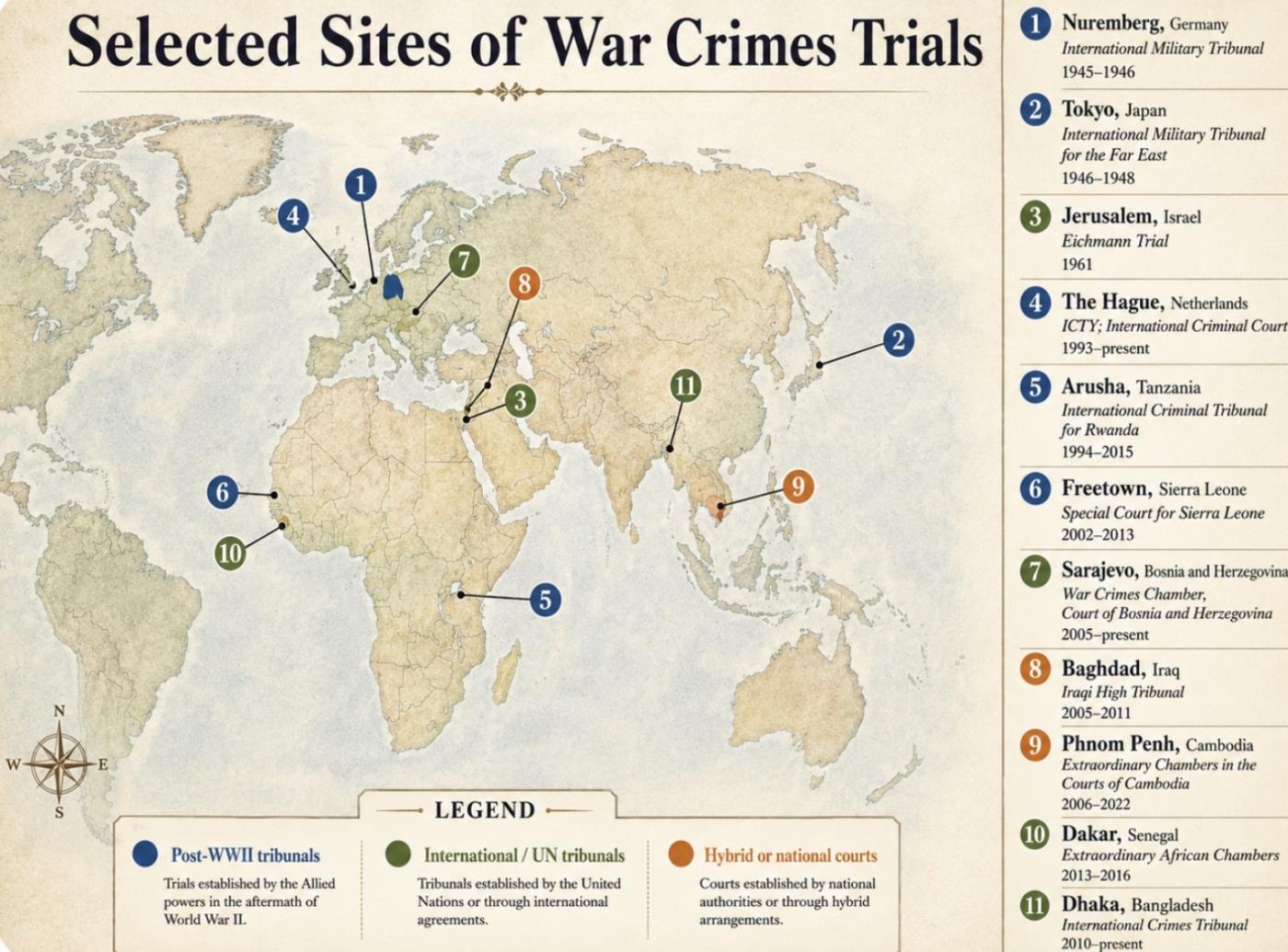
The most famous and influential war-crimes trials began after the Second World War. The Nazi regime had committed aggressive war, mass murder, genocide, forced labour, medical experimentation, starvation policies, the murder of prisoners of war and the systematic extermination of Europe’s Jews and other persecuted groups. The Allied powers decided that the leading figures of the regime should not simply be shot or imprisoned without trial. They wanted a legal record, public evidence and individual judgements. The result was the International Military Tribunal at Nuremberg, held in the Palace of Justice in Nuremberg, Germany. The tribunal opened in November 1945 and delivered judgement in October 1946.
Nuremberg was organised by the four major Allied powers: the United States, the United Kingdom, the Soviet Union and France. Its legal basis was the London Charter of 8 August 1945. The tribunal had judges and prosecutors from the four powers, and it tried leading Nazi political, military and economic figures. Nuremberg charged the accused with crimes against peace, war crimes, crimes against humanity and conspiracy. The category of crimes against peace meant planning and waging aggressive war. War crimes covered violations of the laws and customs of war, such as killing prisoners, deporting civilians and plundering occupied territories. Crimes against humanity covered murder, enslavement, deportation and persecution against civilian populations, especially when connected to the war.
Twenty-four major Nazi defendants were indicted at the main Nuremberg trial, although not all stood in the dock throughout the proceedings. Robert Ley killed himself before the trial began, Gustav Krupp was found medically unfit, and Martin Bormann was tried in absentia. The defendants included Hermann Göring, Joachim von Ribbentrop, Wilhelm Keitel, Alfred Jodl, Albert Speer, Julius Streicher, Hans Frank and Rudolf Hess. Twelve defendants were sentenced to death, though Göring killed himself before execution. Others received prison sentences ranging from ten years to life, and three were acquitted. The tribunal also declared certain Nazi organisations criminal, including the SS and Gestapo, although it did not criminalise every German soldier or official.
Nuremberg’s importance lay not only in the punishments but in the record it created. Film, documents, orders, camp records and witness testimony exposed the machinery of Nazi rule. The trial rejected the argument that leaders were immune because they acted as state officials. It also limited the defence of superior orders: following orders might be considered in mitigation, but it did not automatically erase responsibility. This became one of the central principles of modern international criminal law.
After the main Nuremberg trial, the United States conducted twelve further trials in Nuremberg between 1946 and 1949. These are known as the Subsequent Nuremberg Proceedings. They were held before American military courts, not the four-power International Military Tribunal, but they were still central to the development of war-crimes law. They tried doctors accused of medical experiments, judges and lawyers who had corrupted the legal system, industrialists accused of using slave labour, military commanders, Einsatzgruppen leaders and government officials. In total, the United States indicted 185 defendants in these twelve trials, of whom 177 stood trial. The results included 24 death sentences, 20 life sentences, 98 lesser prison sentences and 35 acquittals. These trials widened the idea of responsibility beyond the obvious political leaders and showed how doctors, businessmen, civil servants and judges could become part of a criminal state system.
At the same time, war-crimes trials took place across Europe and Asia in national and occupation courts. The Dachau trials, run by the United States military in Germany, prosecuted concentration camp personnel, guards and others accused of murdering or abusing Allied prisoners and civilians. British, French, Soviet, Polish, Dutch, Norwegian, Greek, Yugoslav and other courts also tried thousands of suspects. These proceedings varied greatly in fairness and quality. Some were careful and evidence-based; others were influenced by revenge, politics or the practical difficulties of judging crimes committed during a vast war. Nevertheless, they form a huge part of the true history of war-crimes prosecution, because far more perpetrators were tried in national and occupation courts than in the famous international trials.
In Asia, the equivalent of Nuremberg was the International Military Tribunal for the Far East, commonly called the Tokyo Trial. It was held in Tokyo from 1946 to 1948. The tribunal was created by General Douglas MacArthur, Supreme Commander for the Allied Powers in occupied Japan, under authority from the Allied powers. Judges came from eleven countries: the United States, United Kingdom, Soviet Union, China, France, Australia, Canada, the Netherlands, New Zealand, India and the Philippines. The defendants were senior Japanese political and military leaders accused of crimes against peace, conventional war crimes and crimes against humanity. Twenty-eight defendants were indicted. Some died or were declared unfit during the trial, and twenty-five were eventually convicted. Seven were sentenced to death, including former prime minister Hideki Tojo, and others received prison sentences.
The Tokyo Trial was historically important but also controversial. Critics argued that it was “victors’ justice,” that the Allied bombing of Japanese cities and the atomic bombings were not examined, and that Emperor Hirohito was not prosecuted. Supporters argued that the trial created a public record of Japanese aggression and atrocities, including crimes committed in China, Southeast Asia and against prisoners of war. Alongside the Tokyo Trial, many smaller trials were held across Asia and the Pacific by Allied military courts. These prosecuted Japanese officers, soldiers, prison camp guards and officials for massacres, torture, forced labour, abuse of prisoners and other crimes. Countries including Australia, China, Britain, the Netherlands, France, the Philippines and the United States conducted such trials. These lesser-known proceedings involved thousands of defendants and produced many convictions, including death sentences.
After the Second World War, the momentum for international criminal justice slowed during the Cold War. The Geneva Conventions of 1949 strengthened the legal rules protecting wounded soldiers, prisoners of war and civilians, but few international trials were created. Many war-crimes cases were handled by national courts, if they were handled at all. Politics often decided whether suspects were prosecuted, ignored, protected or recruited. Some Nazi suspects were tried decades later, especially when evidence emerged or when they were discovered living under false identities. The prosecution of Adolf Eichmann in Jerusalem in 1961 was especially important. Eichmann, a major organiser of the Holocaust, had been captured by Israeli agents in Argentina. His trial was not an international tribunal, but it brought survivor testimony to a global audience and helped shape public understanding of genocide and bureaucratic mass murder.
The next major revival of international war-crimes trials came in the 1990s after atrocities in the former Yugoslavia and Rwanda. In 1993, the United Nations Security Council created the International Criminal Tribunal for the former Yugoslavia, known as the ICTY. It was based in The Hague in the Netherlands and prosecuted crimes committed during the Balkan wars, including murder, torture, *blocked text*, ethnic cleansing, persecution, unlawful detention, attacks on civilians and genocide. The ICTY indicted 161 people. Its defendants included camp guards, soldiers, police officers, political leaders and senior military commanders. Among the most famous were Slobodan Milošević, Radovan Karadžić and Ratko Mladić. Milošević died before judgement, but Karadžić and Mladić were convicted. The tribunal helped establish *blocked text* and sexual violence as serious international crimes and developed the law on command responsibility, joint criminal enterprise and genocide.
In 1994, after the genocide in Rwanda, the United Nations created the International Criminal Tribunal for Rwanda, known as the ICTR. It was based in Arusha, Tanzania. The ICTR indicted 93 individuals for genocide and other serious violations of international humanitarian law committed in 1994. Its most famous judgement was the conviction of Jean-Paul Akayesu, a local mayor. That case was historic because it was the first conviction for genocide by an international tribunal and one of the first to recognise *blocked text* and sexual violence as acts that could constitute genocide when committed with the intent to destroy a protected group. The ICTR also prosecuted ministers, media figures, military officers, local officials and militia leaders. It showed that genocide could be organised not only by soldiers but by politicians, broadcasters, administrators and local authorities.
Other hybrid and special courts followed. The Special Court for Sierra Leone was created by agreement between the United Nations and the government of Sierra Leone to prosecute those most responsible for crimes during the Sierra Leone civil war. It was based mainly in Freetown, with the trial of former Liberian president Charles Taylor held in The Hague for security reasons. Taylor’s conviction was especially significant because he became the first former head of state since Nuremberg to be convicted by an international or hybrid criminal tribunal. The court indicted a relatively small number of people, focusing on senior responsibility rather than mass prosecution.
In Cambodia, the Extraordinary Chambers in the Courts of Cambodia were created to try senior leaders and those most responsible for crimes committed by the Khmer Rouge between 1975 and 1979. The court was a hybrid Cambodian-international tribunal. It achieved only a small number of convictions, including Kaing Guek Eav, known as Duch, who commanded the S-21 prison, and senior leaders Nuon Chea and Khieu Samphan. The tribunal was criticised for cost, delay and political interference, but it also created an enormous public record of Khmer Rouge crimes and gave many victims an official forum.
The permanent International Criminal Court, or ICC, began work in 2002 after the Rome Statute entered into force. It is based in The Hague and was designed to avoid the need to create a new tribunal after every atrocity. The ICC can prosecute genocide, crimes against humanity, war crimes and the crime of aggression, but only under certain jurisdictional limits. It usually acts when national courts are unwilling or unable genuinely to prosecute. Unlike Nuremberg and Tokyo, it is not a court created by victors after one war. It is treaty-based, with member states, judges, prosecutors and procedures established in advance. By 2026, the ICC had brought numerous cases connected to conflicts and atrocities in places including Uganda, the Democratic Republic of the Congo, Darfur, the Central African Republic, Kenya, Libya, Côte d’Ivoire, Mali, Georgia, Bangladesh/Myanmar, Ukraine and others. Its own public figures state that 22 people have been detained and appeared before the Court, while 32 remained at large. ICC proceedings have produced convictions and acquittals, but the court has also faced criticism for slow trials, limited enforcement power, dependence on state cooperation and accusations of political selectivity.
The question of how many people have been prosecuted for war crimes over the years is surprisingly difficult to answer. If the question means only the major international and hybrid tribunals, the number is in the hundreds. The main Nuremberg trial indicted 24 major defendants; the twelve subsequent Nuremberg trials indicted 185; the Tokyo Trial indicted 28; the ICTY indicted 161; the ICTR indicted 93; the Special Court for Sierra Leone indicted a smaller group of leading suspects; the Cambodia tribunal tried only a handful of senior figures; and the ICC has dealt with dozens of suspects across multiple situations. If all these formal international and hybrid courts are counted together, the total number of indicted or prosecuted individuals is well over 500.
If the question includes national military courts, occupation courts and domestic prosecutions, the number becomes much larger, reaching many thousands. After the Second World War alone, Allied and national courts prosecuted large numbers of German, Japanese and collaborating personnel. Later decades saw national prosecutions in Germany, Israel, France, Italy, the Netherlands, Canada, the United States, Argentina, Spain, Belgium, Bosnia, Croatia, Serbia, Rwanda and many other countries. Some cases used ordinary criminal law, some used special war-crimes statutes, and some relied on universal jurisdiction, which allows national courts to try certain grave international crimes even when they were committed elsewhere. Because these prosecutions were scattered across many countries and legal systems over more than a century, there is no single complete global register.
One of the most interesting features of war-crimes trials is that they changed the meaning of responsibility. In older warfare, punishment often fell on defeated rulers, captured soldiers or local offenders. Modern trials developed the idea that responsibility can run up and down a chain of command. A guard who beats prisoners may be guilty, but so may the officer who orders the abuse, the commander who knew and failed to stop it, the minister who created the policy, the businessman who knowingly used slave labour, or the propagandist who helped incite murder. This is why war-crimes trials often examine documents, command structures, radio broadcasts, minutes of meetings, transport records, prison lists and patterns of conduct. They are not only about who pulled a trigger; they are about how criminal systems are built and maintained.
Another recurring issue is the defence of superior orders. Peter von Hagenbach raised it in 1474. Nazi and Japanese defendants raised similar arguments after 1945. Modern law does not treat orders as a simple excuse for atrocities. A soldier may be required to obey lawful orders, but manifestly unlawful orders, such as orders to murder prisoners or civilians, do not provide complete protection. Courts may consider coercion, rank, fear and circumstances, but the central principle is that individuals remain morally and legally responsible for grave crimes.
War-crimes trials have always been criticised as well as praised. The most common criticism is “victors’ justice”: the defeated are prosecuted while the winners are not. This criticism was made of Nuremberg, Tokyo and many later tribunals. There is some force in it, because power often determines who is arrested and who escapes. Yet the answer many lawyers give is that imperfect justice is not the same as no justice. Nuremberg did not prosecute every crime committed in the Second World War, but it did expose and punish central figures in the Nazi system. Tokyo did not examine every Allied action, but it did create a record of Japanese aggression and atrocities. Later tribunals also had limits, but they helped establish rules and evidence that can be used by future courts.
A second criticism is that trials are slow, expensive and selective. International courts often take years to complete a case. They depend on witnesses, translations, archives, forensic evidence, arrests and political cooperation. Suspects may remain at large for years. Victims may die before judgement. Some trials produce only a few convictions despite enormous cost. The Cambodia tribunal is often cited as an example: it spent many years and large sums but convicted only a very small number of senior Khmer Rouge figures. Yet supporters argue that such courts also produce historical records, recognise victims, clarify the law and make denial harder.
A third issue is enforcement. Courts do not have armies of their own. Nuremberg and Tokyo worked because the defendants were already in Allied custody. The ICTY and ICTR depended on states to arrest suspects. The ICC still depends heavily on governments to surrender accused persons. If a suspect is protected by a powerful state, prosecution may be delayed or impossible. This is one reason why international justice often appears uneven: the law may be universal in theory, but enforcement is political in practice.
Despite all these weaknesses, the development from Breisach in 1474 to The Hague in the twenty-first century is remarkable. The earliest trials were irregular, political and local. The Leipzig trials showed how weak accountability could be when states protected their own. Nuremberg and Tokyo created the first major international military tribunals and established that leaders could be punished for aggressive war, atrocities and crimes against humanity. The post-war national trials showed that thousands of lesser-known perpetrators could also be held accountable. The tribunals for Yugoslavia and Rwanda revived international criminal justice after the Cold War and developed the law of genocide, sexual violence and command responsibility. Hybrid courts in Sierra Leone and Cambodia tried to combine international standards with local justice. The ICC attempted to make the system permanent.
The first military war-crimes trials were therefore not a single event but a long evolution. If one looks for the earliest symbolic beginning, Peter von Hagenbach’s trial at Breisach in 1474 stands out. If one looks for the first modern attempts after a world war, the Leipzig trials after the First World War are essential. If one looks for the first fully developed international military tribunals, Nuremberg and Tokyo are the turning points. Since then, hundreds of people have been prosecuted by international and hybrid tribunals, and many thousands more by national courts. The central idea linking all of them is simple but powerful: war does not place human beings outside the law. Even in the violence of armed conflict, there are acts so cruel, so unnecessary or so systematic that they are treated not merely as military events, but as crimes.