Waffenfarbe
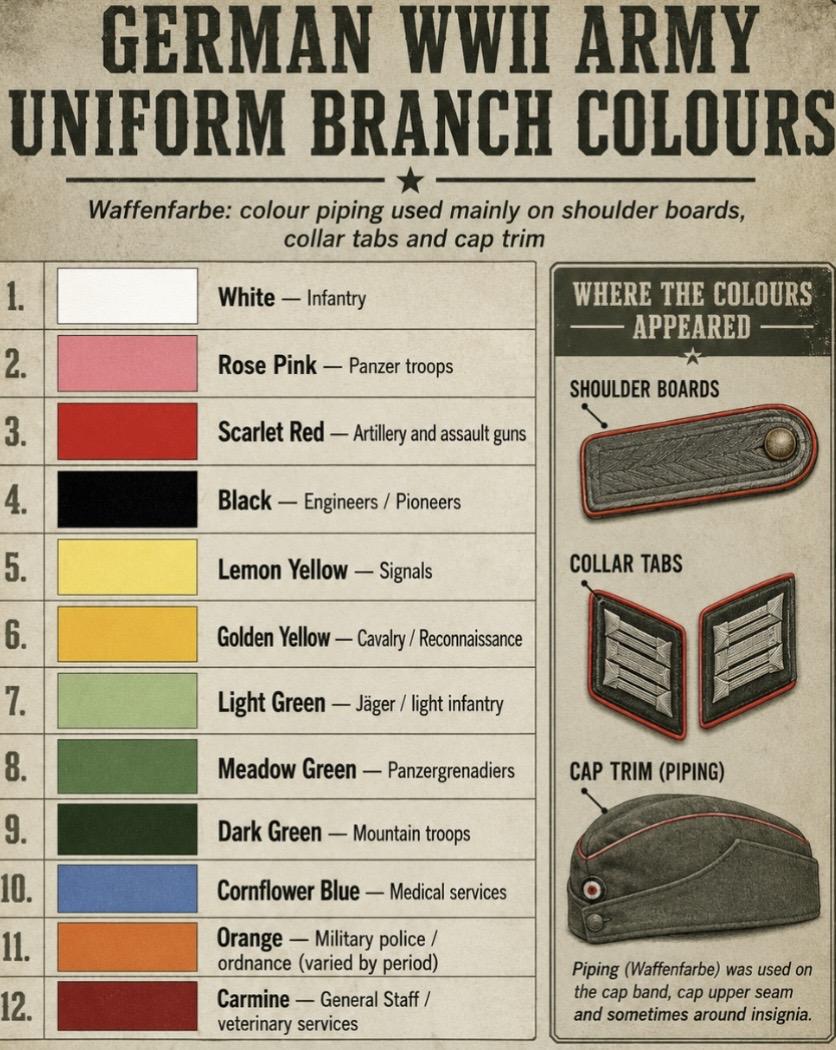
The colour chart explains how the German Army in the Second World War used branch colours, known as Waffenfarbe, to show what type of service a soldier belonged to. These colours were not usually the lining inside the uniform jacket. Instead, they appeared as visible piping or backing on parts of the uniform such as shoulder boards, collar tabs, cap seams and sometimes around insignia. This made them a quick visual guide to the soldier’s role within the army.
The most important thing to understand is that these colours usually showed the branch of service rather than the exact regiment, division or individual unit. A man with white piping, for example, would generally be identified as infantry, but the colour alone would not tell you his precise regiment. For that, other details would be needed, such as shoulder-board numbers, cyphers, cuff titles, badges, documents or dog tags. The colour gave a broad clue, not the full identity.
White was the colour used for infantry, the backbone of the German Army. Infantry soldiers made up a large part of the fighting force and were involved in most types of ground combat. Because infantry was so common, white piping is one of the best-known and most frequently seen branch colours.
Rose pink was used for Panzer troops. This colour is strongly associated with German armoured forces and is often seen on uniforms connected with tank crews and armoured formations. It is one of the most distinctive colours in the system because it immediately suggests a connection with tanks and mobile armoured warfare.
Scarlet red was connected with artillery and assault gun units. Artillery troops operated guns, howitzers and other heavy weapons designed to support infantry and armoured units. Assault gun crews, who used armoured vehicles armed with guns rather than rotating tank turrets, were also often linked with this red branch colour.
Black indicated engineers, also known as pioneers. These troops had a very practical and dangerous role. They built bridges, cleared obstacles, laid or removed mines, prepared demolitions and helped troops cross rivers or break through defensive positions. The black colour therefore pointed to a technical combat role rather than a front-line infantry role alone.
Lemon yellow was used for signals troops. These soldiers were responsible for communications, including radio, telephone lines, message systems and other methods of keeping commanders connected with their units. In a fast-moving war, signals troops were extremely important because poor communication could cause confusion, delays and battlefield failures.
Golden yellow was associated with cavalry and reconnaissance. By the Second World War, traditional horse cavalry had declined in importance, but reconnaissance remained vital. These troops helped find enemy positions, scout routes, report movement and provide information to commanders. In some cases, reconnaissance units used armoured cars, motorcycles or other fast transport rather than horses.
Light green was used for Jäger, or light infantry. These troops were often trained for more mobile or specialist infantry work than standard line infantry. The term Jäger had older military roots and was associated with troops who could operate flexibly, sometimes in difficult terrain or in smaller, more independent groups.
Meadow green was linked with Panzergrenadiers. These were motorised or mechanised infantry intended to work closely with armoured formations. Their role was to move with tanks, hold ground, clear enemy positions and provide infantry support in mobile warfare. This colour therefore suggests troops who sat between ordinary infantry and the armoured branch.
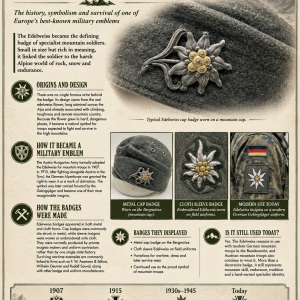
Dark green was connected with mountain troops. These soldiers, known as Gebirgsjäger, were trained to fight in mountainous and difficult terrain. They are also often recognised by the edelweiss badge, which became one of their most famous symbols. Their training and equipment suited them to climbing, mountain movement and fighting in harsh environments.
Cornflower blue was used for medical services. This colour identified personnel connected with medical care, treatment and evacuation of wounded soldiers. Medical troops had a different role from combat branches, but they were still part of the military structure and could be found close to the fighting, especially in aid stations and field hospitals.
Orange was used in some cases for military police, ordnance or related services, although this could vary depending on period and exact function. This is a good example of why branch colours need to be treated carefully. Some colours changed in use, overlapped or were affected by wartime shortages, regulation changes and practical uniform variations.
Carmine was linked with the General Staff and veterinary services. The General Staff connection made this a colour associated with planning, command and higher military organisation. Veterinary services were also important because, despite the image of a highly mechanised army, the German Army still relied heavily on horses for transport, supply and artillery movement, especially on the Eastern Front.
The side panel on the chart is useful because it shows where these colours could actually appear. Shoulder boards were one of the most important places to look. The coloured piping around the edge could quickly show the branch. Collar tabs could also include branch colour backing or edging, depending on the uniform type and period. Caps could show branch colour through piping around the cap band or upper seam.
The chart also corrects a common misunderstanding. Many people ask about uniform linings, but the inside lining of a tunic was usually not the key identification feature. The more meaningful colours were normally on visible trim. Collectors, historians and family researchers therefore tend to look first at shoulder boards, collar tabs, cap piping, badges and surviving paperwork when trying to understand what a uniform represented.
Another interesting point is that the system was useful but not perfect. Wartime uniforms were affected by shortages, field repairs, regulation changes and soldiers mixing old and new items. A uniform might have replaced shoulder boards, faded colours or non-standard details. This means that colour is a strong clue, but it should always be checked alongside other evidence.
Overall, the chart shows a simple visual language used by the German Army. Each colour acted almost like a code, helping to identify whether a soldier belonged to infantry, armour, artillery, engineers, signals, medical services or another branch. It did not tell the whole story by itself, but it gave an immediate first impression of the soldier’s role and place within the military system.