US first offensive Vietnam
On 28 June 1965, the Vietnam War entered a new and deeply significant phase when American ground troops, fighting alongside South Vietnamese and Australian allies, launched what is generally regarded as the first major United States offensive ground operation of the war. Until then, the United States had been moving steadily but cautiously from advice, training, air power and base defence into a direct combat role. American helicopters, advisers and airmen had already been in action, and U.S. Marines had landed at Da Nang earlier in 1965, but the operation that began on 28 June marked something different. It was not merely the defence of an air base, nor the support of a South Vietnamese action from behind the scenes. It was an American-led assault into enemy territory.
The target was War Zone D, a heavily forested Viet Cong base area north-east of Saigon. This was not an accidental choice. War Zone D had long been known as a difficult and dangerous region, a place of jungle, hidden camps, trails, supply stores and guerrilla sanctuaries. It lay close enough to Saigon to threaten the political heart of South Vietnam, but its terrain made it ideal for the Viet Cong to disappear, regroup and avoid decisive battle. The Americans and their allies hoped to strike into this area, disrupt enemy forces, destroy supplies and show that U.S. troops could carry the war to the Viet Cong rather than simply guard installations.
The immediate order for the assault came from General William C. Westmoreland, commander of Military Assistance Command, Vietnam. Westmoreland had been pressing for greater freedom to use American troops in combat. By June 1965 he believed that the Army of the Republic of Vietnam, usually known as ARVN, was under heavy pressure and that the Viet Cong were growing stronger. The Johnson administration had already begun widening the American role, though it often did so carefully in public language. In early June, U.S. officials acknowledged that American ground forces could be used in combat support alongside South Vietnamese troops when necessary. This gave Westmoreland the authority he needed to move beyond static defence.
The principal American unit involved was the 173rd Airborne Brigade, often called the “Sky Soldiers.” The brigade had arrived in South Vietnam from Okinawa in May 1965 and was the first major U.S. Army ground combat unit sent into the country. It was commanded by Brigadier General Ellis W. Williamson, a veteran officer who had helped organise and train the brigade before its deployment. The 173rd had originally been assigned to defend important American facilities such as Bien Hoa Air Base and the port area at Vung Tau, but its mission soon expanded. By late June, it was being used as an offensive striking force.
About 3,000 troops of the 173rd Airborne Brigade took part in the operation. They were joined by roughly 800 Australian soldiers, mainly from the 1st Battalion, Royal Australian Regiment, which had recently arrived in Vietnam and had been attached to the 173rd Airborne Brigade. A South Vietnamese airborne unit also joined the assault. This made the operation a combined allied action involving the United States, Australia and the Republic of Vietnam. Although South Korea, New Zealand, Thailand and other allies would later play roles in the Vietnam War, the key allies involved in this first major U.S. ground offensive were the South Vietnamese and the Australians.
The Australian presence was especially important. The 1st Battalion, Royal Australian Regiment, usually known as 1RAR, brought experience and a different style of jungle warfare. Many Australian soldiers had inherited lessons from earlier British and Commonwealth fighting in Malaya, where quiet patrolling, fieldcraft and patience had been essential against guerrillas. This sometimes contrasted sharply with American methods, which placed heavy emphasis on firepower, artillery, helicopters, speed and aggressive movement. The two approaches would not always fit smoothly together, but their combination during these early operations revealed much about how the allied war effort in Vietnam would develop.
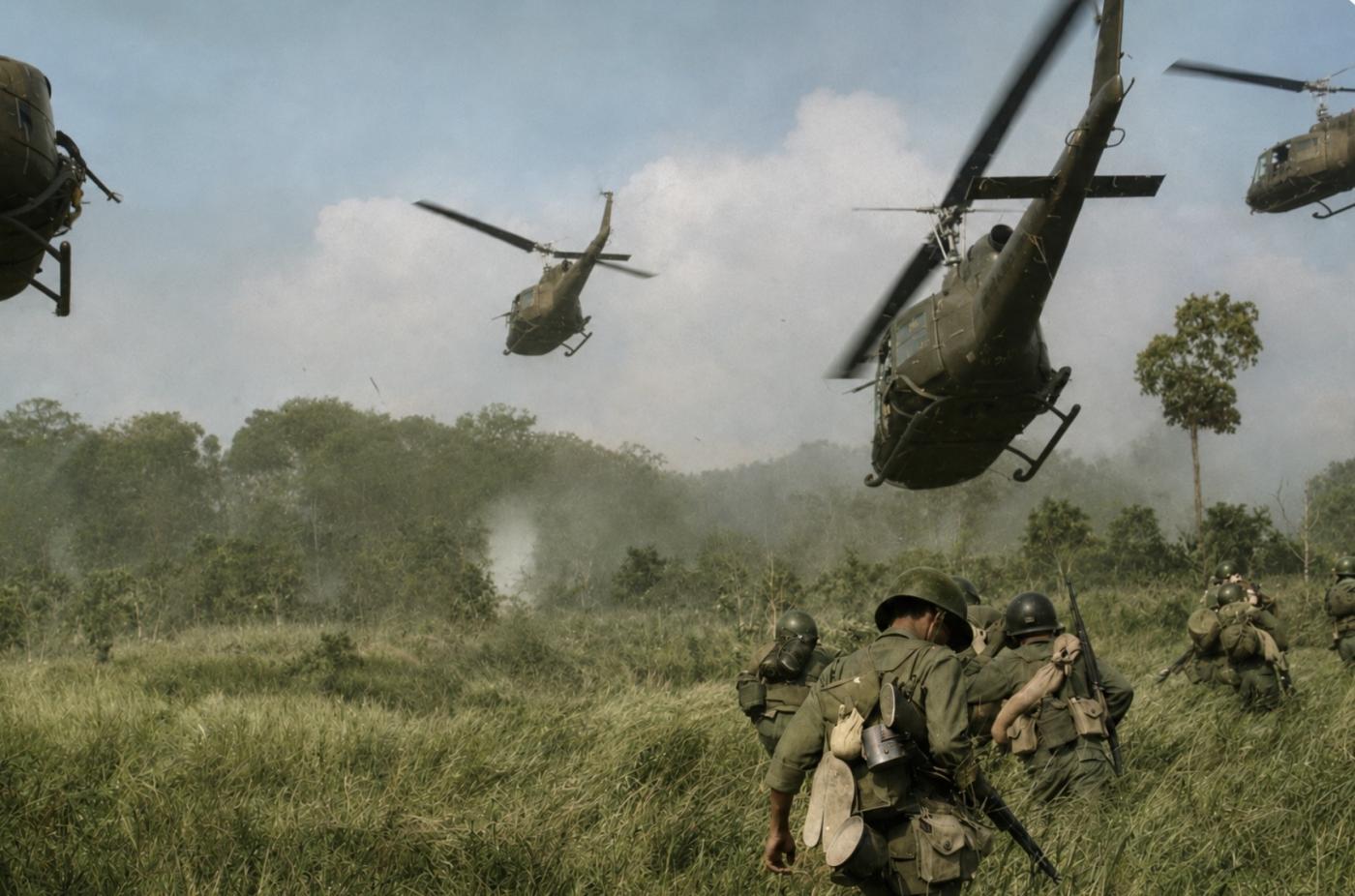
The assault began with artillery fire and the insertion of troops into the jungle. American doctrine at the time increasingly relied on “search and destroy” operations. The basic idea was to use mobility, especially helicopters, to place troops into suspected enemy areas, locate Viet Cong or North Vietnamese formations, fix them in place and then destroy them with infantry, artillery, air strikes and supporting fire. In theory, this would rob the enemy of safe havens and wear down communist forces faster than they could be replaced. The War Zone D operation was one of the earliest tests of that idea by American ground troops.
In practice, the results were limited. The Viet Cong were rarely willing to stand and fight on American terms unless they had chosen the ground and prepared the conditions. In War Zone D, they largely avoided decisive contact. The allied troops pushed through thick jungle, searched suspected base areas and tried to locate hidden enemy forces, but the Viet Cong mostly melted away. This was one of the central frustrations of the Vietnam War: American units could enter a region in strength, dominate it temporarily, and yet fail to force the enemy into the kind of battle that U.S. commanders wanted.
After three days, the operation was called off. It had failed to make major contact with the enemy. The reported casualties were light compared with later battles: one American was killed, nine Americans were wounded, and four Australians were wounded. The operation also uncovered or destroyed some enemy supplies, including rice, but it did not produce a dramatic battlefield victory. For a mission that symbolised the beginning of a new American offensive role, its tactical results were modest.
Yet its importance was far greater than its immediate body count or supply haul. The offensive showed that American troops were no longer in Vietnam simply to advise, train, protect bases or provide fire support. They were now being used to enter enemy-held areas and conduct offensive operations under American command. This shift had enormous consequences. It helped mark the “Americanisation” of the Vietnam War, the point at which the United States moved from supporting the South Vietnamese war effort to carrying a major share of the ground war itself.
The timing was also significant. June 1965 was a moment of crisis and decision. The Viet Cong had been growing bolder, South Vietnamese forces had suffered serious setbacks, and the political situation in Saigon remained unstable. The Battle of Dong Xoai earlier that month had demonstrated the strength and confidence of communist forces. Westmoreland wanted more troops and greater operational freedom. President Lyndon B. Johnson, while still trying to avoid presenting Vietnam as a full-scale American war, was gradually approving larger commitments. Within a month, on 28 July 1965, Johnson would publicly announce a major increase in U.S. forces, raising the American commitment to a new level.
The 28 June operation therefore sits at a turning point. It came after the first U.S. combat troops had landed, but before the enormous troop build-up that would follow. It came after Operation Rolling Thunder had begun bombing North Vietnam, but before the large battles of Ia Drang, Operation Starlite, Operation Hump and the later search-and-destroy campaigns that came to define much of the American war. It was one of the first moments when the United States tested how its soldiers, technology and doctrine would perform against the elusive enemy in the South Vietnamese jungle.
The units involved also tell an important story about the early allied war. The 173rd Airborne Brigade was a highly mobile, elite formation, designed to move quickly and fight aggressively. Its battalions, including elements of the 503rd Infantry and supporting artillery, engineers, cavalry and logistics units, gave Westmoreland a flexible force near Saigon. The attached Australians of 1RAR added another infantry battalion with a strong tradition of disciplined patrolling. The South Vietnamese airborne forces brought local legitimacy and knowledge, though ARVN units in this period were under great strain and varied widely in quality and morale.
The enemy, however, was not a conventional army waiting to be crushed in open battle. In War Zone D, the Viet Cong had the advantage of local knowledge, concealment and a support system built over years. They could choose when to fight and when to withdraw. They did not need to defeat the Americans in a conventional sense; they needed to survive, preserve their networks and continue the political and military struggle. This made the June offensive an early lesson in the limits of American firepower and mobility when the enemy refused to present a clear target.
There were also differences in allied attitudes. Some Australian observers were sceptical of noisy American movement through the jungle, the use of flares, and the tendency to reveal positions through heavy fire or visible movement. Australian jungle doctrine placed more value on stealth and careful patrolling. American commanders, by contrast, often believed that overwhelming firepower and aggressive action could dominate the battlefield. These differences did not mean that one side was brave and the other was not; rather, they reflected different military experiences. The Americans were adapting from World War II and Korea, while Australians had more recent experience of counter-insurgency in Malaya.
The political message of the operation was as important as the military action. The Johnson administration needed to reassure Americans that the use of U.S. combat troops was still consistent with existing policy, even as the reality on the ground was changing rapidly. Officials argued that American forces were acting in support of South Vietnam. But the War Zone D assault made it increasingly clear that the United States was becoming a direct combatant in its own right. From this point forward, the distinction between support and active war became harder to maintain.
For the soldiers who took part, the operation was an introduction to the kind of war they would fight for years: dense jungle, uncertain intelligence, heat, rain, insects, hidden trails, sudden danger and an enemy who might be everywhere or nowhere. The lack of major contact may have made the mission seem anticlimactic, but it foreshadowed the frustrations to come. American units would repeatedly sweep through suspected enemy areas, inflict damage when contact occurred, and then see the enemy return after the operation ended.
The 173rd Airborne Brigade would go on to become one of the best-known American formations of the Vietnam War. Later in 1965 it would fight in Operation Hump, where it suffered heavy casualties in War Zone D. In 1967 it would take part in Operation Junction City, the only major U.S. combat parachute jump of the Vietnam War. Its early involvement in the 28 June offensive gave it a special place in the story of America’s escalation.
The Australians, too, would continue to play a significant part. 1RAR’s attachment to the 173rd Airborne Brigade was an early phase of Australia’s Vietnam commitment. Later Australian forces would operate from Nui Dat in Phuoc Tuy Province, developing their own area of operations and fighting battles such as Long Tan in 1966. But in June 1965, Australian troops were still closely tied to the American brigade, learning the realities of Vietnam while also bringing their own hard-earned jungle warfare habits to the alliance.
The South Vietnamese role should not be overlooked. The war was, at its core, a conflict over the future of Vietnam. ARVN airborne troops and other South Vietnamese formations were central to the allied effort, even though American accounts often place U.S. units at the centre of the story. In June 1965, the Republic of Vietnam was politically fragile, but its soldiers had already been fighting for years. The American offensive role did not replace the South Vietnamese war; it transformed it by placing huge American military power alongside it.
In hindsight, the 28 June 1965 assault into War Zone D was not a great battlefield victory. It did not destroy the Viet Cong in the area, and it did not prove that search-and-destroy tactics could win the war. What it did was mark the beginning of a new phase. It showed that the United States had crossed a threshold. American troops were now being ordered into offensive ground operations, with allied support, in the jungles and base areas of South Vietnam.
That is why the operation remains historically important. Its immediate results were small, but its meaning was large. It was a signal that the Vietnam War was becoming an American ground war. The men of the 173rd Airborne Brigade, the Australian soldiers of 1RAR, and their South Vietnamese airborne allies were the first to carry out that new policy in a major offensive action. What began on 28 June 1965 in the tangled jungle of War Zone D was a preview of the long, costly and controversial combat role the United States would assume in Vietnam.