Short Stirling
The Short Stirling was one of Britain’s most important bombers of the Second World War, although it is often less remembered than the Avro Lancaster and the Handley Page Halifax. Its name is sometimes wrongly written as “Sterling”, but the correct spelling is Stirling, named after the Scottish city. It was the first four-engined heavy bomber to enter service with the Royal Air Force during the war, and at the time it was a huge step forward for British bomber design.
The aircraft was designed and built by Short Brothers, usually known simply as Shorts. The company already had great experience building large aircraft, especially flying boats such as the Short Sunderland. This helped them produce a big, strong machine that could carry a heavy load and survive a great deal of punishment. The main people associated with the design were Sir Arthur Gouge and Claude Lipscomb, working with the Shorts design team.
The project came from an Air Ministry requirement issued before the war. Britain wanted a modern heavy bomber with four engines, good range, strong defensive armament, and the ability to carry a large bomb load. The government also wanted it to use existing airfields and possibly serve as a transport aircraft if required. These demands shaped the final design in several ways, some helpful and some harmful.
Before the full-size bomber was built, Shorts made a smaller test aircraft to study the design. The full-size prototype first flew in May 1939, just a few months before Britain entered the war. Production then moved ahead quickly because the RAF urgently needed heavy bombers. It entered service in 1940 with No. 7 Squadron, and its first bombing operation took place in February 1941 against targets near Rotterdam.
Production was carried out mainly by Short Brothers at Rochester in Kent and by Short & Harland in Belfast. The Austin Motor Company at Longbridge also helped build the type, along with many other firms making parts and assemblies. In total, about 2,371 were built between 1939 and 1945. Not all of these were pure bombers. Some were later versions or conversions used for transport, paratroop work, supply dropping, and towing gliders.
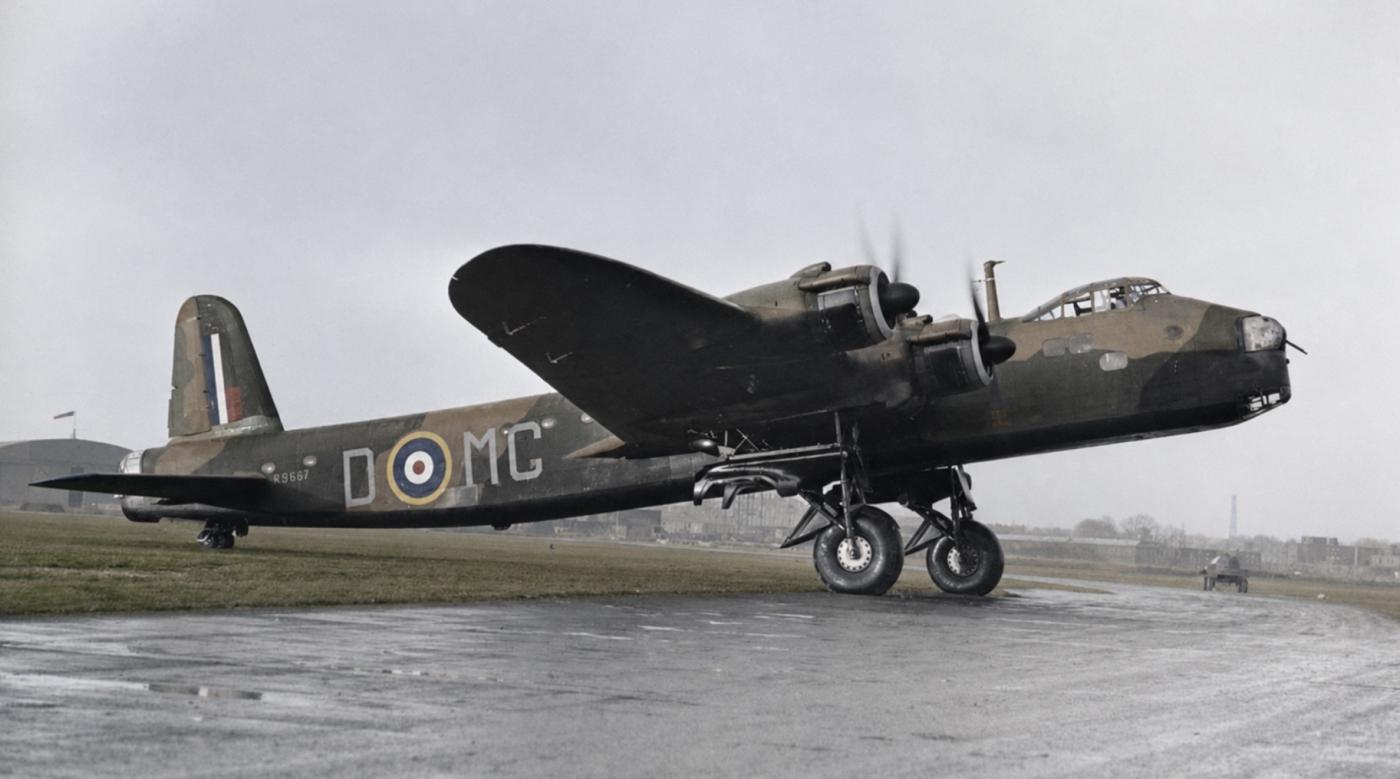
For its time, this was a very large and impressive aircraft. It had a crew of seven and was powered by four Bristol Hercules radial engines. The crew usually included two pilots, a flight engineer, a navigator, a bomb aimer, a wireless operator, and gunners. Defensive machine guns were carried in turrets, including a rear turret, which was especially important because German night fighters often attacked bombers from behind.
Its maximum bomb load was about 14,000 pounds, which was a heavy load for the early years of the war. However, this figure depended on the distance of the mission. On long raids, less could be carried because more fuel was needed. Another problem was the layout of the bomb bay. It was divided into narrow sections, which meant very large single bombs could not be carried. Later in the war, when the RAF began using bigger blast bombs, this became a serious disadvantage compared with the Lancaster.
Even so, the aircraft worked hard in Bomber Command. It flew many dangerous night raids over occupied Europe and Germany. It also took part in minelaying operations, where aircraft dropped sea mines into enemy waters. This was difficult and hazardous work, often carried out at low level and at night. Crews showed great courage, and many badly damaged machines still managed to return home.
One of the interesting things about this bomber is that many pilots liked flying it. Although enormous, it was said to handle well in the air and could be surprisingly manoeuvrable for its size. It was also strongly built, and crews often trusted it to bring them back after heavy damage. Its major weakness was height. It could not fly as high as the Lancaster or Halifax, which made it more vulnerable to anti-aircraft fire and night fighters.
The poor high-altitude performance was mainly caused by the wing design. The wingspan had been limited during development, partly because of official requirements about size and airfield use. This gave the aircraft a shorter, thicker wing than it really needed. The result was good lift and reasonable handling, but weaker performance at altitude. In simple terms, it was strong and powerful, but it could not climb high enough to escape danger as well as later bombers could.
Its undercarriage was also unusual. The aircraft had very long landing gear, giving it a nose-up angle on the ground. This helped with take-off, but it also made the machine look tall and awkward. Landings could be difficult, especially for inexperienced pilots, but once crews became used to it, the type was respected as dependable.
By 1943, it was being moved away from the main bombing role. This was not because it had failed completely, but because better aircraft had arrived. The Lancaster could fly higher, farther, and carry larger bombs. The Halifax was also more adaptable in the main bomber role. As a result, the older heavy bomber was gradually withdrawn from front-line bombing and given other important jobs.
In its later wartime career, it became very useful as a transport and airborne forces aircraft. It was used to drop supplies to resistance fighters in occupied Europe, carry paratroops, and tow large gliders. The Mk IV version was especially important as a glider tug. It could tow Horsa and Hamilcar gliders, which carried troops, jeeps, guns, and other equipment into battle. In this role, the aircraft helped support major Allied airborne operations.
It also served in special operations, dropping agents, weapons, and supplies into enemy-occupied territory. These missions were often flown at night and required great skill. Crews had to navigate carefully, fly low, and drop their loads accurately, often into small fields marked by resistance groups on the ground. Although no longer the RAF’s best heavy bomber, it remained extremely useful.
After the war, the type quickly disappeared from service. It had been designed for wartime needs and was soon replaced by better transport aircraft. Very few parts survived, and no complete original example exists today. This is one reason why it is not as famous as the Lancaster, which can still be seen in museums and flying displays.
The Short Stirling was not perfect, but it played an important part in Britain’s wartime air effort. It was the RAF’s first four-engined heavy bomber of the Second World War and helped bridge the gap between older twin-engined bombers and the later, more famous heavy bombers. It carried heavy loads, endured dangerous missions, and served in several different roles. Its crews faced great danger, especially during the early years of the bomber offensive, when losses were high and bombing methods were still developing.