Russian KV-1 Tank
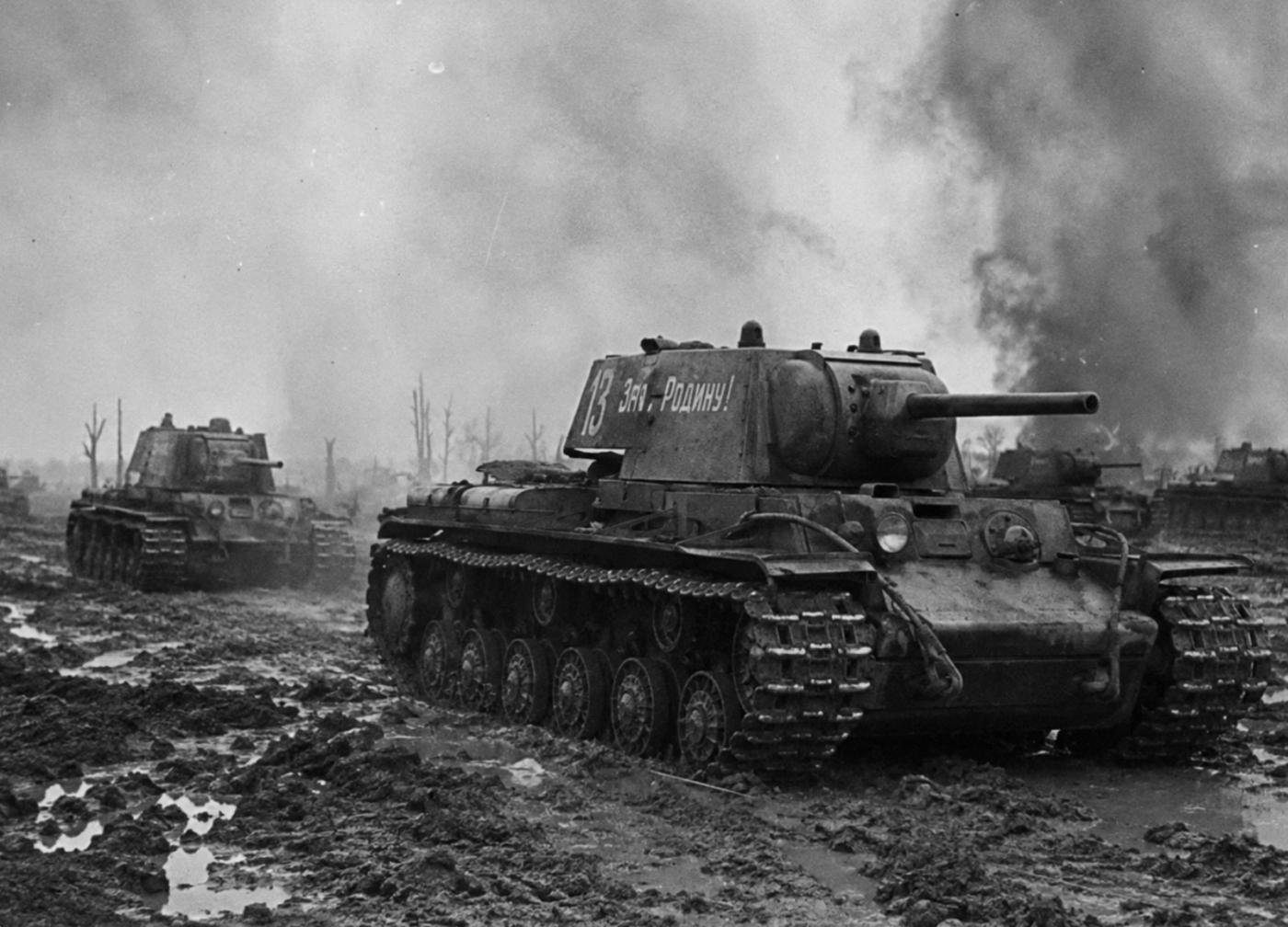
The Russian KV-1 was one of the most important heavy tanks of the Second World War, especially during the early years of the German invasion of the Soviet Union. It was not the fastest tank, and it was not always the easiest machine to operate, but when it first appeared on the battlefield it came as a nasty shock to the Germans. Its thick armour made it almost immune to many of the anti-tank guns and tank guns that Germany was using in 1941, and for a time it gave the Red Army a heavy tank that could take punishment which would have destroyed most other vehicles.
The name KV stood for Kliment Voroshilov, a senior Soviet military and political figure. Like many Soviet tanks of the period, it was named for a prominent Communist leader. The design was developed in the late 1930s at the Kirov Plant in Leningrad, with the team led by Zh. Ya. Kotin, one of the Soviet Union’s most important tank designers. Kotin and his engineers were working at a time when Soviet tank design was changing quickly. The earlier Soviet heavy tanks, especially the huge multi-turreted T-35, had looked impressive but were slow, complicated, and not very practical. The lessons from the Spanish Civil War and Soviet experience in border fighting showed that tanks needed strong armour, reliable engines, and a useful main gun, rather than several turrets and a large crew.
This new heavy tank grew out of that change in thinking. Instead of a massive multi-turreted vehicle, it was a single-turret design with very thick armour and a 76.2 mm gun. This made it far more modern than earlier Soviet heavy tank ideas. Prototypes were tested during the Winter War against Finland in 1939 and 1940. The fighting in Finland showed the value of heavy armour, especially when attacking fortified positions, but it also exposed problems with mobility and mechanical reliability. Even so, the Soviet authorities saw great promise in the design, and it was approved for production.
The main manufacturer at first was the Kirov Plant in Leningrad. After the German invasion of the Soviet Union in 1941 and the threat to Leningrad, production was shifted and expanded. The Chelyabinsk Tractor Plant in the Urals became especially important. This huge industrial centre was later nicknamed Tankograd, or “Tank City”, because of the enormous number of tanks and armoured vehicles produced there. The vehicle was also connected with other Soviet factories and supply networks, but the Kirov Plant and Chelyabinsk were the most closely associated with it.
Around 5,200 examples were produced between 1940 and 1943, depending on how different versions and related variants are counted. This was a large number for a heavy tank, though much smaller than the production numbers of the T-34 medium tank. The T-34 became the main Soviet tank of the war, while this heavier machine filled the role of a breakthrough tank. Its job was to smash through strong defences, absorb enemy fire, and support infantry and other armoured units.
The great strength of the tank was its armour. Early models had protection up to about 75 mm thick, which was extremely heavy for the time. Later versions had even more armour in places, and some were fitted with additional armour plates. Its protection was not just thick on the front; it had strong side armour too, which made it hard to knock out from many angles. In 1941, many German 37 mm anti-tank guns were almost useless against it. German crews nicknamed their 37 mm gun the “door knocker” because it could hit the tank and make noise but often failed to penetrate.
This gave the vehicle a fearsome reputation. There were cases in 1941 where a single tank of this type held up German advances for hours, or even longer, because the attackers lacked weapons powerful enough to destroy it quickly. The famous German 88 mm anti-aircraft gun, used in an anti-tank role, became one of the most reliable ways to deal with heavily armoured Soviet tanks of this kind. Heavy artillery, close-range attacks, mines, and attacks on the tracks or rear were also used. It was not invincible, but during the opening stages of Operation Barbarossa it was one of the few Soviet tanks that could genuinely outclass much of the German armour it faced.
The main gun was usually a 76.2 mm weapon. Early vehicles carried the L-11 gun, but later production tanks used improved weapons such as the F-32 and then the ZiS-5. The 76.2 mm gun was a useful all-round weapon. It could fire armour-piercing shells against enemy tanks and high-explosive shells against infantry, anti-tank guns, buildings, and field positions. Against German tanks in 1941 and much of 1942, the gun was quite effective. German Panzer III and early Panzer IV tanks had much thinner armour than they would later receive, so the Soviet heavy tank’s gun could deal with them at normal combat ranges.
However, its firepower was not as impressive as its armour. The gun was similar in calibre to that of the T-34, meaning that this heavy vehicle was much larger and heavier than the T-34 but did not always carry a more powerful weapon. This became one of the major criticisms of the design. As German tanks improved, with thicker armour and better guns, the 76.2 mm gun began to feel less powerful for a heavy tank. Such a vehicle was expected to have either much stronger protection, much stronger firepower, or ideally both. In this case, the armour was excellent, but the gun was not a dramatic step above medium tanks.
The tank also carried machine guns, usually 7.62 mm DT machine guns. These were fitted in different positions depending on the version, commonly including a coaxial machine gun beside the main gun, a hull machine gun, and sometimes a rear-facing turret machine gun. These weapons were important for defending against infantry, especially soldiers trying to get close with explosives, grenades, or anti-tank weapons. Soviet tank crews often had to fight in confused and close conditions, so machine guns were an essential part of the armament.
The crew normally consisted of five men. These were the commander, gunner, loader, driver, and radio operator or hull machine gunner. This was better than some earlier Soviet tank designs, because the commander was not forced to do every job inside the turret. Even so, visibility was poor, and Soviet tank commanders often struggled to see what was happening around them. This was a common weakness in many Soviet tanks of the early war period. A vehicle with thick armour and a good gun could still be at a disadvantage if the crew could not easily spot enemies, communicate, or react quickly.
In terms of accuracy, the gun was reasonably effective when properly maintained and handled by a trained crew, but battlefield accuracy depended on many things. The optics were not as good as the best German sights, and Soviet crew training in the early war was often rushed. Many Soviet tanks were lost not because the basic design was useless, but because crews lacked experience, communications were poor, and units were thrown into battle during desperate conditions. The gun could hit and destroy enemy tanks, but German crews often had better tactical coordination, better radio communication, and more experience in 1941.
The vehicle used a diesel engine, usually the V-2K, a version of the famous Soviet V-2 diesel engine family. This engine produced around 600 horsepower. On paper this gave reasonable performance for such a heavy machine, but in reality it often suffered from mechanical problems. Its transmission was a major weakness. Drivers found it heavy and difficult to operate, and breakdowns were common. The tank was also very heavy, weighing roughly 45 tons, and this caused problems with bridges, roads, mud, and recovery if it broke down or became stuck.
It was not a fast tank. Its road speed was roughly around 35 km/h, though in real conditions it was often slower. Cross-country movement could be difficult, especially in mud, snow, or broken ground. The heavy weight gave it good protection but reduced its mobility and reliability. This was one of the great trade-offs in tank design. The vehicle could survive hits that would destroy lighter tanks, but it could also be left behind if it broke down or could not keep up with a moving battle.
There were several versions. Early production models were followed by improved and modified variants, including tanks with different guns, turrets, armour arrangements, and cast or welded turret designs. Some later machines became very heavy because extra armour was added. This made them tougher but also worsened the mechanical strain. Eventually the Soviets realised that simply adding more armour was not enough. The tank needed to be more practical, easier to build, and easier to move.
One important version was the KV-1S. The “S” stood for skorostnoy, meaning “fast”. This model was introduced to improve mobility and reliability. It had reduced armour compared with the heaviest versions, a redesigned hull and turret, and better driving characteristics. It was lighter and more manageable, but it also lost some of the massive protection that had made the early model so famous. The KV-1S was a useful step, but by then Soviet tank thinking was moving toward newer heavy tanks with better firepower.
The same chassis was also used for other armoured vehicles. One of the most famous was the KV-2, a massive assault tank with a huge box-like turret and a 152 mm howitzer. The KV-2 was designed to destroy bunkers and fortified positions, but it was tall, slow, and mechanically troublesome. The wider KV family helped lead to later Soviet heavy tanks, especially the IS series, named after Joseph Stalin. The IS-2, with its powerful 122 mm gun, became a far more dangerous heavy tank later in the war and was better suited to fighting improved German armour.
Its battlefield record was mixed but important. In 1941 it was one of the few Soviet tanks that genuinely frightened German soldiers. Its armour could make it extremely hard to destroy, and there are many accounts of German anti-tank rounds bouncing off the hull and turret. In defensive fighting, a well-placed example could be a serious obstacle. In offensive operations, it could support infantry and absorb fire that would otherwise stop lighter vehicles.
At the same time, the design suffered badly from poor reliability, weak transmission, limited visibility, and the chaos of the early war. Many were abandoned because they broke down, ran out of fuel, became stuck, or could not be recovered. The Germans captured some examples and used them themselves, usually after repairing or modifying them. Captured tanks were sometimes fitted with German equipment and markings, though they were never common in German service.
Another problem was production cost and efficiency. The vehicle was expensive and used a lot of materials and factory effort. The T-34, though not perfect, was cheaper, faster, more mobile, and easier to produce in huge numbers. Since the heavy tank’s gun was not much more powerful than the T-34’s, Soviet planners increasingly questioned whether it was worth the extra cost and weight. By 1943, the design was becoming outdated. German tanks such as the later Panzer IV, Tiger, and Panther had changed the balance of armoured warfare. The Soviets needed heavy tanks with stronger guns, not just thicker armour.
This Soviet heavy tank remains one of the most interesting armoured vehicles of the Second World War because it arrived at a turning point in tank design. It proved that heavy armour could dominate a battlefield if the enemy was not prepared for it. It also showed that armour alone was not enough. A tank also needed good mobility, reliable mechanical parts, good optics, good crew layout, and a gun powerful enough to stay useful as enemy tanks improved.
For the Red Army in 1941, it was both a blessing and a problem. It was strong enough to terrify German anti-tank crews, but difficult enough to maintain that many were lost without being knocked out in combat. It was a powerful symbol of Soviet engineering: rugged, heavily armoured, and built for brutal warfare, but also rough, heavy, and mechanically demanding.