Polish Airborne Helmet
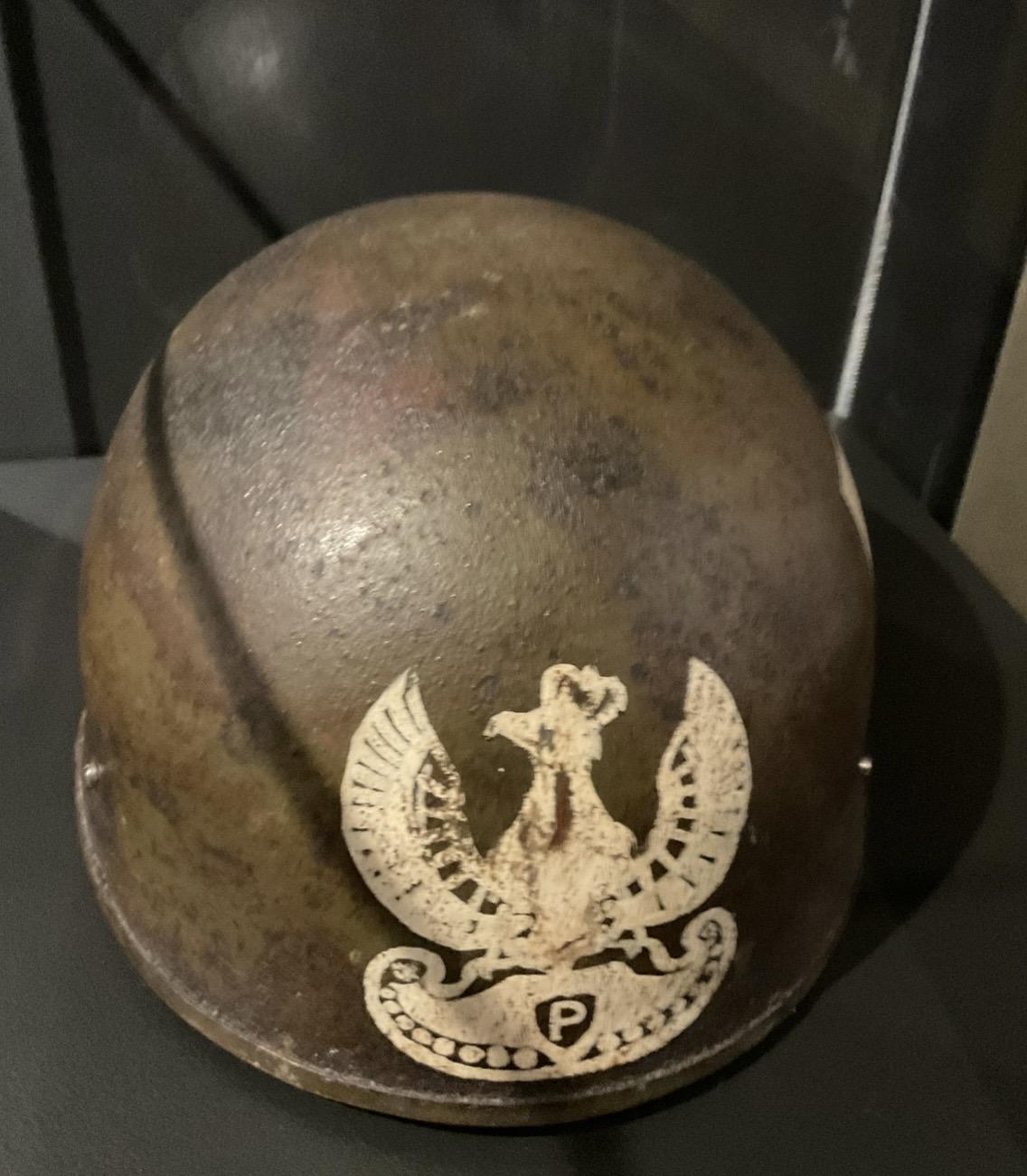
The helmet shown here is a British airborne helmet of the Second World War, used by Polish airborne troops and marked with their own Polish insignia. The steel helmet itself was British issue, but the eagle painted on the front made it unmistakably Polish. That combination is what makes it such an interesting piece: it was British-made equipment worn by a Polish formation that fought alongside the British Army, yet remained a separate Polish unit with its own identity, command and traditions.
The helmet is the type developed for British parachute and airborne troops. Ordinary British infantry helmets, such as the familiar Mk II steel helmet, were not well suited to parachuting. Their broad brim and simple chinstrap were acceptable for ground troops, but they were awkward for men jumping from aircraft. A paratrooper needed a helmet that sat close to the head, stayed secure during the jump, and gave protection during a hard landing. For that reason the British developed a special airborne helmet, commonly known as the Helmet, Steel, Airborne Troops, or HSAT.
This airborne helmet had a rounded, compact shell with no wide brim, making it more practical for parachute use. It was fitted with a stronger liner and a more secure chinstrap than the ordinary infantry helmet. Early British airborne helmets were produced in very small numbers, including the rare early “P Type”, before later wartime patterns were manufactured in larger quantities. The basic idea was influenced by the needs of parachute warfare and by the appearance of other airborne helmets already in use, including the German paratrooper helmet, though the British version was a distinct British design.
The Polish paratroopers did not design their own separate helmet. Instead, like many Allied troops training in Britain, they were equipped from British stores. They wore British battledress, British airborne smocks, British webbing and British airborne helmets. What made their equipment different was the addition of Polish insignia. On this helmet the Polish eagle has been painted or stencilled onto the front of the shell. It is this insignia that turns a British airborne helmet into a Polish airborne helmet in historical terms.
The eagle is based on the Polish White Eagle, the national symbol of Poland. On helmets it was usually simplified into a stencil form so that it could be painted onto the curved steel surface. Because of this, surviving examples often look uneven, worn or slightly crude rather than like a neat factory-made badge. The paint on this example appears pale, possibly white or aged cream, though Polish airborne helmet eagles are also seen in yellowish tones. Wear, age, dirt and lighting can all change how the colour appears today.
The small “P” at the bottom of the insignia links the helmet to the Polish airborne troops. The eagle was not merely decoration. It announced that the man wearing the helmet was Polish. This mattered greatly. These soldiers were using British equipment and operating under Allied command, but they were not British soldiers and were not simply absorbed into British regiments. They belonged to a separate Polish formation: the 1st Independent Polish Parachute Brigade.
The 1st Independent Polish Parachute Brigade was formed in Scotland in 1941 under the command of Stanisław Sosabowski. Its men were Polish soldiers in exile. Some had escaped from occupied Poland, others had fought in France in 1940 and reached Britain after the fall of France, and others arrived by different routes after Poland had been overrun. They trained in Britain as airborne troops, using British facilities and British equipment, but the brigade itself remained Polish.
This independence is one of the most important parts of the story. The Polish brigade was not a British parachute regiment with Polish volunteers mixed into it. It was a Polish unit in its own right. It had Polish officers, Polish ranks, Polish insignia and Polish national purpose. The British supplied and supported it, and in operations it came under Allied command, but its identity remained Polish. The helmet reflects that arrangement perfectly: British shell, Polish eagle.
The brigade was created with a special aim. Its original purpose was to be dropped into occupied Poland to support a future uprising against German occupation. The men trained with the hope that they would return to their homeland by parachute. Their motto, “Najkrótszą drogą,” means “by the shortest way.” For Polish soldiers stranded in Britain while their country was occupied, this phrase carried deep meaning. The parachute was imagined as the shortest route back to Poland.
By 1944 the brigade numbered roughly 2,200 to 2,300 men. It was a complete airborne brigade, not just a symbolic detachment. It included parachute battalions, headquarters troops, engineers, signals, medical personnel, anti-tank elements and supporting services. Its size was modest compared with a full division, but it was a serious fighting formation. Its men were highly trained and had a strong sense of national mission.
The brigade’s best-known battle was Operation Market Garden in September 1944. Instead of being sent to Poland, Sosabowski’s brigade was committed to the Allied airborne operation in the Netherlands. The plan was to seize bridges leading towards Germany, including the bridge at Arnhem. The British 1st Airborne Division landed first, while the Polish brigade was intended to reinforce the battle. Bad weather and transport problems delayed the Polish drop, and by the time the Poles landed near Driel on 21 September 1944, the British airborne troops north of the Rhine were already in serious danger.
The Polish paratroopers fought from the south side of the Rhine and tried to cross the river to support the British at Oosterbeek. The attempt was extremely difficult. There were too few boats, the river was wide and dangerous, and German fire made the crossing costly. Some Polish troops managed to get across, while others helped hold positions around Driel and later covered the withdrawal of British airborne survivors. The brigade suffered heavy casualties during the operation.
The fighting at Arnhem and Driel gave the Polish brigade a lasting place in airborne history. Sosabowski had warned that the plan was risky, and after the failure of Market Garden he and his men were unfairly criticised by some British commanders. Later judgement has been kinder. The courage and difficulty of the Polish role are now widely recognised, and the brigade is remembered with honour in the Netherlands and among airborne veterans.