Piper Bill Millin
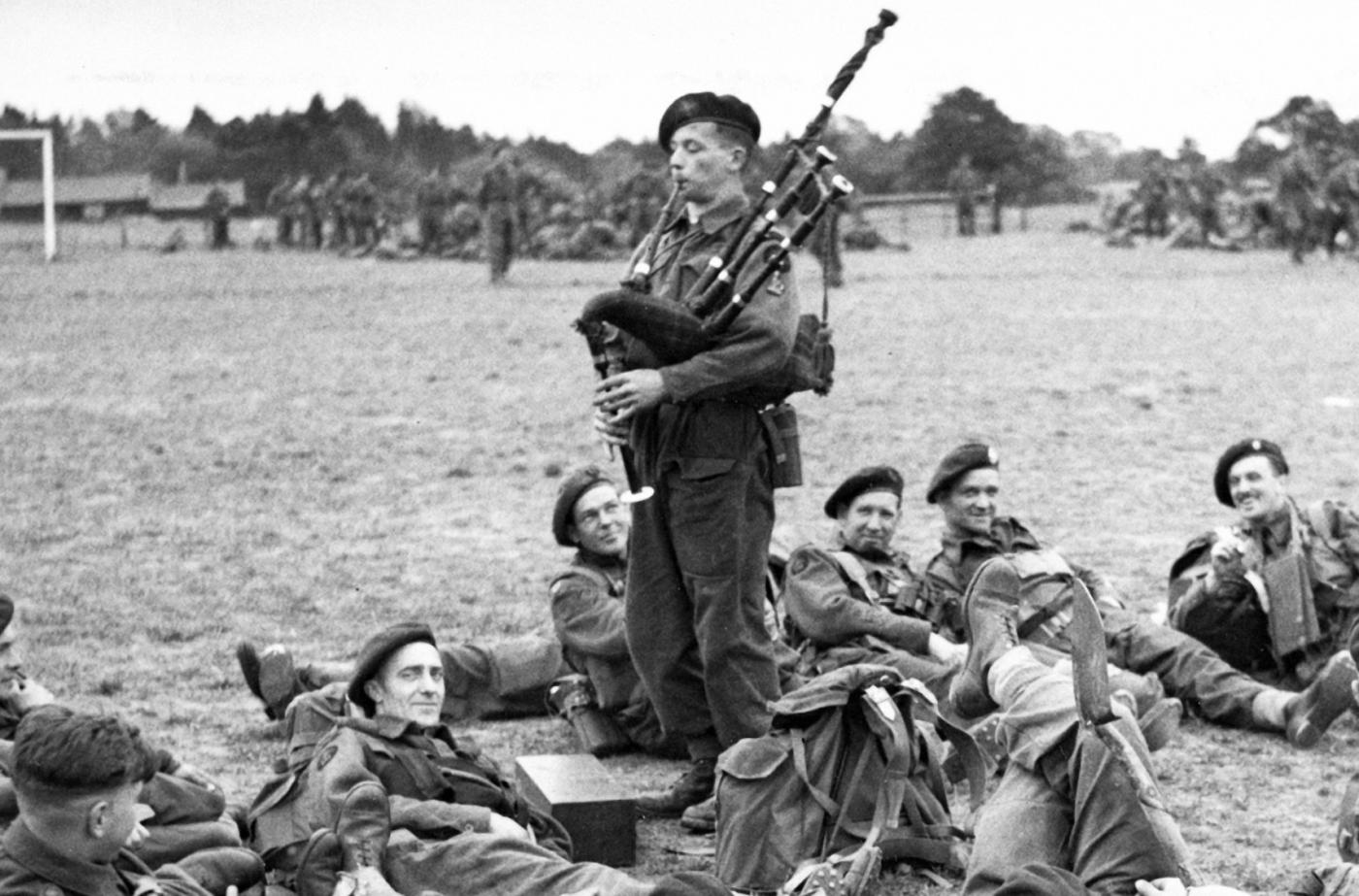
Among the many extraordinary figures who passed into legend on D-Day, few are as unforgettable as Private William “Bill” Millin, the young commando piper who walked ashore on Sword Beach playing the bagpipes while men around him were being shot, shells were bursting, and the largest seaborne invasion in history was unfolding. He became known to many as “Piper Bill” and, in folklore, as the “Mad Piper of D-Day”. The nickname was not official, but it captured the strange, brave, almost impossible image of a lone piper in Highland dress, armed not with a rifle but with pipes, stepping into the chaos of Normandy.
He was born on 14 July 1922 in Regina, Saskatchewan, Canada, to Scottish parents. His family returned to Scotland when he was still a small child, and he grew up in Glasgow. Like many young Scots of his generation, he learned the bagpipes early and became steeped in the musical traditions of the Highland regiments. Before the Normandy landings, he served in pipe bands connected with the Highland Light Infantry and the Queen’s Own Cameron Highlanders. He later volunteered for commando service and trained at Achnacarry in the Scottish Highlands, the famous commando training centre where men were hardened for raids, amphibious assaults, and close fighting.
It was there that he came under the command of Simon Fraser, the 15th Lord Lovat, a Scottish aristocrat, commando leader, and one of the more colourful British officers of the war. Lovat commanded the 1st Special Service Brigade, a force that included British commandos and Royal Marines. He understood theatre, morale, and symbolism, and chose the young piper as his personal musician. That role may sound ceremonial, but on D-Day it became something far more dangerous.
By the Second World War, British Army regulations had restricted the use of pipers in battle. The old image of pipers leading soldiers forward under fire belonged more to earlier wars, and the modern battlefield of machine guns, mortars, mines, and artillery made such traditions seem suicidal. When Lord Lovat ordered him to play during the landings, the piper is said to have reminded him that War Office regulations no longer allowed pipers to play in front-line action. Lovat’s famous answer, often repeated in accounts of the story, was that those were English War Office rules, and that as Scotsmen the rule did not apply to them. Whether spoken exactly as remembered or polished by retelling, the line fits both men perfectly: Lovat as the eccentric commander, and the young private as the obedient soldier being asked to do something almost absurdly dangerous.
On 6 June 1944, he landed with Lovat’s commandos on Sword Beach, the easternmost of the five Allied landing beaches in Normandy. Sword was assaulted mainly by British forces, and the task of Lovat’s commandos was to push inland and link up with the airborne troops who had seized the bridges over the Caen Canal and River Orne, including the bridge that became famous as Pegasus Bridge. He came ashore in a kilt of Cameron tartan, said to be the same tartan his father had worn during the First World War. He carried his bagpipes and a traditional Highland dirk, but no rifle.
The picture is almost unbelievable. Men were wading through water, stumbling over obstacles, struggling under the weight of equipment, and trying to get off the exposed beach before German fire found them. Landing craft were coming in, vehicles were moving, wounded men were calling out, and shells and bullets were cutting across the sand. In the middle of that, the pipes began to play.
The tunes most often associated with him on Sword Beach include “Highland Laddie” and “The Road to the Isles”. Some accounts also mention “All the Blue Bonnets Are Over the Border”. The music carried across the beach in a way few other instruments could have done. To some men it must have seemed surreal; to others, magnificent. It reminded British troops of home, of Scotland, of regimental tradition, and of the older martial spirit that the pipes had represented for generations. In the terror of the landing, the sound gave men something human, familiar, and defiant to cling to.
He later recalled that his comrades cheered and waved when they heard him, though not everyone was pleased. One version of the story has a soldier shouting at him to get down because he was attracting fire. That reaction is entirely understandable. On a battlefield, a man standing upright and playing music appears to be inviting death not only for himself but perhaps for those around him. Yet he continued, because Lord Lovat had ordered him to do so, and because the duty of a piper was to play.
The most famous piece of folklore surrounding the story is the claim that German soldiers did not shoot him because they thought he had gone mad. The tale has usually been told with captured German snipers or machine-gunners later being asked why they had not killed the piper. Their supposed answer was that they thought he was insane, or that they could not bring themselves to shoot a man who was clearly mad. It is a wonderful story, and it helped create the nickname “Mad Piper”. It should be treated as folklore rather than a proven military record, because it is difficult to verify exactly who said it and when. Still, the tale is closely associated with his later recollections, and it has become part of his legend. Whether or not every word is literally true, it captures the astonishing strangeness of what the Germans may have seen: a kilted piper calmly walking through smoke and fire as if the invasion beach were a parade ground.
His day did not end on the sand. After landing, Lord Lovat’s commandos pushed inland toward the bridges held by men of the 6th Airborne Division. The airborne troops had landed by glider in the early hours of D-Day and had seized the bridges in one of the most daring operations of the invasion. Lovat’s brigade was meant to relieve them around midday. Famously, Lord Lovat apologised for being late when he arrived, though the exact timing varies in retellings. As the commandos approached and crossed the bridge area, the pipes were heard again, and their sound became part of the memory of the relief of Pegasus Bridge.
The crossing was not ceremonial. The area remained dangerous, and men were killed as the commandos moved over the bridge. The piper survived, but he was not untouched by the experience. He saw wounded men and dead comrades, and in later life he spoke with the restraint common to many veterans who had witnessed extreme violence. His story is often told as a glorious adventure, but it belonged to a day of fear, noise, blood, and loss. The bravery of the man with the pipes should not obscure the cost paid by the men around him.
After D-Day, he continued to serve through the campaign in north-west Europe, including further action after Normandy. The war did not turn him into a professional celebrity. Like many servicemen, he returned to civilian life and built a quiet future. He was demobilised in 1946 and at one stage worked on Lord Lovat’s estate. Later he trained as a psychiatric nurse, a career that says something important about him. After being remembered for one of the most flamboyant acts of battlefield courage in the war, he spent much of his working life caring for people in mental distress. He worked in Scotland and later in Devon, where he settled.
He married Margaret, who was from Edinburgh, and they had a son, John. In Devon he became associated with Dawlish, and in time his D-Day pipes, kilt, bonnet, and dirk became treasured objects of remembrance. There has been some discussion over which set of pipes was used at which stage of the campaign, because one set is associated with Dawlish Museum and another with the Pegasus Bridge museum in Normandy. The important point is that his instruments and uniform items became physical links to one of the most memorable moments of the Normandy landings.
His fame grew partly because of the 1962 film “The Longest Day”, which dramatized the D-Day landings and included the figure of Lord Lovat’s piper. The film helped fix the image in popular memory: the pipes sounding as commandos march through battle. The real man did not seek to become a myth, but he became one all the same. Veterans remembered him, historians wrote about him, and the public embraced the story because it seemed to contain so much of what people associate with D-Day: courage, eccentricity, tradition, terror, and defiance.
In later years he returned to Normandy for commemorations. He was honoured in France, and in 2009 received the Légion d’honneur, one of France’s highest distinctions, in recognition of his wartime service. By then he was an elderly man, but the sight and sound of the pipes still connected him to the young private who had stepped from a landing craft into history.
He died in Torbay, Devon, in August 2010, aged 88. His wife Margaret had died before him, and he was survived by his son John. After his death, tributes described him as brave, modest, and unforgettable. In 2013, a life-size bronze statue of him was unveiled at Colleville-Montgomery, close to Sword Beach. The statue shows him as he is remembered: kilted, standing with his pipes, facing the shore where he had once played under fire. It is not a statue of a general or a statesman, but of a private soldier whose courage took an unusual form.
The legend endures because it sounds almost impossible, yet the heart of it is true. A young piper really did land on Sword Beach with Lord Lovat’s commandos. He really did play the bagpipes during the invasion. He really did wear Highland dress when almost everyone else was dressed for modern war. He really did survive. Around those facts grew the folklore of the Germans who would not shoot him because they thought he was mad. That story may never be fully provable in every detail, but it belongs to the larger truth of the day: on 6 June 1944, amid one of history’s most violent military operations, music sounded where no one expected music to survive.
He was not mad. He was afraid, as any sane man would have been. But he was disciplined, loyal, and brave enough to do what he had been ordered to do.