P-47 Thunderbolt
The Republic Thunderbolt became one of America’s most powerful and rugged fighter aircraft of the Second World War, a huge single-seat machine that earned a reputation for strength, firepower and survival. It was not slim and graceful like a Spitfire or Mustang, and beside many other fighters it looked almost oversized, but its size was part of its character. It could fight at high altitude, dive at tremendous speed, escort bombers, attack ground targets and bring pilots home after damage that would have destroyed lighter aircraft.
The Thunderbolt was designed by Alexander Kartveli, a Georgian-born aircraft designer working for Republic Aviation in the United States. Kartveli had already worked on earlier Seversky and Republic fighters, but this new aircraft was far more ambitious. Reports from the air war in Europe showed that a modern fighter needed more power, more armour, heavier firepower and better high-altitude performance. His answer was to build the aircraft around the massive Pratt & Whitney R-2800 Double Wasp radial engine, an 18-cylinder air-cooled engine producing around 2,000 horsepower in many wartime versions. A large turbo-supercharger system helped the aircraft perform well in the thin air where bomber escort battles were fought.
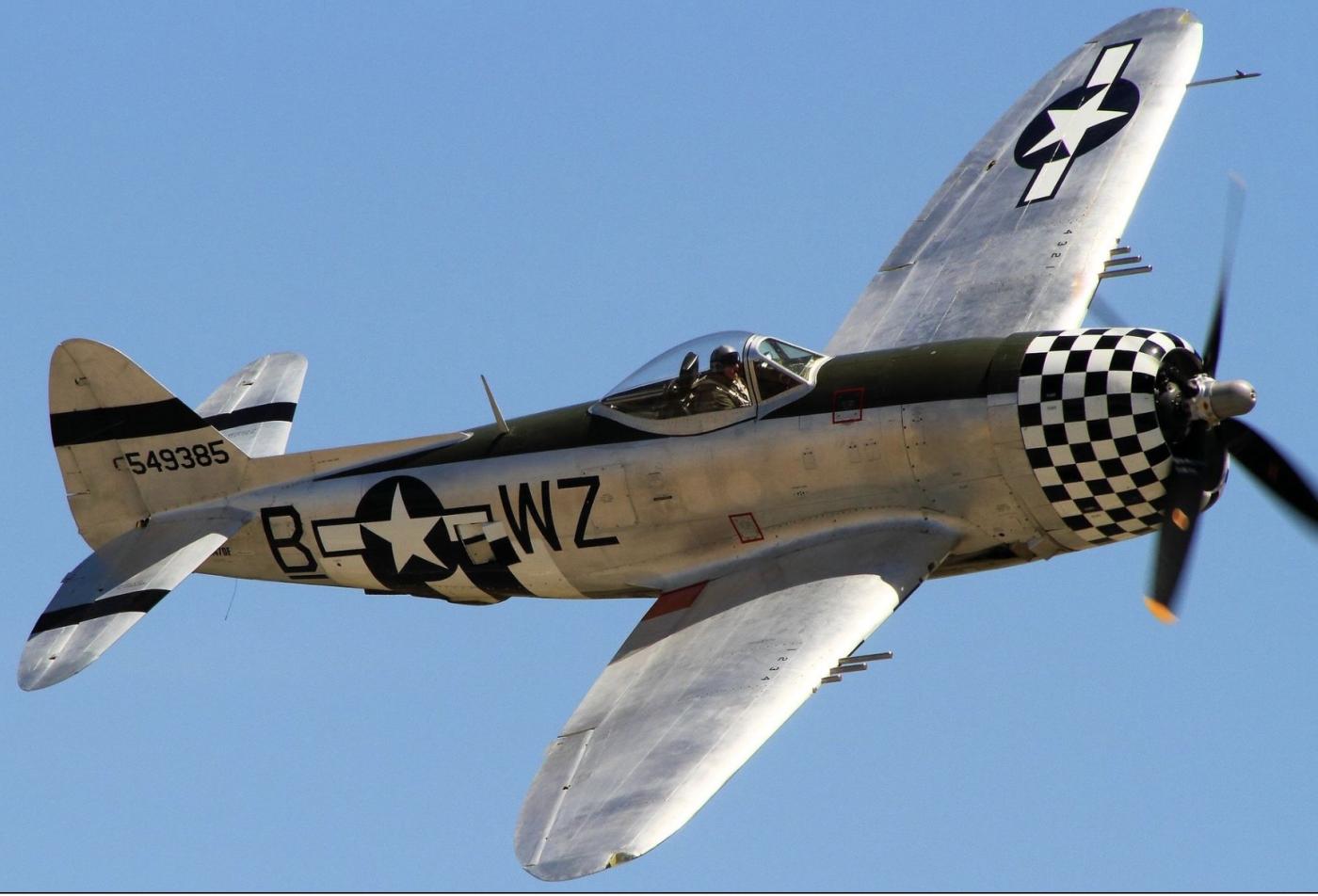
The result was one of the largest single-engined fighters of the war. Fully loaded, it could weigh as much as some twin-engined aircraft. Early versions had the “razorback” fuselage, with a raised spine behind the cockpit, while later models introduced the famous bubble canopy, giving the pilot much better all-round vision. That bubble-top shape became one of the best-known outlines of the Thunderbolt.
It was built mainly by Republic Aviation at Farmingdale, New York, and Evansville, Indiana, with a smaller number produced by Curtiss under licence as the P-47G. In total, about 15,683 were built, making it one of the most produced American fighters of the war. It served with the United States Army Air Forces and was also supplied to other Allied nations, including Britain, France, Brazil, Mexico and the Soviet Union.
Its firepower was formidable. The standard armament was eight .50 calibre Browning M2 machine guns, four in each wing. This gave the pilot a devastating weight of fire, useful against enemy fighters, bombers, vehicles, trains, flak positions and airfields. The aircraft also carried a generous ammunition supply, often around 3,400 rounds in total, allowing longer firing time than many fighters armed with cannon but fewer shells.
Although first used as a high-altitude escort fighter, the Thunderbolt became especially famous as a fighter-bomber. As the war progressed, particularly after the P-51 Mustang took over more of the long-range escort role, the Thunderbolt was increasingly used for ground attack. It could carry bombs, drop tanks and rockets. Typical loads included 500 lb bombs, and later versions could carry up to about 2,500 lb of external ordnance in some arrangements. It could also fire 5-inch rockets against vehicles, bridges, strongpoints and railway targets. With eight machine guns, bombs and rockets, it became a flying sledgehammer.
Its range varied by model and load. Early versions had limited reach for deep bomber escort work, which was one reason the Mustang later became so important. With improved fuel capacity and external tanks, later Thunderbolts became far more useful. A typical P-47D had a range of roughly 800 miles on internal fuel, while ferry range with drop tanks could reach around 1,800 miles. In combat, range depended on altitude, throttle setting, fuel tanks, weapons carried and whether the pilot had to fight.
The aircraft was fast for its size. Many versions could exceed 420 mph at altitude, and the later P-47M was faster still, used late in the war to chase V-1 flying bombs and fast German aircraft. It was especially strong in a dive. Pilots learned that if they were in trouble, they could often push the nose down and use the aircraft’s weight and strength to escape. It was not as nimble in a low-speed turning fight as lighter fighters, but when flown with speed, height and diving attacks, it was extremely dangerous.
One of its most admired qualities was toughness. The big air-cooled radial engine had no vulnerable liquid-cooling system like those used in many inline-engined fighters. A bullet through a radiator could doom a liquid-cooled aircraft, but the Thunderbolt could often keep flying despite serious damage. There are many accounts of aircraft returning with cylinders shot away, wings full of holes, tail surfaces damaged and large sections of skin torn open. Pilots trusted it because it gave them a better chance of survival.
The cockpit was roomy compared with many fighters, and crews often joked about the aircraft’s size. Its nickname was “Jug,” possibly from “Juggernaut” or from the rounded shape of the fuselage. Whatever the origin, the name suited it. The Jug was heavy, powerful and hard-hitting. It demanded respect on take-off and landing, but once mastered it gave pilots confidence.
The Thunderbolt served in several theatres, but it is most closely associated with the air war over Europe. American fighter groups used it to escort B-17 Flying Fortresses and B-24 Liberators during daylight bombing raids. Early on, its range limited how far it could accompany the bombers, but drop tanks improved this. After D-Day in June 1944, it became a vital ground-attack aircraft, striking German trains, road convoys, artillery positions, bridges, fuel dumps and troop concentrations. Its attacks made movement by day extremely dangerous for German forces.
It also served in the Pacific and in the China-Burma-India theatre, though the enormous distances there often favoured longer-ranged aircraft. Britain used Thunderbolts mainly in the Far East, especially for ground attack, while the Soviet Union received some through Lend-Lease, although Soviet air combat usually took place at lower altitudes than the Thunderbolt had originally been designed for.
Several important versions appeared. The early P-47B helped introduce the type, the P-47C improved it, and the P-47D became the main wartime model, produced in huge numbers. Later D models gained the bubble canopy, improved engines, water injection for extra power and stronger fittings for bombs and tanks. The P-47M was a high-speed late-war version, while the P-47N was designed for very long-range operations in the Pacific, with larger wings and greater fuel capacity.
Some of the most successful American fighter pilots flew the Thunderbolt. The 56th Fighter Group of the U.S. Eighth Air Force became especially famous and stayed with the type even when many other units changed to Mustangs. Aces such as Francis “Gabby” Gabreski and Robert S. Johnson proved that, in skilled hands, the Thunderbolt was not only a ground-attack brute but also a deadly air-to-air fighter.
It did have weaknesses. It was heavy, large and not ideal for slow turning combat. Early range was limited, and its climb was not always equal to smaller fighters. But its strengths were remarkable. It was fast, heavily armed, strong in a dive, able to carry heavy weapons and capable of surviving terrible punishment.
By the end of the war, the Thunderbolt had flown hundreds of thousands of sorties. It escorted bombers, fought enemy aircraft, destroyed targets on the ground and helped the Allies dominate the skies over Europe. It was not the most elegant fighter of the war, nor the longest-ranged, but it was one of the toughest and most useful. Designed by Alexander Kartveli and built in great numbers by Republic Aviation, it stood for power, endurance and firepower. For many pilots, it was the aircraft that brought them home. For the enemy below, it was a roaring, diving monster with eight guns, bombs and rockets, and very little mercy.