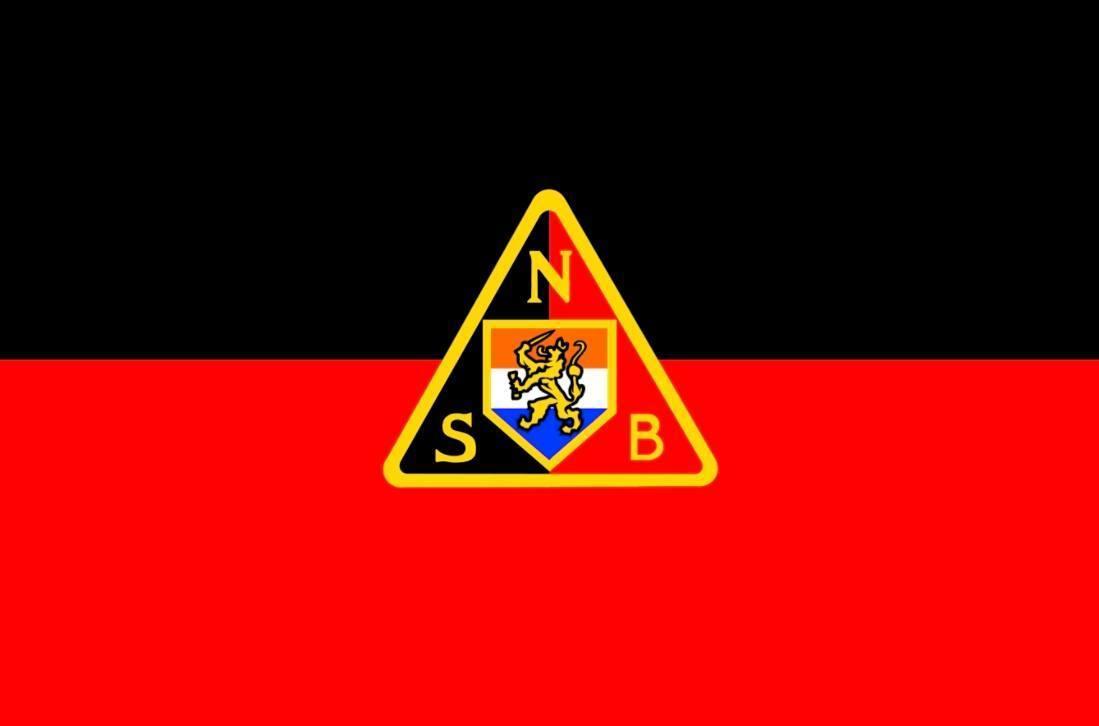
The NSB (National Socialist Movement)
The NSB, the National Socialist Movement, was a Dutch political party that became notorious during the Second World War. It was founded in 1931 by Anton Mussert and Cornelis van Geelkerken. Unlike Mussolini and Hitler, Mussert and Van Geelkerken were not soldiers. Mussert was a civil engineer from Utrecht. Van Geelkerken was a municipal employee.
The NSB rejected the Dutch parliamentary system. It believed that democracy divided the nation into selfish groups. Instead it wanted one strong leader and one national community. The party was fiercely anti-communist. It disliked socialism in its democratic form. It attacked liberalism and the old political parties. Its programme initially consisted mainly of fascist demands that were common at the time:
Strong government
Abolition of individual voting rights
Corporatist socio-economic organisation
An economy serving the national community
Compulsory labour and social security
Restriction of freedom of the press
In the beginning the NSB was not openly as extreme as the German Nazi Party. Even though its programme was similar to parts of the NSDAP programme, it did not start with the same central focus on antisemitism. Some early members even argued that Dutch Jews could belong to the nation. From its founding until 1938, Jews were allowed to become members of the NSB. It is estimated that around 150 Jews held NSB membership in 1935. As Hitler’s Germany became more powerful, the NSB moved closer to Nazi ideology. By October 1938, Jewish members and Jewish activities were banned by the NSB.
The NSB’s greatest electoral success came in 1935. In the provincial elections it won almost eight percent of the vote. That was a shock to many Dutch people. It showed that the movement had become more than a fringe group. Yet the success did not last. The Dutch political establishment and much of society turned against the NSB. Churches, trade unions and political parties warned their members not to join. Civil servants were often forbidden to be members. By 1937, the NSB vote had fallen sharply.
Everything changed in May 1940 when Germany invaded the Netherlands. The Dutch army fought for five days, but was forced to surrender after the Germans bombed Rotterdam and destroyed much of the city centre. They also threatened to do the same to Utrecht, Amsterdam and The Hague. Queen Wilhelmina and the Dutch government left for London. The country was placed under German occupation.
For the NSB this was the moment it had been waiting for. Mussert believed that the Germans would reward his loyalty. He hoped to become the leader of a new Dutch state under German protection. In 1942, Hitler even gave him the title “Leader of the Dutch People”. In practice, however, this title meant little. The Germans never fully trusted Mussert, partly because of ideological differences. Hitler saw the Netherlands mainly as a Germanic territory that should eventually be absorbed into a greater German empire. Mussert imagined a Dutch nation under his own leadership. Nazi officials had little interest in that fantasy. Real power in the occupied Netherlands was held by Arthur Seyss-Inquart, the high-ranking Austrian Nazi official who became Reich Commissioner for the Netherlands.
Still the NSB became the main Dutch collaborationist party. It was the only legal political party during the occupation. Its members were favoured for jobs in local government, propaganda, policing and administration. Some became mayors. Others helped enforce German rules. The party also recruited for German military units. Dutch volunteers joined the Waffen-SS and fought on the Eastern Front. It is estimated that around half of these volunteers were NSB members.
The darkest part of the NSB story is its role in the machinery of occupation and persecution. The Holocaust in the Netherlands was carried out by the German authorities, with help from Dutch institutions and collaborators. More than 100,000 Dutch Jews were murdered. The NSB did not control this process, but it supported the occupier and helped create the climate in which persecution became possible. Its newspapers spread Nazi propaganda. Its members defended anti-Jewish measures. Some took part directly in arrests and betrayal.
In the Netherlands betrayal could even be profitable. Collaborators and so-called Jew hunters were paid bounty money for finding Jews in hiding or handing them over to the authorities. For some, persecution became not only an act of ideology or obedience, but also a way to make money.
As the war turned against Germany, the position of the NSB became more desperate. After the Allied landings in Normandy in June 1944, many Dutch people expected liberation soon. In September 1944, the Dutch government in exile called on railway workers to strike in support of the Allied advance. The Germans responded harshly. The winter that followed became known as the Hunger Winter. In the western Netherlands thousands died from hunger and cold.
During these final months the hatred of the NSB grew. Its members knew that defeat would bring revenge. Some fled with the Germans. Others tried to hide their past. When liberation came in May 1945, many NSB members were arrested. Some were attacked in the streets. Women accused of collaboration had their heads shaved.
Anton Mussert was arrested shortly after the liberation. He had made no serious attempt to flee. In his own mind this fitted the image he had of himself. He did not see himself as a common traitor, but as a patriot who had tried to protect the Netherlands in a German-dominated Europe. In court he argued that he had acted out of love for the fatherland and that collaboration had been the only way to prevent something worse.
This also connected to the tension mentioned earlier in the article. Mussert had clashed with Hitler’s vision for the Netherlands. Hitler saw the country as part of a future Greater Germanic empire. Mussert still imagined a Dutch nation under his own leadership. But this argument did not save him. The judges saw his cooperation with the occupier as high treason. He was sentenced to death and executed by firing squad in 1946.
Cornelis van Geelkerken, the other founder of the NSB, also faced justice after the war. He was arrested and later sentenced to life imprisonment. His sentence was eventually reduced and he was released in 1959. Unlike Mussert, he survived the post-war trials and lived until 1976.
After the war the NSB was banned, but its name remained. In Dutch memory the movement became a lasting symbol of collaboration, betrayal and cowardice. The word “NSB’er”, meaning NSB member, is still used today for someone seen as a traitor, informer or collaborator. Its political power ended in 1945, but the history attached to the name survived.
Credit: Tom Dankers (Historian), Arnhems Oorlogsmuseum 40-45, Netherlands.