Normandy Landings Postponed
The story of D-Day is often told as if it moved forward with a kind of unstoppable certainty, as though the great Allied armada simply gathered in the Channel and then sailed for France exactly as planned. In reality, the whole operation came very close to being postponed for much longer, and the final decision to go was made in the tense atmosphere of a country house in Hampshire, with the weather outside almost as important as the armies, ships and aircraft waiting for the signal.
The invasion of Normandy had originally been planned for Monday 5 June 1944. That was the date chosen for Operation Overlord, the vast Allied assault on Hitler’s Atlantic Wall. The timing was not random. The planners needed a very particular combination of conditions. The landing craft had to cross the English Channel in darkness so they would be harder to spot, but the troops also needed some light when they reached the beaches. The airborne forces needed moonlight so that pilots and paratroopers could find their drop zones. The naval bombardment needed visibility. The engineers needed a low tide, so that the beach obstacles placed by the Germans could be seen and dealt with before the tide covered them again. All these things had to come together at the same time, which meant that only a small number of dates in early June were suitable.
The first possible window was 5, 6 and 7 June. After that, the Allies would have had to wait around two weeks for the tides and moon to come right again. That delay would have been dangerous. Hundreds of thousands of men were already sealed in camps across southern England. Ships were loaded. Landing craft were packed. The whole southern coast had become a military machine waiting to move. Keeping such a huge secret for much longer would have been almost impossible. German intelligence might notice changes in radio traffic, troop movements, shipping patterns or reconnaissance activity. Even the morale of the men could suffer if they were kept waiting too long, crowded together and unable to know when they would go.
The problem was the weather. In the first days of June 1944, the Channel was hit by poor conditions. Strong winds, low cloud, rough seas and bad visibility threatened the whole operation. A landing on the Normandy beaches was already a dangerous business, but trying to land men, tanks, vehicles and supplies through rough surf could turn danger into disaster. Landing craft might be swamped. Soldiers could be sick and exhausted before they even reached the shore. Naval gunfire might be less accurate. Aircraft might not find their targets. Paratroopers could be scattered miles away from where they were meant to land. The invasion depended on thousands of separate pieces working together, and bad weather could pull them apart.
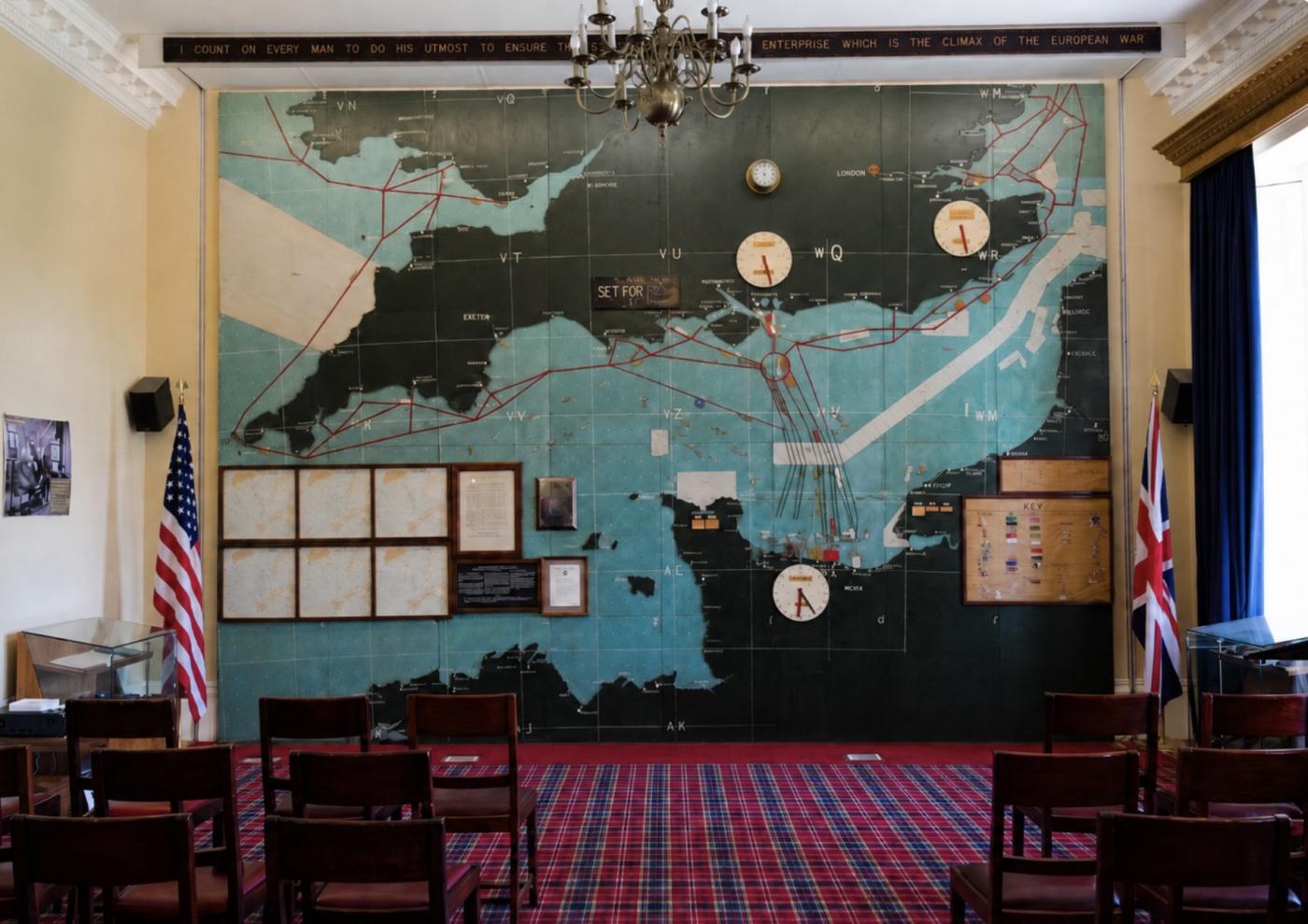
The decision was made at Southwick House, near Portsmouth. This became the advanced headquarters of the Supreme Headquarters Allied Expeditionary Force. It was here that General Dwight D. Eisenhower, the Supreme Allied Commander, gathered with his senior commanders and advisers to decide whether the invasion could go ahead. Southwick House was not a grand battlefield, but one of the most important decisions of the Second World War was made there. Inside its rooms were men carrying the weight of an operation that had taken years to prepare and on which the liberation of Western Europe depended.
Eisenhower was the man who had to make the final decision. Around him were senior figures including Admiral Sir Bertram Ramsay, who commanded the naval side of the invasion, Air Chief Marshal Sir Trafford Leigh-Mallory, who commanded the Allied Expeditionary Air Force, and General Bernard Montgomery, who commanded the ground forces for the initial assault. Each had his own area of responsibility, and each knew what failure might mean. Ramsay had to think about the ships and landing craft. Leigh-Mallory worried especially about the airborne troops and the danger of sending them into bad weather. Montgomery, full of confidence, believed the troops were ready and that the operation must go forward if conditions allowed.
One of the most important men in the room was not a battlefield commander at all. He was Group Captain James Stagg, the chief meteorological officer. Stagg had the uncomfortable duty of telling the commanders what the weather was likely to do. Weather forecasting in 1944 was nothing like it is today. There were no satellites watching storm systems from space. Forecasts had to be built from reports taken from ships, aircraft, land stations and Atlantic observations. Stagg had to interpret incomplete information and then present it to men who had the largest invasion force in history waiting on his words.
The weather forecasts caused a serious argument because not all meteorologists agreed. Some American forecasters were more optimistic at first, while Stagg and his British team were deeply concerned about the storms moving across the Atlantic. On 4 June, with the weather worsening, Stagg warned that conditions for 5 June would be too poor. The Channel would be rough, cloud would interfere with air operations, and visibility would be bad. The invasion could not safely go ahead as planned.
Eisenhower faced an awful choice. If he launched on 5 June and the weather wrecked the landings, the result could be a catastrophe. Men might drown before reaching the beaches. Airborne troops might be lost in confusion. Supplies might fail to arrive. The Germans might be given the chance to push the Allies back into the sea. But if he delayed, the great machinery of Overlord would have to remain hidden and ready, perhaps for another fortnight. Every day increased the risk of discovery. Every day added strain.
The order was therefore given to postpone the invasion from 5 June. This was not a simple matter of telling a few men to wait. Convoys had already begun to move. Some ships were at sea. Orders had to be sent out to turn parts of the force back or hold them in place. The Channel was full of vessels, and the whole operation had to be paused without creating confusion. It was a remarkable achievement in itself that such a vast movement could be delayed and then restarted.
Then came the crucial change. In the early hours of 5 June, Stagg brought new information. A small break in the weather was expected for 6 June. It would not be perfect. The seas would still be rough, the wind would still be troublesome, and conditions would still be far from ideal. But there appeared to be a narrow gap, just enough to give the invasion a chance. After 6 June, the weather was expected to worsen again. This meant that Eisenhower had to decide whether to take a risky opportunity or wait for the next suitable tide and moon.
The meeting at Southwick House was filled with tension. Leigh-Mallory had serious doubts about the airborne operation, fearing heavy losses among paratroopers and glider troops. Ramsay believed the naval forces could manage the crossing if the weather improved enough. Montgomery was eager to go. The men in that room knew that no forecast could guarantee success. They were not being offered certainty, only a chance.
Eisenhower listened to the advice, weighed the risks, and then made the decision. He said words to the effect of, “Okay, let’s go.” With that, the invasion was set for Tuesday 6 June 1944. It was one of the most important command decisions of the war. Eisenhower later wrote a short message accepting full responsibility in case the landings failed. He put it in his pocket. In it, he said that if the operation failed, the fault would be his alone. This small note shows the human side of the decision. Behind the maps, uniforms and grand strategy was one man who knew that thousands of lives depended on his judgement.
The delay from 5 June to 6 June may seem small when looked at from a distance, only twenty-four hours, but it was enormous in practice. It meant that the men already waiting in ships had to endure another day at sea or in cramped conditions. Many were seasick. Some had already been briefed and knew they were going to France. The secrecy was still intense. Letters had been written home but not sent. Chaplains moved among the troops. Officers checked equipment again and again. For many men, the extra day must have felt endless.
The Germans were also affected by the weather, but in a very different way. The poor conditions made many German commanders believe an invasion was unlikely. Field Marshal Erwin Rommel, who had been strengthening the Atlantic Wall, had even gone back to Germany for his wife’s birthday and to meet Hitler, partly because the weather seemed to make an immediate landing improbable. Other German officers were away from their posts or less alert than they might have been in perfect invasion weather. The storm that nearly stopped the Allies also helped to disguise them.
This is one of the great ironies of D-Day. The weather was bad enough to force a delay, but not bad enough to stop the invasion completely. At the same time, it was bad enough to make the Germans less ready. The Allies took the risk of moving in conditions that were barely acceptable, while the Germans judged those same conditions too poor for an invasion. That narrow difference helped shape history.
When the invasion fleet finally crossed the Channel on the night of 5–6 June, it was still a rough passage. Many soldiers were sick. Landing craft pitched and rolled. Equipment was soaked. Some units landed in the wrong places. The airborne drops were scattered in several areas. Nothing about the operation was clean or easy. Yet the delay had given the Allies the one chance they needed. By the end of 6 June, despite terrible losses on beaches such as Omaha, Allied forces had gained a foothold in Normandy.
The decision made at Southwick House was therefore not simply a matter of choosing a date. It was a gamble based on weather, tide, moonlight, secrecy, morale and military judgement. It showed how even the largest operation in history could depend on a weather forecast and a commander willing to carry the burden of responsibility. D-Day was delayed because nature refused to obey the timetable of war, but it was not abandoned because a brief break in the storm appeared at exactly the right moment.
Had Eisenhower chosen differently, the history of the war might have changed. A landing on 5 June could have been a disaster. A delay of two weeks might have given the Germans more warning or allowed them to strengthen their defences. But on 6 June 1944, the Allies took their chance. The great armada sailed, the paratroopers flew, and the men who had waited through the delay finally went ashore in Normandy. That one-day postponement is a reminder that history is not only made by generals and armies, but also by weather, timing, nerve and the lonely responsibility of decision.