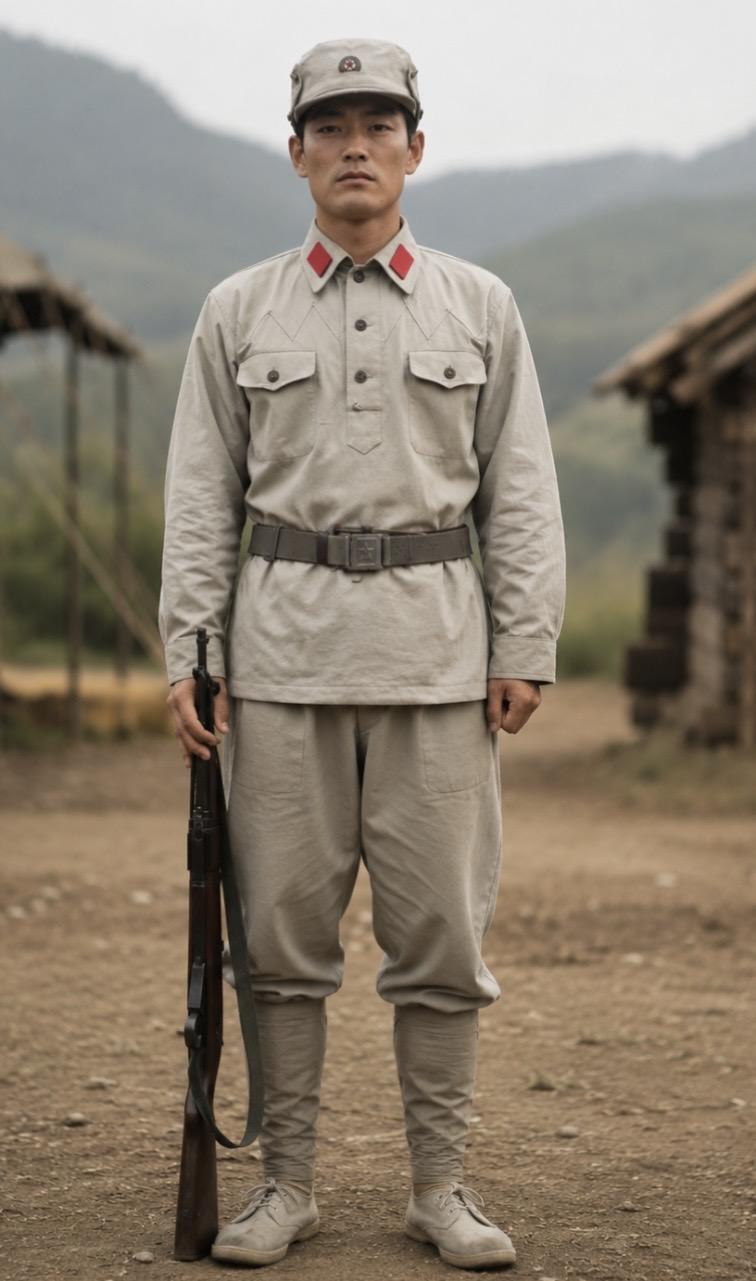
N.Korean uniform
The field uniform worn by North Korean soldiers in the early 1950s was a practical and unmistakably austere garment, shaped by the needs of the Korean War and by the military influence of the Soviet Union and China. In photographs and surviving references from the period, the Korean People’s Army soldier is often shown in a simple khaki-grey or light olive cotton uniform, designed less for parade-ground display than for movement, durability and mass issue. The colour was usually muted, sometimes appearing grey, tan, greenish-khaki or faded stone depending on fabric, wear and lighting. This subdued colour suited the Korean landscape, where dusty roads, mountain tracks, villages and rough camp conditions quickly weathered any uniform.
The tunic was one of the most noticeable parts of the uniform. It was generally plain, loose and functional, with a straight or slightly bloused body and a buttoned front. Many examples had two chest pockets with flaps, giving the soldier a simple but organised appearance. The cut reflected a mixture of Soviet-style military dress and older East Asian field clothing traditions. It was not a highly tailored Western tunic; it was meant to be produced in quantity and worn by men operating in harsh conditions. The fabric was often cotton or a cotton-like material for summer and field use, with heavier clothing issued for colder weather. The Korean climate demanded this flexibility, as soldiers could face hot, humid summers and bitterly cold winters in the mountains.
The red collar tabs seen on the uniform are among its most striking features. These bright patches stand out sharply against the pale khaki-grey cloth and give the uniform much of its identity. Red was not merely decorative; it was politically symbolic, associated with revolutionary struggle, communist ideology and the new state’s military culture. On many early Korean People’s Army uniforms, collar tabs and shoulder-board details helped distinguish rank, branch or status, although battlefield wear was often simplified. In a portrait image, the red collar tabs immediately communicate the period and political character of the army, while also adding a strong visual contrast to an otherwise plain field uniform.
The field cap was another key feature. The soft peaked cap, usually made from the same or similar cloth as the uniform, was practical and lightweight. It could be worn in camp, on the march or in ordinary field duties. The small badge at the front commonly featured a red star motif, often placed on a circular metal backing. This five-pointed star was one of the most recognisable symbols of communist military identity across the Soviet-influenced world. On a North Korean cap, it linked the soldier visually to a wider socialist military tradition while also serving as a national and ideological emblem. The cap in the picture, with its modest shape and small central badge, fits the general appearance of Korean War-era field headgear.
The belt was both useful and symbolic of military order. A broad grey or dark olive webbing belt could hold basic equipment and helped pull the loose tunic into a neater shape. Some belts had simple metal buckles, while others reflected Soviet or Chinese-influenced designs. The belt gave structure to the otherwise soft cotton uniform and helped carry small items needed in the field. In period photographs, soldiers could appear with ammunition pouches, canteens, packs, bayonet frogs or other equipment attached, although not every portrait or staged image shows the full combat load.
The trousers were usually loose and practical, often cut with enough room for marching, squatting and moving across rough ground. In the early 1950s, North Korean soldiers might wear straight trousers, baggier field trousers or trousers secured at the lower leg. This gave the lower half of the uniform a rugged appearance, especially when combined with puttees, gaiters or wrapped leggings. These leg coverings were common in many armies before and during the Korean War because they protected the ankle, kept dirt and stones out of footwear, and helped stop loose trouser legs from catching in brush or equipment.
The boots and footwear are an important part of the overall impression. Korean People’s Army soldiers did not always have uniform, high-quality leather boots. Depending on supply, season and unit, footwear could include ankle boots, canvas shoes, cloth shoes, rubber-soled footwear or boots worn with leg wraps. In many wartime conditions, practical availability mattered more than perfect regulation. The footwear in the picture, pale and simple, gives the impression of canvas or light field shoes worn with wrapped lower legs. This is believable for a soldier in camp or on ordinary field duty, especially in a summer or temperate-weather setting. Heavy leather boots would have been more protective, but they were not always available to every soldier in the same form.
The uniform’s plainness is one of its most historically interesting qualities. Unlike later ceremonial North Korean uniforms, which could be highly polished and decorated, the early 1950s field uniform was spare and utilitarian. It belonged to an army that was newly formed, rapidly expanded and deeply influenced by its communist allies. Soviet styling can be seen in the cap, insignia culture, belts and general military appearance, while Chinese influence was also present in the broader simplicity and mass-issue practicality of the clothing. At the same time, the uniform had its own Korean character because it was worn in a specific war, climate and political setting.
Motifs on the uniform were few but powerful. The red star on the cap represented revolutionary military authority and communist allegiance. The red collar patches echoed the same ideological colour and created a sharp formal identity. The plain khaki-grey cloth suggested the common soldier rather than an officer in parade dress. Buttons, pocket flaps, belt buckles and stitched seams were small details, but together they gave the uniform its disciplined shape. The absence of excessive decoration is itself meaningful: the field soldier was presented as stern, practical and ideologically committed rather than ornamental.
When paired with a rifle, the uniform takes on the complete appearance of a Korean War-era infantryman. North Korean forces used a mixture of Soviet, Chinese and captured weapons during the conflict, and the rifle was central to the image of the ordinary soldier. A long wooden-stock rifle or carbine beside the figure helps place the uniform in the correct period, before the later dominance of more modern assault rifles in North Korean service. The weapon, belt, cap badge and red tabs together create a visual language of early Cold War military identity.