Nederlandsche Landwacht: The Feared Dutch Auxiliary Police Under SS Control
Nederlandsche Landwacht: The Feared Dutch Auxiliary Police Under SS Control The Landwacht was one of the most hated organisations in the occupied Netherlands. It was not the Waffen-SS division that later became known as Landstorm Nederland. That was a military formation. The Landwacht discussed here was the Dutch auxiliary police force of the occupation. Its official name was the Nederlandsche Landwacht, and it was created on 12 November 1943.
By 1943 the war had changed. Germany was no longer winning easily. The Eastern Front had become a disaster, Allied bombing grew heavier, and resistance in the Netherlands became bolder. NSB members, meaning members of the Dutch Nazi movement, were no longer just disliked. Some were attacked, and some were assassinated by the resistance. This development made the Dutch Nazi movement very nervous.
NSB leader Anton Mussert wanted protection for his followers. He still imagined himself as the leader of a future Dutch state under German protection, and the Landwacht seemed to offer him something useful. It could protect NSB members, and give the movement its own armed force.
The Germans saw it differently. They wanted more control, and they needed men who knew local streets, local families and local hiding places. The regular Dutch police could not always be trusted. Some officers helped the occupier, others deliberately worked slowly, and some helped the resistance. For Hanns Albin Rauter, the highest SS and police leader in the Netherlands, the Landwacht was useful because it could act as a rough local police force and do dirty work close to home.
Cornelis van Geelkerken became Inspector General of the Landwacht. He was the second man of the NSB after Mussert, which gave the organisation a strong NSB character from the start. Yet real power did not stay with Mussert and Van Geelkerken. Rauter gained more influence, and after Dolle Dinsdag on 5 September 1944, when rumours of an Allied breakthrough caused panic among Dutch Nazis and collaborators, the Landwacht came directly under his control. From that moment it moved deeper into the German SS police system.
The Landwacht was made up mainly of NSB members. In the summer of 1944 it had about 10,000 to 20,000 members in total, depending on how full-time and auxiliary members are counted. Only a small part served full time. Around 1,250 to 1,500 men worked as full-time Landwachters, while about 9,000 others served as auxiliary Landwachters. The full-time men served as a job, while the auxiliary men did Landwacht work next to their normal lives. This made the organisation very local. A Landwachter could be a neighbour. He could know who had extra food, which family had someone in hiding or who listened to illegal radio broadcasts from London.
The men were badly armed at first. Many carried old shotguns, and some of these weapons had been taken from Dutch civilians earlier in the war. This gave the Landwacht its nickname. People called them “Jan Hagel”. The name referred to shotguns, but it also carried the sense of rabble and scum. Later the Landwacht also received military weapons, including Italian Carcano rifles, which made some units more dangerous than their improvised early appearance suggested.
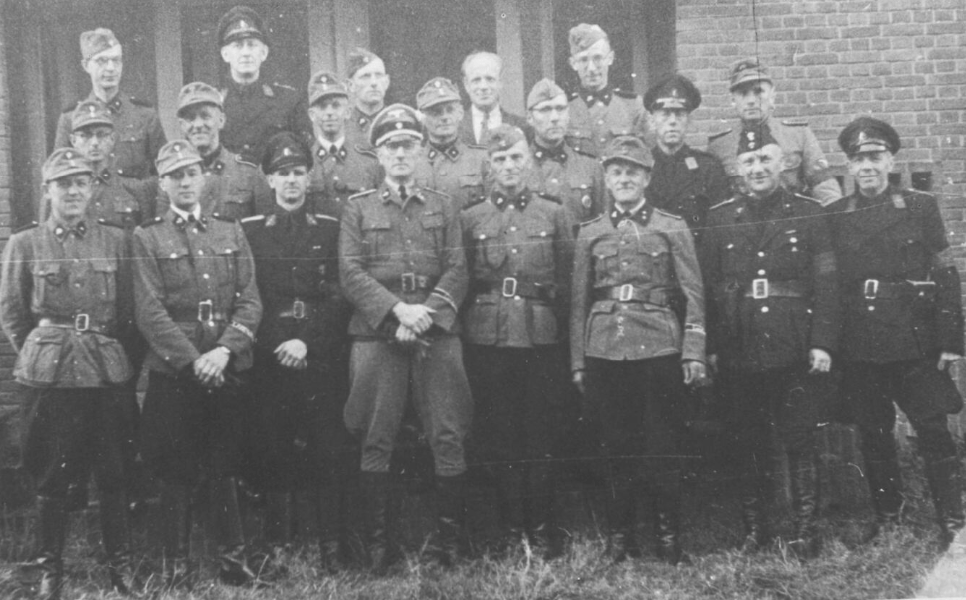
At first many Landwachters did not have proper uniforms. Often they wore an armband. Later they could wear black clothing or old pieces of uniform, but the result was never the clean image of a state police force. It looked improvised, local and threatening. That was part of the fear. These were not distant German officials. These were Dutch collaborators with weapons.
Their official tasks sounded orderly. They guarded buildings, checked identity papers, supported the police and helped keep public order. In reality their work became much darker. They searched houses, arrested people, hunted resistance members, looked for people in hiding and helped the German security services.
This made the Landwacht especially dangerous. The German occupier had power, but the Landwacht had local knowledge. That combination could be deadly. A German officer might not know who lived behind a certain door, but a Dutch Landwachter might know it very well. He might know who was Jewish, who had refused to work in Germany, who had extra ration cards, or who had disappeared from public view.
The Landwacht became known for violence and theft. Landwachters stole food, robbed civilians, threatened people and beat suspects. Some tortured prisoners, and some committed murder. Their behaviour was often arbitrary. A search could become a robbery, a checkpoint could become extortion, and a political duty could become personal revenge.
A grim example was Hillegondus Botter from Nieuw-Dordrecht. He had worked as a guard in camp Erica near Ommen and later as an auxiliary police officer in Assen. In 1944 he was posted in south-eastern Drenthe, where he became notorious for his brutality. During a raid near Nieuw-Schoonebeek, Botter and others shot two prisoners and robbed the bodies. He also fatally shot a colleague during an argument in Emmen and *blocked text* at least twenty people. Local men such as Botter showed how the Landwacht could turn occupation policy into personal violence.
The Hunger Winter made their reputation even worse. In the winter of 1944 and 1945 many people in the western Netherlands were starving. Food was scarce, and families walked for miles to trade goods for potatoes or grain. Landwachters stopped people on the road and took food parcels. They claimed to act for order, but to hungry civilians it looked like armed theft.
The Landwacht also showed the weakness of Mussert’s position. He wanted an NSB force that could protect his movement and strengthen his claim to power. Instead the organisation became a tool of the German police system. Rauter and the SS pulled it closer to their own aims. The Landwacht did not make the NSB stronger in the eyes of the Dutch public. It made the NSB even more hated.
In the final months of the war the atmosphere became brutal. Germany was losing, the resistance became more active, and collaborators became more afraid. The Landwacht reacted with harder measures. Raids, arrests and intimidation increased. In some places Landwachters joined local terror groups. They no longer looked like defenders of order. They looked like armed men trying to survive the collapse of the occupation.
When liberation came in 1945, the Landwacht collapsed with the rest of the collaborationist system. Many members fled, while others tried to hide their past. Some claimed they had only joined for money or food. Some said they had been forced, and others said they had done nothing serious. These arguments did not always help. For many Dutch people the armband and the shotgun were enough.
After the war Landwachters were arrested and tried. Their cases differed. Some had done guard duty, while others had taken part in arrests, violence or murder. The courts had to judge each man separately, but public memory was less careful.
That is why its memory did not depend on military fame. The Landwacht did not fight major battles as a division, and it did not become famous on the front like the Waffen-SS. Its history was smaller and uglier. It belonged to streets, villages, checkpoints and front rooms. It was the armed neighbour who searched houses, stopped hungry civilians on the road, stole food parcels and joined the manhunts for Jews, resistance members and people in hiding.
Credit: Tom Dankers, Historian, Arnhems Oorlogsmuseum 40-45, Nederlands