Monty’s Staff Car
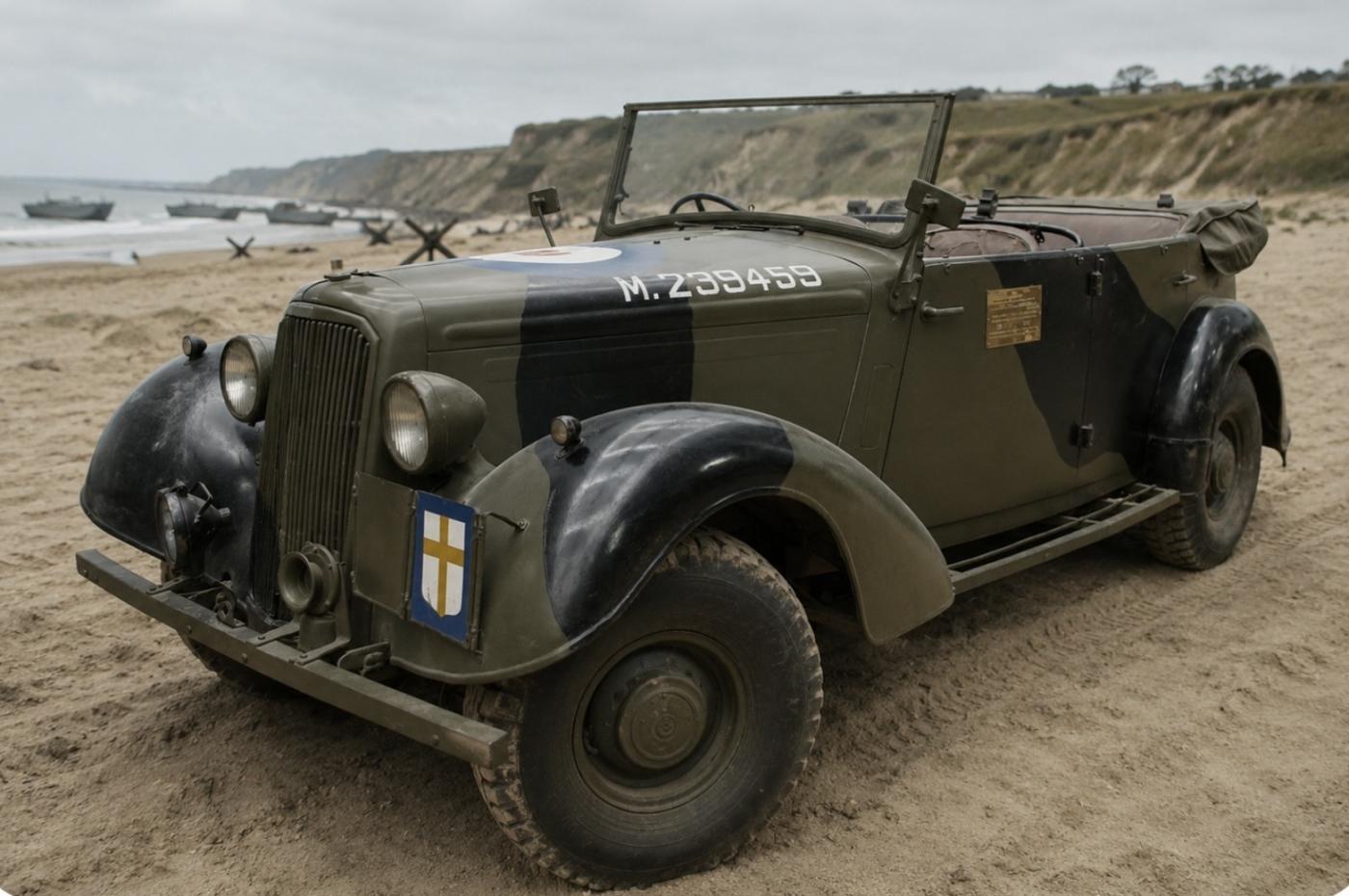
General Bernard Law Montgomery’s famous “Old Faithful” staff car was a 1941 Humber Super Snipe open tourer, a British military staff car that became closely associated with Montgomery during some of the most important campaigns of the Second World War. It was not a tank, armoured car or command vehicle in the heavy military sense, but a fast, practical, chauffeur-driven car used by a senior commander who needed to move quickly between headquarters, forward positions and troops in the field. To Montgomery, it was far more than transport. It became part of his image, part of his command routine, and one of the best-known personal vehicles used by any British general during the war.
The car was made by Humber, part of the Rootes Group, and was based on the Humber Super Snipe, a large and powerful British car that had been adapted for wartime use. The Super Snipe was well suited to staff-car duties because it combined speed, strength and reliability. Montgomery’s car was an open four-seater tourer with military fittings, a practical layout and a desert camouflage finish. It was designed to carry senior officers over long distances and rough roads, and in North Africa that mattered enormously. The desert war demanded vehicles that could survive heat, dust, bad tracks, long journeys and hurried movement between dispersed units. Montgomery’s Humber gained its nickname because it did exactly that.
“Old Faithful” was used by Montgomery as his personal chauffeur-driven transport while he commanded the British Eighth Army in North Africa, Sicily and Italy. It was attached to his Tactical Headquarters, often known as the Monty Caravans, and it took him out to see formations and speak directly to soldiers. Montgomery was famous for his personal appearances before troops. He believed morale was a weapon, and he liked to address men in plain, confident language before major operations. The staff car helped make this possible. It carried him to units in the field, and from it he gave many of the talks that helped build his reputation as a commander who was visible, direct and certain of victory.
The car’s fame is tied especially to the desert campaign and the Eighth Army’s recovery under Montgomery in 1942. When he took command, British morale had been badly shaken by reverses against Rommel’s Afrika Korps. Montgomery set about restoring confidence, tightening command arrangements and preparing the army for the Battle of El Alamein. His public style mattered: the black beret, the badges, the plain speech and the staff car all became part of the Monty image. “Old Faithful” was the vehicle in which many soldiers saw him arrive, and it therefore became a moving symbol of his presence at the front.
The Humber’s usefulness did not end with the victory at El Alamein. It continued to serve Montgomery during the campaigns that followed across North Africa and into Sicily and Italy. These were not easy theatres for any vehicle. The car would have faced sand, heat, poor roads, dust, mud, mountain routes and constant use. Its survival and continued service explain why the affectionate nickname stuck. “Old Faithful” was not a glamorous name, but it was exactly the sort of name soldiers give to equipment that simply keeps doing its job.
One interesting point is that Montgomery later used other famous staff cars, which can cause confusion. The “Old Faithful” name properly belongs to his 1941 Humber Super Snipe from the North African, Sicilian and Italian campaigns. A different Humber Super Snipe, often called Monty’s “Victory Car”, was used from the D-Day landings through the campaign in North-West Europe. That later car is associated with Normandy, the advance across Europe and victory in 1945. Montgomery also used a 1939 Rolls-Royce Wraith in France and Germany after D-Day, another historically important vehicle. The Rolls-Royce has recently attracted attention because it was restored by Richard Hammond’s company, The Smallest Cog, and returned to the Royal Logistic Corps Museum. However, when people refer specifically to “Old Faithful”, they are usually referring to the wartime Humber Super Snipe used with the Eighth Army.
After Montgomery returned to Britain to take up his role in the planning and command of the D-Day landings, “Old Faithful” did not go with him. It remained behind and continued to be used as personal transport for later Eighth Army commanders. After the war, the car was eventually shipped back to Britain and presented to its makers, the Rootes Group. Its post-war history is not completely documented, and there appears to be a gap in the surviving record between the end of the war and 1958. By 1958, however, the vehicle had entered museum life when it was placed on loan at the National Motor Museum at Beaulieu.
The car later moved again. In 1985, the loan was transferred to the Museum of Army Transport at Beverley. In 1997, it was placed on loan to the Imperial War Museum. In 2010, Peugeot, which had inherited the connection through corporate changes after Rootes became part of Chrysler Europe and later came under Peugeot ownership, gifted the car to the Imperial War Museum. This ensured that “Old Faithful” would remain preserved as part of Britain’s national military collection.
The vehicle itself has also had conservation and repainting work during its long post-war life. In 1960 it was returned to its original coachbuilders, Thrupp & Maberly, which by then formed part of the Rootes Group, and it was repainted before returning to Beaulieu. It also appeared in promotional events connected with the Rootes Group in the 1960s. These details are important because they show that “Old Faithful” was not simply abandoned after the war. It had become a recognised historic object, first connected with the motor industry and later with military history.
Today, General Montgomery’s “Old Faithful” is preserved by the Imperial War Museum. The Imperial War Museums collection identifies it as a Humber Super Snipe Staff Car, production date 1941, employed by Field Marshal Montgomery of Alamein. It is part of the IWM’s collection of vehicles, aircraft and ships. It has been displayed at Imperial War Museum sites, including London, and is now best understood as an Imperial War Museums collection object rather than a privately owned vehicle.
The reason the car remains so interesting is not only that it belonged to Montgomery. Many senior officers had staff cars. What makes “Old Faithful” special is its association with a turning point in the war and with Montgomery’s very deliberate style of leadership. It was the car of the Eighth Army commander at the time when the British Army moved from retreat and uncertainty to victory at El Alamein and the long pursuit westward. It carried him through the environment that made his reputation: the desert, the mobile headquarters, the troop visits and the morale-building speeches. It represents not just transport, but command presence.
In military history, vehicles often become famous because they are dramatic machines: tanks, aircraft, warships or armoured cars. “Old Faithful” was different. It was a staff car, an officer’s working vehicle, but its significance came from the man who used it and the events it witnessed. It reminds us that command in wartime depends not only on maps and orders, but also on movement, visibility and personal contact. Montgomery understood the importance of being seen. His Humber Super Snipe helped him do that, and for that reason “Old Faithful” remains one of the most evocative British staff cars of the Second World War.