Miles Master m.9
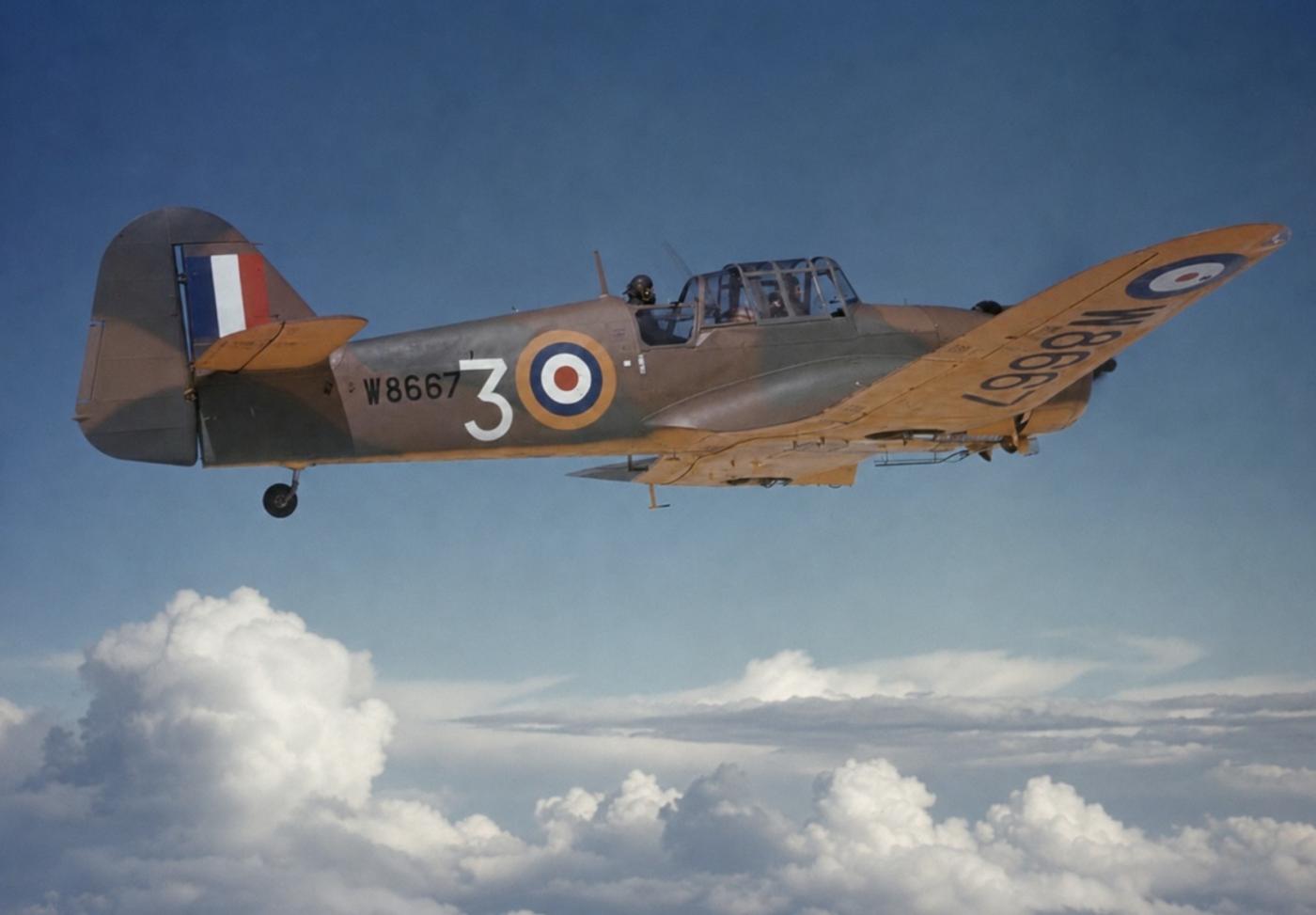
The Miles Master M.9 was one of the most important British training aircraft of the Second World War, even though it is far less famous than the fighters whose pilots it helped to prepare. It was a two-seat, low-wing monoplane advanced trainer, built to give student pilots the feel of a modern, fast, retractable-undercarriage aircraft before they moved on to operational types such as the Hawker Hurricane and Supermarine Spitfire.
The Master was designed by Frederick George Miles, usually known as F. G. Miles, and produced by Phillips and Powis Aircraft Limited, the company based at Woodley Aerodrome near Reading in Berkshire. Phillips and Powis later became Miles Aircraft, but during the early production period the Phillips and Powis name was still in use. The Miles company was one of the most interesting British aircraft firms of the period, because it specialised in practical wooden aircraft that could be produced quickly and economically. Woodley became closely associated with Miles designs, and the Master was one of the company’s greatest wartime successes.
The story of the Master began before the war with the Miles M.9 Kestrel, a private-venture advanced trainer. The Kestrel first appeared in the late 1930s and was intended to show that a training aircraft could have modern fighter-like performance without being as costly or difficult to handle as a front-line fighter. The Kestrel used a Rolls-Royce Kestrel engine, and its clean monoplane design showed promise at a time when Britain urgently needed to modernise its pilot-training system.
The need for such an aircraft became more serious because the Royal Air Force was expanding rapidly. The RAF had been expecting the de Havilland Don to fill an advanced training role, but the Don proved unsatisfactory. The Air Ministry therefore turned to Miles, whose Kestrel design offered a more practical route to a fast advanced trainer. The Kestrel was redesigned into the Miles Master, with changes to the canopy, fuselage, tail, radiator arrangement and engine installation. The result was the M.9A Master, which became known in service as the Master I.
The Master I made its first flight on 31 March 1939, only months before the outbreak of the Second World War. It was introduced into RAF service in 1939, at exactly the moment when Britain needed thousands of new pilots. The timing could hardly have been more important. A pilot who had learned on simple elementary trainers needed something more demanding before being trusted with a Hurricane, Spitfire, Defiant or other operational aircraft. The Master gave that intermediate step.
The aircraft was built mainly of wood, with a plywood-covered semi-monocoque fuselage and wooden wings. This was not backward or crude; it was a sensible wartime choice. Britain needed to conserve strategic metals, and Miles had considerable experience in wooden aircraft construction. The Master was strong, fully aerobatic and suitable for the hard use expected at training schools. It had a retractable undercarriage, flaps, a variable-pitch or constant-speed propeller depending on fit, and a cockpit layout that accustomed pilots to more advanced controls than those of basic trainers.
The crew sat in tandem, with the pupil in the front cockpit and the instructor behind. The rear seat was raised to give the instructor a better view over the pupil’s head. This was a valuable feature in a trainer because the instructor needed to see both the pupil’s actions and the surrounding airspace. The Master also had dual controls, and the cockpit was designed for the practical business of teaching young pilots how to handle a fast aircraft. Compared with a Tiger Moth or Magister, it was a major step up in speed, weight, cockpit procedure and landing technique.
The original Master I was powered by the Rolls-Royce Kestrel XXX, a liquid-cooled V-12 engine of about 715 horsepower. This engine was no longer modern enough for first-line fighters, but it was very useful for a trainer. It gave the Master lively performance while making use of available stocks of engines. The Master I could reach roughly 240 miles per hour, depending on version and conditions, which made it fast enough to prepare pilots for the new generation of RAF monoplanes.
One of the most interesting things about the Master is that its engine story reflects the pressures of wartime production. When supplies of the Rolls-Royce Kestrel became limited, Miles redesigned the aircraft to take the Bristol Mercury XX radial engine. This version was the M.19 Master II. The Mercury was an air-cooled nine-cylinder radial engine of about 870 horsepower. It changed the aircraft’s appearance, giving it a rounder radial-engine nose instead of the slimmer V-12 installation of the Master I. The Master II first flew in October 1939 and became the most numerous version.
Later, another engine change produced the M.27 Master III. This version used the American Pratt & Whitney R-1535 Twin Wasp Junior radial engine, rated at about 825 horsepower. The use of an American engine was another sign of the pressure on British engine supply and the importance of keeping training aircraft production moving. The Master III gave the RAF another way of maintaining output when British engines were needed for combat aircraft.
The Master was produced in large numbers. In total, more than 3,000 were built, making it one of the most numerous Miles aircraft. Production took place at Woodley in Berkshire, at South Marston near Swindon, and at Doncaster. The expansion of production was a major industrial achievement for a company that had begun the 1930s as a comparatively small aircraft maker. The Master helped turn Miles into a significant wartime manufacturer.
In RAF service, the Master was used mainly by advanced flying units and service flying training schools. Its purpose was not to teach a man how to fly from the beginning, but to turn a basic pilot into someone ready for high-performance military aircraft. It introduced trainee pilots to greater speed, heavier controls, retractable landing gear, more demanding approaches and landings, and the general discipline of flying a modern military monoplane.
The aircraft was also used for fighter affiliation and weapons training. Some Masters could carry practice bombs, and some were fitted with a machine gun for training purposes. This meant that pilots could practise aiming, diving, approach discipline and other combat-related skills without using scarce front-line fighters. In wartime, that was extremely valuable, because every hour flown on a trainer saved wear and risk on aircraft needed by operational squadrons.
There was even a fighter version, the Miles M.24 Master Fighter. This was an emergency single-seat conversion armed with six .303-inch machine guns. It was created during the anxious period when Britain feared invasion and needed every possible fighter. In practice, it did not become a combat aircraft, but its existence shows how desperate the situation appeared in 1940 and how adaptable the Master airframe was considered to be.
Another important variant was the glider tug version. During the war, some Masters were adapted to tow training gliders, especially as Britain developed airborne forces. These aircraft helped train glider pilots before they moved on to larger operational gliders. The Master was powerful enough for this secondary role and was already available in useful numbers.
The Master was not a glamorous aircraft, but it was a crucial one. Many wartime pilots passed through its cockpit on their way to operational aircraft. It bridged the gap between elementary training and combat flying at a time when the RAF needed trained pilots in enormous numbers. It was also a very British answer to a very British problem: an aircraft made largely of wood, designed quickly, built in quantity, and fitted with whatever suitable engines could be made available.
Its design was also forward-looking for a trainer. It had the speed and complexity needed to prepare pilots for modern fighters, but it was still forgiving enough to be used in a training environment. The fact that the instructor sat higher than the pupil, the use of dual controls, and the attention given to visibility and cockpit layout all show that the Master was not simply a modified sports aircraft. It was a purpose-designed training machine.
Despite the large number built, no complete Miles Master survives today. This is one of the sadder facts about the aircraft. Trainers were often worked hard, damaged, repaired, used again, and then scrapped when they were no longer needed. Because the Master was made largely of wood and was not a famous combat type, few people thought to preserve one. As a result, an aircraft that trained so many RAF pilots has almost disappeared physically from history.