Mad Jack Churchill
John Malcolm Thorpe Fleming Churchill, better known to history as “Mad Jack” Churchill or “Fighting Jack” Churchill, remains one of the most extraordinary British soldiers of the Second World War. In an age of tanks, aircraft, machine guns and artillery, he went into battle carrying a longbow, arrows, a Scottish broadsword and, when the moment suited him, a set of bagpipes. His story has sometimes been retold so often that fact and legend blur together, but the truth is remarkable enough without exaggeration. He was not merely an eccentric officer with old-fashioned weapons. He was a brave, highly capable fighting soldier who led men in some of the most dangerous commando operations of the war and survived experiences that would have broken many others.
Churchill was born on 16 September 1906 into a family with strong imperial and military connections. His father, Alec Fleming Churchill, worked in colonial service posts, and Jack’s early life was touched by the wider British Empire of the period. He was educated at the Dragon School in Oxford, then at King William’s College on the Isle of Man, before entering the Royal Military Academy Sandhurst. In 1926 he was commissioned into the Manchester Regiment, beginning a military career that would be anything but ordinary.
From the beginning, he showed the restless independence that later made him famous. Posted to Burma and India, he threw himself into army life but also into the kind of personal adventures that revealed his appetite for danger and challenge. He became a skilled motorcyclist and is said to have ridden huge distances across difficult country, including a long ride across India that involved heat, rough roads and at least one collision with a water buffalo. He also developed a love of the bagpipes, learning from the pipe major of the Cameron Highlanders while serving in the East. For an English officer in the Manchester Regiment, this was unusual, but Churchill was never much interested in being ordinary.
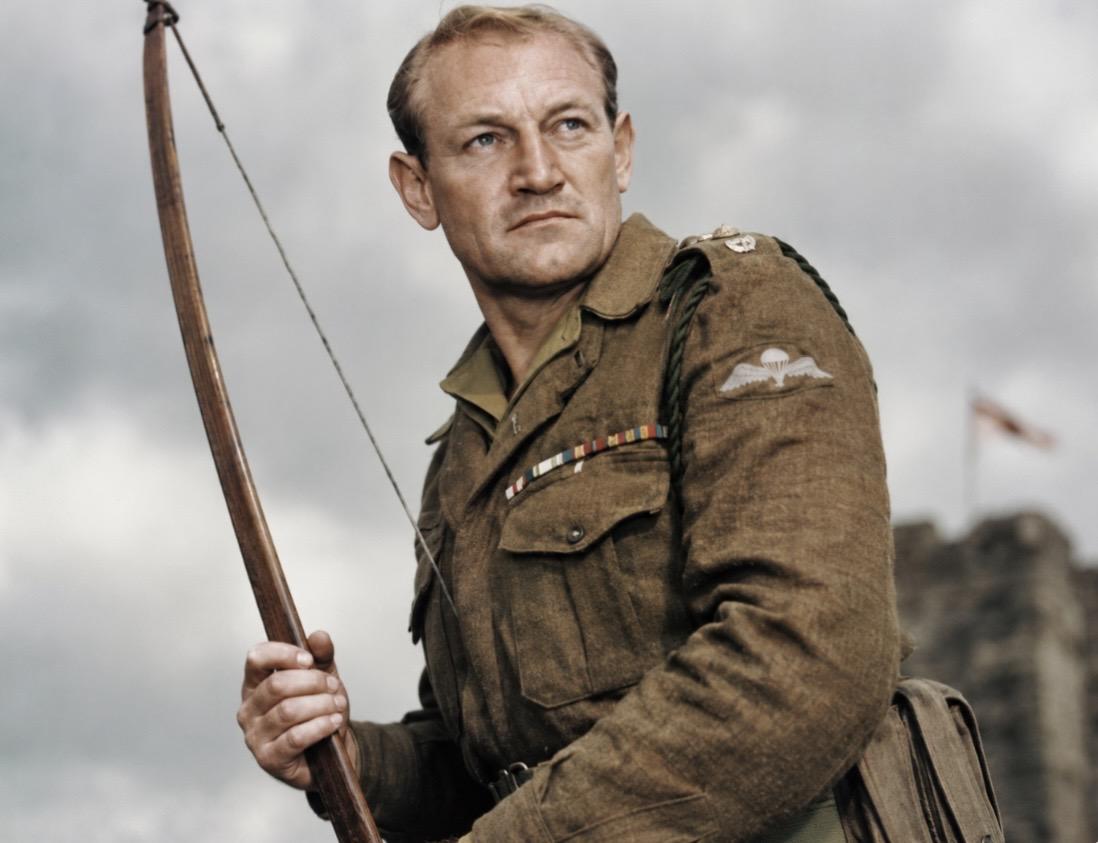
He left the regular army in the 1930s, but he did not settle into a quiet life. He worked in newspaper editing, appeared in films as an extra and continued to pursue sport and adventure. He was a keen archer and became good enough to represent Great Britain at the world archery championships in Oslo in 1939. This detail is important because his later use of the longbow was not a theatrical prop picked up on a whim. He knew how to use it. He understood its range, limitations and psychological effect. In his hands it was both a weapon and a symbol.
When war broke out in 1939, Churchill returned to military service. The British Army he rejoined was preparing for a new kind of industrial war, but he brought with him a personal view of soldiering that seemed to belong to an earlier century. His most famous saying, often repeated in accounts of his life, was that any officer who went into action without his sword was improperly dressed. To most soldiers this was absurd. To Churchill it was a statement of identity. He believed in dash, example and the power of personal courage. He wanted his men to see that their officer was not asking them to go anywhere he would not go himself.
The incident that made him unique in modern military history came during the fighting in France in May 1940, not on D-Day as is sometimes wrongly claimed. Britain’s army was falling back before the German advance, and Churchill was serving with the Manchester Regiment during the desperate days before Dunkirk. Near the village of L’Épinette, close to Béthune, his unit was involved in an ambush against German troops. As the enemy approached, Churchill used his longbow. The accepted story is that he shot a German soldier, often described as an NCO, with an arrow before the rest of the ambush opened up with rifle fire. That act is widely regarded as the last confirmed or last recorded killing of an enemy soldier with a bow and arrow in military combat.
It sounds almost impossible: a British officer in 1940, facing the army of Hitler’s Germany, using a weapon associated with Agincourt rather than blitzkrieg. Yet the circumstances make it more understandable. This was close-range fighting, confused and sudden, involving small groups of men, cover, buildings and hedges. The bow was silent, and in the hands of an expert it could be deadly at short distance. It also had an effect far beyond the physical wound it caused. Imagine the shock among German soldiers who expected rifle and machine-gun fire but saw one of their own hit by an arrow. Churchill understood morale, theatre and fear. His old weapons were impractical in many situations, but in that moment they became part of the ambush’s surprise.
After Dunkirk, Churchill volunteered for the Commandos, the new raiding force created to strike back at German-occupied Europe. This suited him perfectly. The Commandos needed officers who were aggressive, imaginative and willing to lead from the front. Churchill was all three. He became associated with No. 3 Commando and later No. 2 Commando, and his reputation grew quickly.
One of his most famous early commando actions came during Operation Archery, the raid on Vågsøy in Norway on 27 December 1941. Churchill went ashore carrying his sword and, according to the best-known accounts, played the bagpipes as the landing craft approached. The scene has become one of the classic images of Commando folklore: a British officer stepping into a modern amphibious raid with pipes, sword and grenades. He was wounded during the operation, but his courage and leadership were noted. The raid itself was a success, damaging German installations and boosting British morale at a time when Britain badly needed visible proof that it could hit back.
In 1942 Churchill took command of No. 2 Commando. This was no small achievement. The Commandos were elite troops, and their officers had to command respect from men trained for some of the hardest tasks in the army. His eccentricity did not prevent that respect; in many ways it strengthened it. Soldiers will forgive oddness in a commander if he is brave, competent and fair. Churchill proved that he was willing to share every danger.
His most astonishing exploit came during the fighting in Italy after the Allied landings at Salerno in September 1943. Churchill and his men were involved in bitter fighting around the village of Pigoletti. In one famous episode, he advanced with only a small party and used darkness, aggression and surprise to capture German positions. Moving from post to post, he called out orders and bluffed enemy soldiers into surrendering. By the end of the action, he and his runner had taken a large number of prisoners, often given as forty-two, including mortar crews who were made to carry their own weapons back. It was an extraordinary example of nerve and battlefield psychology. For his conduct at Salerno, Churchill received the Distinguished Service Order.
The following year he was involved in operations in Yugoslavia, where British Commandos worked alongside Tito’s Partisans against German forces. In 1944, during Operation Flounced on the island of Brač, Churchill’s luck finally ran out. His force came under heavy attack, and many of his men were killed or wounded. As the Germans closed in, the story goes that Churchill played “Will Ye No Come Back Again?” on his bagpipes before being knocked unconscious by grenades and captured. Whether every detail is exact or polished by legend, the essential truth remains that he was taken prisoner after a fierce and costly action.
The Germans believed, wrongly, that he might be related to Winston Churchill, which made him a prisoner of special interest. He was sent to Sachsenhausen concentration camp, where high-value prisoners were held. Even captivity did not end his habit of defiance. He escaped from Sachsenhausen with another prisoner, crawling under wire and attempting to make his way across Germany. He was recaptured near the Baltic coast and later moved to another camp. In 1945, as Germany collapsed, he escaped again, this time walking through dangerous territory until he reached American forces in Italy. It was a fitting end to his war in Europe: not rescued quietly, but escaping under his own power.
Churchill was not finished with war. After Germany’s defeat, he was sent to the Far East, hoping to continue the fight against Japan. When he heard that the atomic bombs had brought the war to a sudden end, he reportedly remarked that if it had not been for the Americans, the war could have gone on for another ten years. It was a darkly comic comment, but it reflected something true about him. He was one of those rare men who seemed built for battle, not because he loved suffering, but because danger gave him purpose.
After the Second World War, he continued to serve. He was involved in military duties in Palestine during the troubled final period of the British Mandate, where violence between Arabs, Jews and British forces created a grim and complicated environment. One of the most striking post-war stories about him concerns the Hadassah medical convoy attack in Jerusalem in 1948. Churchill attempted to assist those under attack and later helped evacuate survivors. It showed that his courage was not limited to conventional battlefields.
He eventually retired from the army with the rank of lieutenant colonel. Civilian life did not make him ordinary. He became known for eccentric habits that seemed almost designed to keep the legend alive. He enjoyed sailing, built detailed radio-controlled model ships and took up surfing after seeing it in Australia, becoming one of the early enthusiasts for the sport in Britain. There are stories of him commuting by train and suddenly throwing his briefcase out of the window as the train passed his garden, simply because it saved him carrying it from the station. To anyone else this would seem bizarre. For Jack Churchill, it was practical.
He married Rosamund Denny in 1941, and after the war he lived a quieter family life, though never one that could be called dull. Those who knew him often remembered not a self-promoting showman, but a modest, brave and unusual man who had no need to exaggerate himself. His record did that for him. He had won the Military Cross, the Distinguished Service Order and a Bar to the DSO. He had fought in France, Norway, Italy and Yugoslavia. He had been wounded, captured, escaped and returned to duty. He had led Commandos in some of the most dangerous fighting of the war. And, uniquely, he had carried into modern battle weapons that belonged to a much older warrior tradition.
Mad Jack Churchill died on 8 March 1996 at the age of eighty-nine. By then his story had already become legend, but it remains powerful because it represents something more than eccentricity.