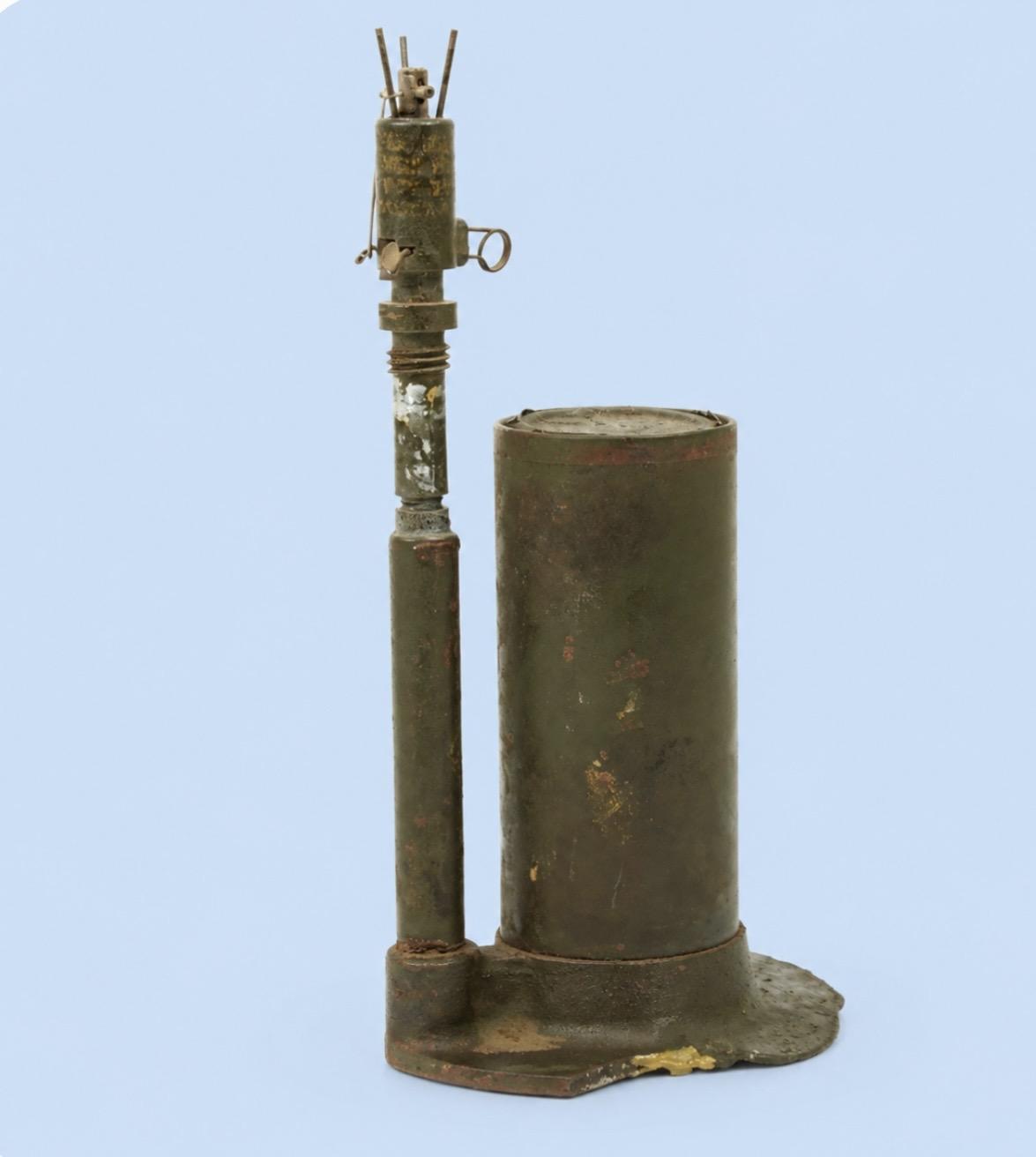
M48 Parachute mine
The flare shown above was officially known as the U.S. Flare, Trip, Parachute, M48, but it is best described in plain terms as a parachute trip flare. It was a ground warning device used to reveal movement at night. Unlike a hand-held distress flare or a simple signal light, it was a compact battlefield pyrotechnic that worked rather like a one-shot miniature mortar. When disturbed by someone crossing a defended approach, it launched an illuminating candle into the air. The candle then descended beneath a small parachute, throwing bright light over the surrounding ground.
This type of flare belonged to a wider family of military pyrotechnics used for warning, illumination, and battlefield control. Its main purpose was to alert defenders to enemy movement. Illumination and signaling were secondary uses, but in battle these roles often blended together. At night, a sudden burst of light told the defenders that someone had crossed a protected approach and, at the same time, exposed the intruder to observation and fire.
During the Korean War, where patrols, raids, infiltrations, and attacks often took place after dark, such warning devices were highly valuable. They were placed around outposts, trench systems, wire obstacles, artillery positions, hilltop perimeters, and likely enemy approach routes. The flare did not stop an attack by itself. Its job was to reveal movement early enough for soldiers to react with rifles, machine guns, mortars, artillery, or prearranged defensive fire.
The device was a U.S. military ordnance item rather than a commercial product. Surviving examples are usually marked by model, lot number, loading date, and sometimes contractor or plant markings. Because production was handled through government contracts, it is not always accurate to name one single manufacturer without reading the markings on a specific example. The safest description is that these flares were produced for the U.S. Ordnance Department by contracted ammunition and pyrotechnic manufacturers.
Its working principle was simple in purpose but clever in design. A tripwire or similar trigger was placed across a likely route of movement. When the wire was disturbed, the firing mechanism started the pyrotechnic sequence. A small launching charge projected the illuminating element upward, after which the candle ignited and descended beneath its parachute. The result was a brief but intense overhead light that could reveal men moving through wire, crawling toward bunkers, or gathering for an assault.
The parachute made the flare much more useful than a ground-burning light. A surface flare could be hidden by rocks, folds in the ground, trenches, tall grass, or shell holes. A descending light in the air could illuminate a much wider area. Manuals described the flare as reaching several hundred feet and burning for roughly 20 seconds. Those seconds were short, but in night fighting they could be decisive. A machine-gun crew, sentry, or forward observer only needed a moment of light to spot movement and call attention to it.
In Korea, the device fitted naturally into the defensive systems that surrounded hills and outposts. Defenders relied on belts of barbed wire, mines, listening posts, patrols, registered artillery targets, and trip flares. The warning flare was one layer in that system. If enemy troops tried to cut wire, crawl through gaps, or move silently up a slope, the sudden light could expose them before they reached grenade range.
Its importance increased during the static phase of the war from 1951 to 1953. Much of the fighting became a contest for ridgelines, bunkers, and named outposts. Night attacks were common because darkness helped troops move without being seen from the air or by artillery observers. Chinese and North Korean forces were skilled at moving quietly through difficult ground, probing wire, and infiltrating close to defensive positions. A trip flare could break that concealment at the worst possible moment for the attacker.
The psychological effect was also powerful. Night fighting was confusing and frightening. Sounds carried strangely across valleys, shadows moved, and soldiers could not always tell whether a noise came from an animal, a friendly patrol, or an enemy assault party. When a warning flare suddenly fired, the whole area changed. Defenders were alerted, attackers lost darkness as cover, and everyone nearby knew that the position was now on edge.
The device had limitations. Bad weather, mud, snow, freezing conditions, shellfire, and poor placement could reduce its value. Korea’s winters were bitterly cold, and the hills were often rocky, steep, or churned up by artillery. A flare placed in the wrong spot could reveal friendly positions, fail to show the real approach route, or be triggered by accident. Loose wire, animals, nearby explosions, or returning patrols could all cause confusion.
There were also safety risks. This was a pyrotechnic military item, not a harmless lamp. It produced intense heat and could start fires or injure anyone too close to it. Soldiers had to know where such devices were placed so friendly patrols did not blunder into them. In well-run defensive positions, flare locations were recorded and fitted into the wider fire plan.
One useful comparison is with the M49 surface trip flare. The surface type burned brightly near its mounted position, while the parachute version launched its light source into the air. The surface flare was simpler and could burn longer, but the parachute design gave a broader overhead illumination. Both were warning devices, but they produced different battlefield effects.
An interesting way to think about the parachute trip flare is as an unattended sentry. It could not think, identify uniforms, or decide whether movement was dangerous. But it could watch a strip of darkness without getting tired. In an age before modern night-vision equipment, that mattered. Korean War soldiers had searchlights, star shells, aircraft flares, mortar illumination, and hand signals, but they did not have the compact electronic night-vision devices that later generations would use. A simple trip flare helped fill that gap.
The flare’s short burn time was part of its character. It did not turn night into day for long. Instead, it created a sudden flash of information. Where was the movement? How many men were there? Were they at the wire? Were they moving toward a bunker? Had a patrol triggered it by mistake? Those questions had to be answered quickly. The device gave defenders only a brief window, but in battle a brief window could be enough.
For collectors and historians, surviving examples are interesting because their markings can reveal date, lot, and sometimes production background. Some examples are inert training or display pieces, while others are dangerous live ordnance and should never be handled casually. Any live or uncertain pyrotechnic item should be treated as hazardous and left to qualified explosive ordnance personnel.
In the story of the Korean War, the parachute trip flare was a small object with an outsized role. It represents the nightly struggle around trenches and outposts, where victory often depended on detecting movement before the enemy reached the wire. It was not glamorous, and it rarely appears in broad campaign histories, but for the soldiers guarding dark hills in Korea, a sudden flare rising into the sky could mean the difference between warning and surprise.