Le Paradis Massacre
The atrocity involving the Royal Norfolk Regiment near Dunkirk was the massacre at Le Paradis, a small village near Lestrem in northern France, on 27 May 1940. It happened during the desperate fighting that led up to the evacuation from Dunkirk. The soldiers involved were mainly from the 2nd Battalion, Royal Norfolk Regiment, part of the British Expeditionary Force. They were not killed in battle on the Dunkirk beaches, but during a rearguard action inland, where British units were trying to delay the German advance long enough for other Allied troops to escape.
In May 1940 the German invasion of France and the Low Countries had moved with terrifying speed. The British Expeditionary Force, along with French and Belgian forces, was pushed back towards the Channel coast. By late May, the situation was critical. Units that could not be evacuated immediately were ordered to hold defensive lines, delay German forces, and buy time. The Royal Norfolks were among those caught in this grim task. Their position lay in the area around Le Paradis, not far from Béthune and the roads leading north towards Dunkirk.
The men of the 2nd Battalion, Royal Norfolk Regiment, fought as part of the defensive screen. Some of them, including men of C Company and battalion headquarters, became isolated near a farmhouse often referred to in accounts as Cornet Farm. They were attacked by troops of the Waffen-SS, specifically the SS Totenkopf Division, a formation known for its intense Nazi indoctrination and brutality. The British defenders resisted strongly despite being cut off, under heavy pressure, and short of ammunition. Contemporary and later accounts describe them holding out in buildings around the farm until their ammunition was exhausted.
The British soldiers eventually surrendered. This is the key point that makes Le Paradis a war crime rather than simply a battlefield tragedy. They were prisoners of war. They had laid down their arms and were no longer lawful targets. According to accounts later used in war-crimes proceedings, the men came out under a sign of surrender, and many were already wounded. Instead of being treated as prisoners, they were handled roughly and marched away by the SS troops.
The prisoners were taken towards a farm paddock beside a barn. There, machine guns had been positioned facing the place where the prisoners were lined up. The men were arranged along the barn wall or in front of it, with no realistic means of escape. The machine guns then opened fire. The soldiers were shot down in a mass execution. Some accounts state that survivors or wounded men were then finished off with rifle fire, pistols, bayonets, or blows. In total, 97 British soldiers were massacred after the last stand at Le Paradis.
The officer later held responsible was SS-Hauptsturmführer Fritz Knöchlein, commander of the SS company involved. The unit is usually identified as part of the SS Totenkopf Division. The killings were not an accident caused by confusion in battle. They were the deliberate killing of surrendered prisoners. This violated the laws and customs of war, including the basic principle that prisoners of war must be protected after capture.
Two men survived the massacre: Private Albert Pooley and Private William O’Callaghan. Both had been hit during the firing. O’Callaghan managed to pull Pooley away from the bodies, and the two hid nearby, often described as hiding in a pigsty or farm outbuilding. They survived for several days with the help of French civilians, including Madame Creton and her son Victor, who risked severe punishment by helping wounded British soldiers. Eventually the two survivors were captured by German forces, but they lived through the war and later gave evidence.
At first, the full story was not widely known. Pooley was badly wounded and spent a long time in German medical care before being repatriated. When he first told what had happened, British authorities were slow to accept the account. It was difficult at that stage for many officials to believe that British prisoners had been systematically murdered after surrender. The truth became harder to ignore when O’Callaghan returned after the war and confirmed Pooley’s story. Their combined testimony became central to the later investigation.
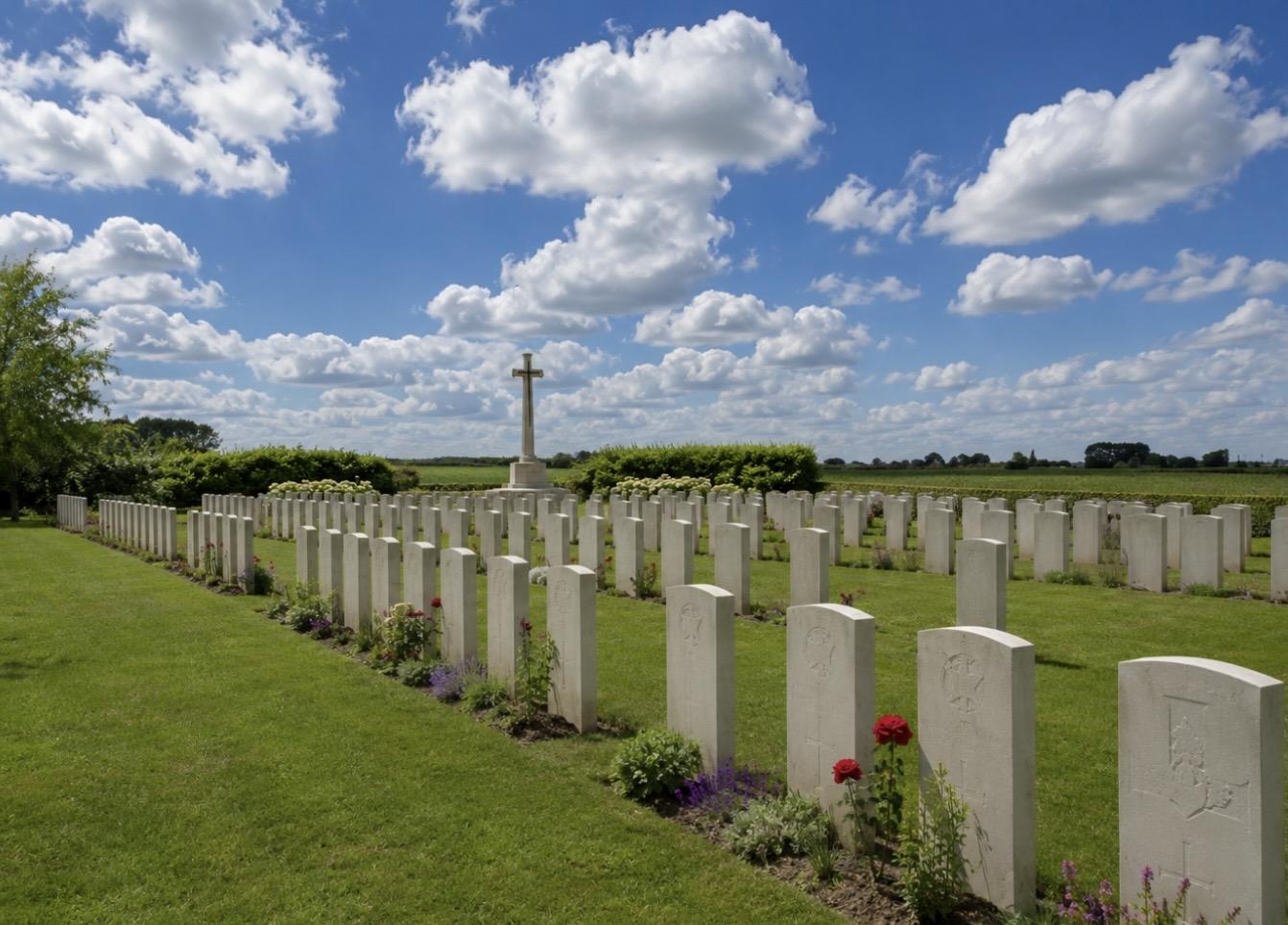
The bodies of the murdered soldiers were initially buried locally. About 50 of the 97 bodies were identified when the remains were recovered and reburied. Many of the dead now lie at Le Paradis War Cemetery, Lestrem. The dead included men from the Royal Norfolk Regiment and other British units caught up in the fighting. Memorials later commemorated the 97 soldiers who died in the massacre on 27 May 1940 at Le Paradis, including men of the 2nd Battalion Royal Norfolk Regiment, the 1st Battalion Royal Scots, and other British Expeditionary Force units.
After the war, British investigators pursued the case as a war crime. The evidence included testimony from the two survivors, local French witnesses, and material identifying the SS unit involved. Fritz Knöchlein was eventually arrested and tried by a British military court at Hamburg in 1948. He denied responsibility, but the court found him guilty. He was sentenced to death and was executed by hanging in January 1949. No large number of other men from the unit were prosecuted for their part in the massacre, which has remained a source of anger and sorrow for families and regimental historians.
The atrocity is important for several reasons. First, it shows that the fighting around Dunkirk was not only about the dramatic evacuation from the beaches. Inland, many units were sacrificed or nearly destroyed in rearguard actions. The evacuation succeeded partly because men like those of the Royal Norfolks held their positions under overwhelming pressure. Secondly, Le Paradis exposed the criminal behaviour of parts of the Waffen-SS in the 1940 campaign. The massacre was not committed in the later, more familiar setting of the Eastern Front or the concentration camp system, but in France, during the opening year of the war in the west. Thirdly, it is a reminder of how easily the dead might have been forgotten had two wounded men not survived to testify.
The massacre also sits alongside other atrocities committed during the same period of fighting in northern France and Belgium. Around the Dunkirk campaign there were several killings of prisoners and civilians by German forces, including other incidents involving SS units. Le Paradis remains one of the best-known British examples because of the Royal Norfolk connection, the survival of Pooley and O’Callaghan, and the later trial of Knöchlein.
For Norfolk, the event became a deep regimental wound. The Royal Norfolk Regiment had a long history, but Le Paradis became one of its darkest and most solemn episodes. Memorials in France and Britain preserve the memory of the dead. A memorial at Norwich Cathedral is dedicated to the soldiers who died in the massacre, and books such as Last Stand at Le Paradis have helped keep the story in public memory.