Kriegsmarine Enigma Machine
The Kriegsmarine Enigma was one of the most important and difficult cipher systems used by Germany during the Second World War. Although Enigma machines were used by the German army, air force, navy, intelligence services and other organisations, the naval version used by the Kriegsmarine was in many ways the most serious challenge for Allied codebreakers. It was not just the machine itself that made it so dangerous, but the way the German navy used it, the strictness of its procedures, the extra rotors, the special codebooks, and the vital importance of the messages it protected.
The Kriegsmarine depended on wireless communication. Its ships and submarines were spread across huge areas of ocean, often far from any German base. A U-boat in the North Atlantic, a surface raider in distant waters, a weather ship in the Arctic, or a naval command station in occupied France all needed to send and receive instructions. Radio made this possible, but radio was never private. Any signal sent through the air could be picked up by an enemy listening station. The Germans knew this, so the real protection was not in hiding the signal, but in making the message unreadable. That was the purpose of Enigma.
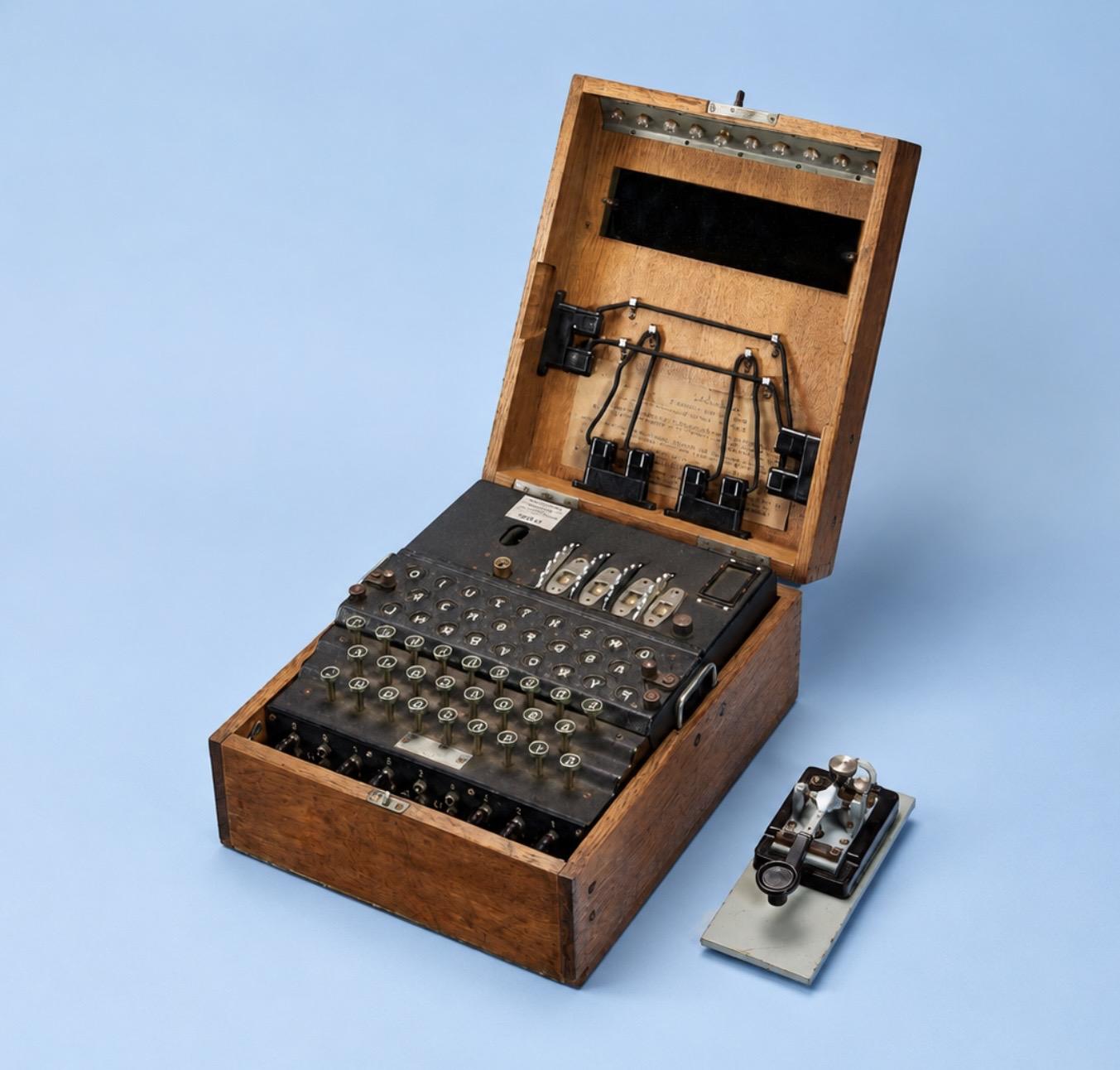
The naval Enigma machine looked at first like a small typewriter fitted inside a wooden case. It had a keyboard, a lampboard, a set of rotors under a lid, and a plugboard at the front. It did not print words on paper. When an operator pressed a key, a different letter lit up on the lampboard. The operator wrote that letter down. Letter by letter, an ordinary message became a meaningless-looking string of letters, usually sent in groups of five by Morse code. At the receiving end, another operator with an Enigma machine set up in exactly the same way typed in those encrypted letters and read the original message from the lamps.
What made Enigma so clever was that it did not use the same substitution all the time. In a simple cipher, A might always become Q and B might always become L. Enigma was different. Every time a key was pressed, the machine changed internally. The rotors moved, altering the electrical path through the machine. This meant that pressing the same letter again could produce a completely different result. A could become Q once, then perhaps T, then M, then another letter later on. This constantly changing alphabet made the machine appear almost impossible to break.
Inside the machine, the path of the electrical current was the secret. When the operator pressed a letter, the current first went through the plugboard. From there it passed through the rotors, each of which contained hidden wiring. The current then reached the reflector, which sent it back through the rotors by another route. After passing once more through the plugboard, it lit a letter on the lampboard. The whole process happened instantly, but the route was complicated and changed as the rotors stepped forward.
The rotors were the heart of the machine. Each rotor was a wheel with electrical contacts on both sides and scrambled wiring inside. The wiring turned one letter into another as the current passed through. A machine using three rotors already had a large number of possible settings, because the rotors could be chosen, arranged in different orders, and set to different starting positions. The Kriegsmarine made this more complicated by using more rotors than the army or air force. Naval Enigma operators eventually had eight main rotors to choose from, marked I to VIII. This gave the German navy many more possible combinations and made naval traffic far harder to break.
The order of the rotors mattered greatly. If a machine used rotors I, IV and VII in one order, it produced a different cipher from the same rotors placed in another order. Each rotor also had a starting position, shown by letters visible through little windows on the top of the machine. On top of that, each rotor had a ring setting, known as the Ringstellung. This altered the relationship between the visible alphabet ring and the internal wiring. To someone unfamiliar with the machine, these details might seem small, but to a codebreaker each one multiplied the difficulty.
The reflector was another important part of the system. It allowed the same Enigma machine settings to be used both for enciphering and deciphering. This was very practical for military use. A U-boat did not need one machine to encrypt and another to decrypt. The same machine did both jobs. But the reflector also created a weakness that later became useful to the Allies. Because of the way Enigma was wired, a letter could never encrypt as itself. If the operator pressed A, the lamp would never show A. To the Germans this did not seem a serious problem, but to the codebreakers at Bletchley Park it became one of the clues that helped them reject wrong settings.
The plugboard, or Steckerbrett, made the machine far stronger. It sat at the front of the Enigma and allowed pairs of letters to be swapped by cables. If A was plugged to M, then A and M were exchanged before and after the current passed through the rotors. During much of the war, German military Enigma commonly used ten plugboard leads, which meant twenty letters were paired and six were left unplugged. This created an enormous number of possible arrangements. The plugboard was one of the reasons Enigma could not simply be solved by understanding the rotor wiring. Even if the rotors were known, the plugboard settings still had to be discovered.
The Kriegsmarine version was not a single unchanging machine. Early in the war, the navy used the three-rotor naval Enigma, usually known as the M3. This machine was similar in appearance to other military Enigma machines, but the naval operating system was more secure. The German navy used more careful message procedures and extra code material. Its operators were trained to follow stricter rules than many army or air force operators. This made their traffic more difficult to attack.
The most famous Kriegsmarine machine was the four-rotor Enigma, usually known as the M4. It was introduced for U-boat traffic in February 1942 and caused a serious crisis for Allied codebreakers. The M4 added a fourth rotor, a thin wheel used with a thin reflector so that it could fit into the same general machine casing. This extra rotor greatly increased the number of possible settings. To the Germans it was a sensible improvement. To the Allies it was disastrous at first, because much of the important U-boat traffic suddenly became unreadable.
The main U-boat cipher network was called Shark by the Allies. When the four-rotor M4 entered use on this network, Bletchley Park was thrown into a blackout. For months, the Allies struggled to read the messages that directed German submarines in the Atlantic. This came at one of the most dangerous periods of the Battle of the Atlantic, when U-boats were sinking Allied merchant ships at an alarming rate. Convoys crossed the ocean carrying food, oil, aircraft, weapons, troops and raw materials. If the U-boats had cut that lifeline, Britain’s ability to stay in the war would have been placed in grave danger.
The Kriegsmarine Enigma was not used alone. The navy also used special codebooks before messages were put through the machine. These included short signal books, weather codes and naval grid references. This meant that many messages were already shortened or disguised before Enigma encrypted them. U-boats often needed to send brief signals, because staying on the radio too long was dangerous. Allied direction-finding stations could detect a transmission and estimate the position of the submarine. The shorter the signal, the safer the U-boat.
A typical U-boat message might report a convoy sighting, a position, fuel state, damage, weather conditions or a request for orders. Instead of spelling out everything in full, the operator could use short groups from a codebook. These were then enciphered on Enigma and transmitted. This saved time, but it also made the work harder for Allied codebreakers, because the underlying plain text was not always ordinary German. It might be a compressed code group from a naval book.
The daily settings were the key to everything. Every Enigma operator needed to know which rotors to use, the order of the rotors, the ring settings, the plugboard connections and the procedure for setting the message key. These instructions were printed in secret key sheets and codebooks. Without them, the machine was almost useless. With them, another German station could set up its machine in the same way and read the message.
The Germans guarded these documents very carefully. U-boats carried cipher material in special containers and crews were under orders to destroy it if capture seemed likely. Some material was printed in ink that would run in water, and some was kept ready to be thrown overboard. In the chaos of battle, however, things did not always go as planned. Damaged submarines surfaced unexpectedly, crews abandoned ship in panic, and boarding parties sometimes reached vessels before everything had been destroyed.
Captured material became one of the great secrets of the Enigma war. Allied codebreakers were brilliant, but they were not magicians. Captured key sheets, short signal books, weather codes, rotors and machine parts could give them the clues they needed. One of the most famous captures came from U-110 in May 1941. The submarine was forced to the surface and abandoned, and British sailors managed to recover valuable Enigma material before it sank. The Germans did not realise how much had been taken, which made the capture even more useful.
Another vital moment came with U-559 in October 1942. British sailors boarded the sinking submarine in the Mediterranean and recovered codebooks connected with the naval Enigma system. Some of the men involved lost their lives when the submarine went down. The documents they recovered helped Bletchley Park break back into the Shark traffic after the introduction of the M4. It was a reminder that the intelligence war was not only fought by mathematicians in huts, but also by sailors risking their lives in the dark, wet interiors of sinking U-boats.
Bletchley Park, the British codebreaking centre in Buckinghamshire, became the heart of the Allied attack on Enigma. The work there built on the earlier achievements of Polish codebreakers, who had made crucial breakthroughs against Enigma before the war and shared their knowledge with Britain and France. At Bletchley, the naval Enigma problem was handled by specialists including Alan Turing and many others whose names were less famous but whose work was essential.
The codebreakers searched for patterns, mistakes and likely pieces of text. These likely pieces were called cribs. A crib might be a guessed phrase in a weather report, a standard opening, a repeated naval expression, or a message format used again and again. Once a crib was found, machines called Bombes could test possible Enigma settings at high speed. The Bombe did not simply read messages by itself. It helped eliminate impossible settings and point the codebreakers towards likely solutions.
Naval Enigma remained harder than many other German systems because Kriegsmarine messages were often shorter, more disciplined and less predictable. Army and Luftwaffe operators made more mistakes and used more repeated formats. The navy was more careful. U-boat traffic in particular gave Bletchley Park long periods of difficulty. Even when the Allies broke into a network, the Germans could change procedures, introduce new keys or alter settings, and the work had to begin again.
The importance of Kriegsmarine Enigma lay in the Battle of the Atlantic. When Allied intelligence could read U-boat traffic, convoys could sometimes be routed around danger. If a line of submarines was waiting across a convoy route, the convoy could be diverted. If a supply submarine was ordered to meet U-boats at sea, aircraft or warships might be sent to find it. If German command shifted its submarine groups, the Allies could respond. This did not mean every message was read in time, and it did not mean every convoy was saved, but it gave the Allies a hidden advantage of enormous value.
The intelligence gained from Enigma was known as Ultra. It was among the most secret information of the war. The Allies had to use it carefully. If German commanders noticed that convoys always avoided U-boat traps, they might suspect that their cipher had been broken. For that reason, Ultra intelligence was often disguised. A patrol aircraft might be sent to “find” a submarine whose position was already known from a decrypt. A convoy might be rerouted for reasons that appeared to be connected with weather, reconnaissance or routine planning. Protecting the secret was almost as important as reading the messages.
The Germans had great faith in Enigma. Many German officers believed the machine was unbreakable if used correctly. In one sense, their confidence was understandable. The number of possible settings was vast, and without the right procedures, documents and machines, reading the traffic seemed impossible. What they did not fully understand was that the Allies were not simply trying every possible setting blindly. They were using captured material, operator habits, cribs, mathematical logic, mechanical testing machines and enormous human effort.
The weakness of Enigma was not that it was badly designed. It was actually a remarkable piece of engineering for its time. Its weakness was that no machine exists alone. It depends on people, procedures, documents and habits. German operators sometimes made mistakes. Messages sometimes followed predictable patterns. Codebooks were sometimes captured. The machine’s design contained small weaknesses, such as the fact that no letter could encrypt as itself. Each weakness by itself might not have been enough, but together they opened doors.
Life for the Kriegsmarine Enigma operator was not glamorous. On a U-boat, the radio room was cramped and tense. The operator had to copy Morse signals, handle secret documents, set up the Enigma correctly, and avoid errors. A single wrong rotor setting or plugboard connection could make a message unreadable to the receiver. During patrols, the operator worked in a world of stale air, machinery noise, sweat, fear and constant danger. He knew that transmitting for too long could help enemy direction-finding stations locate the boat.
The U-boat commander also faced a difficult balance. Radio silence made the submarine harder to find, but it also cut the boat off from command. Sending reports allowed Dönitz to coordinate attacks, but it exposed the submarine to detection. Enigma protected the contents of the message, but it could not hide the fact that a signal had been sent. This became increasingly important as Allied radio direction-finding improved.
The M4 Enigma showed both the strength and the limits of German cipher security. Its introduction caused real trouble for the Allies, proving that the Germans could still improve their systems. Yet it did not end Allied codebreaking. With captured documents, improved Bombes, American assistance and relentless work, the Allies eventually recovered the ability to read much of the traffic. Once that happened, the U-boat war became increasingly difficult for Germany.
By 1943, the tide in the Atlantic was turning. Better escorts, escort carriers, centimetric radar, long-range aircraft, Huff-Duff, improved weapons and intelligence all combined against the U-boats. Enigma intelligence was not the only reason for Allied success, but it was a major part of the wider system. It helped commanders understand where the submarines were, how German tactics were changing, and where the next danger might come from.
One of the most interesting things about the Kriegsmarine Enigma is that it was both a triumph and a trap. For the Germans, it allowed fast and flexible command of submarines across the ocean. Without radio and Enigma, Dönitz could not have controlled the U-boat war in the same way. But that same flow of messages gave the Allies material to intercept, study and eventually exploit. The more the German navy communicated, the more chances the codebreakers had to break in.
The secrecy surrounding Enigma lasted long after the war. Many people who worked at Bletchley Park were unable to talk about their wartime service for decades. Some returned to ordinary lives without even their families knowing what they had done. The full importance of Enigma codebreaking only became widely known years later. By then, the story had become one of the great examples of intelligence, mathematics and engineering changing the course of history.
Today, surviving Kriegsmarine Enigma machines are rare and highly valued. The four-rotor naval M4 is especially prized because of its direct connection with the U-boat war. To see one now is to look at a small machine that once sat in the centre of a vast secret struggle. It was not large, loud or dramatic. It did not look like a weapon. Yet it influenced convoy routes, submarine attacks, naval strategy and the survival of thousands of sailors.
The Kriegsmarine Enigma was important because it stood at the meeting point of technology, secrecy and warfare. It allowed Germany to command its naval forces over great distances, especially the U-boats that threatened Britain’s Atlantic lifeline. It gave German commanders confidence that their orders were safe from enemy eyes. At the same time, the Allied battle to read those messages became one of the most important hidden campaigns of the war.
In the end, the Kriegsmarine Enigma was not defeated by one person or one discovery. It was overcome by a chain of effort: the original Polish breakthroughs, the work of Bletchley Park, the design and use of Bombe machines, the bravery of sailors who captured codebooks, the patience of wireless intercept operators, and the careful use of Ultra intelligence by Allied commanders. The machine itself was brilliant, but the system around it could be attacked.