Hobos “funnies”
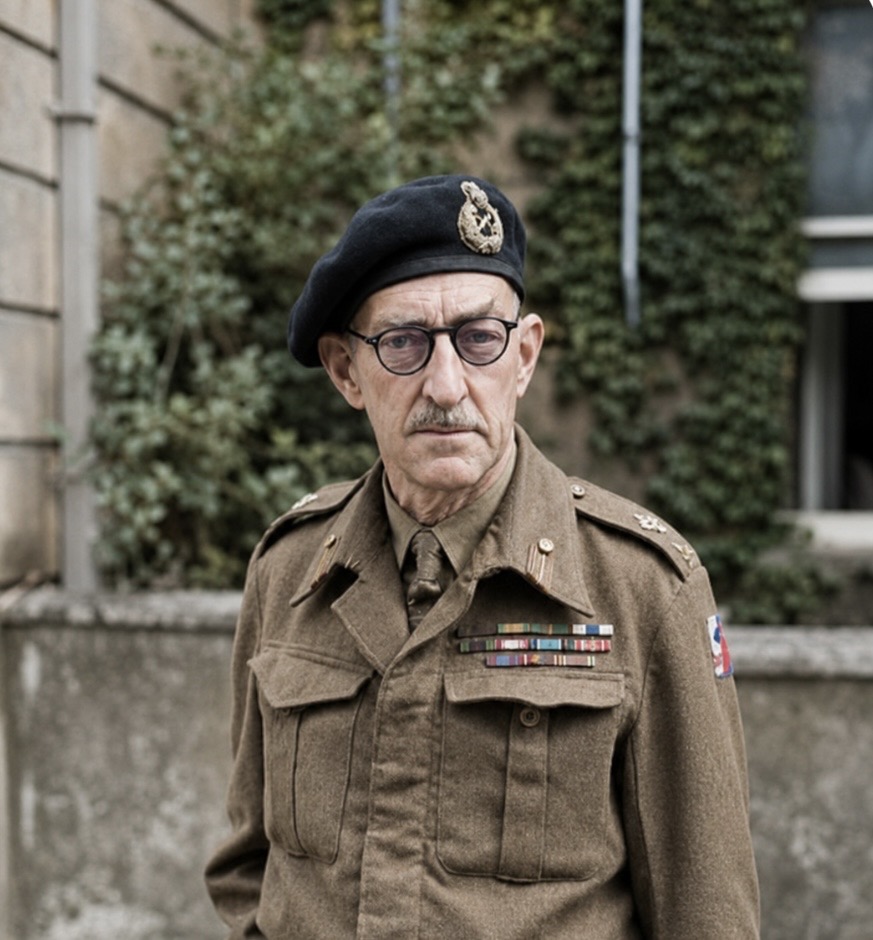 Major-General Sir Percy Hobart, known to many as “Hobo”, was one of the most unusual and important British soldiers of the Second World War. He was not the sort of commander who believed that courage alone could solve every battlefield problem. To Hobart, it was wasteful and unimaginative to keep throwing infantry against wire, mines, concrete, soft sand and enemy guns, hoping that enough men would survive to push a few yards forward. He believed machines, properly designed and boldly used, could save lives as well as win ground. That belief helped produce some of the strangest and most useful armoured vehicles of D-Day: the famous “Hobart’s Funnies”.
Percy Cleghorn Stanley Hobart was born in Naini Tal, India, in 1885, into a British family serving in the empire. He was educated in Britain and went through the Royal Military Academy at Woolwich before being commissioned into the Royal Engineers. That engineering background mattered. Hobart was not just a soldier who liked tanks; he understood obstacles, terrain, machinery and practical battlefield problems. During the First World War he served in France and Mesopotamia, winning recognition for bravery and ability. He later moved into the new world of armoured warfare, a field that many traditional officers still distrusted.
Hobart rose through the ranks because he saw the future earlier than many of his superiors. In the years between the wars, while some still thought of tanks as little more than moving shields for infantry, Hobart argued that armour could be used in fast, concentrated, decisive ways. He helped develop British armoured thinking and became closely associated with the Royal Tank Corps. His ideas, however, made him enemies. He was clever, impatient and difficult to ignore, and he did not fit comfortably into an army still full of cavalry habits and conservative thinking. By 1940 he had been forced into retirement, an astonishing waste of one of Britain’s best tank minds. For a time he was reduced to serving in the Home Guard.
Winston Churchill helped bring him back. Britain needed men who could think differently, and Hobart was given the chance to train armoured formations again. Eventually he was placed in command of the 79th Armoured Division, which became less a normal division and more a great workshop of battlefield invention. Its job was to solve the problems that would face the Allied armies when they landed in Normandy: mines, sea walls, shingle, soft sand, deep ditches, concrete bunkers, wire and anti-tank obstacles. Ordinary bravery would not be enough. Hobart’s answer was to build special tanks for special problems.
The result was a collection of machines so odd-looking that they became known as “Hobart’s Funnies”. They may have looked comical, but they were deadly serious. They were designed to get men off the beaches quickly and keep the invasion moving inland before the Germans could crush the bridgehead.
One of the most useful was the Churchill AVRE, or Armoured Vehicle Royal Engineers. This was a Churchill tank adapted to carry Royal Engineers and their equipment into the thick of battle. It could fire a large demolition charge, nicknamed the “Flying Dustbin”, against bunkers, walls and strongpoints. Instead of sending engineers forward on foot under machine-gun fire, the AVRE gave them armour, mobility and heavy hitting power.
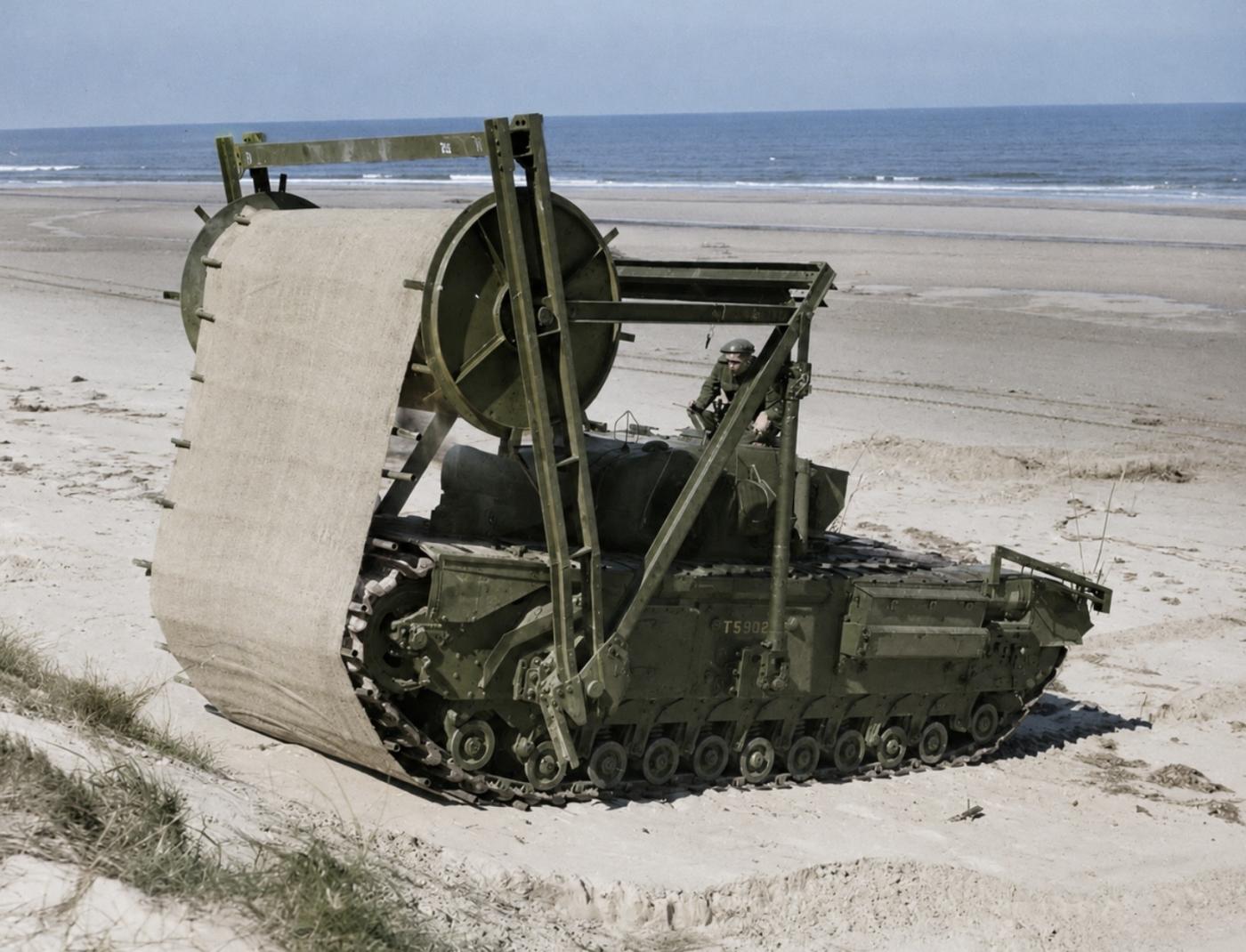
The bobbin tank was another brilliant answer to a simple but dangerous problem. Vehicles landing on beaches could become trapped in soft sand or mud, blocking the way for everything behind them. The bobbin carried a huge roll of strong matting, which it laid out in front of itself as it moved. This created a temporary road across unstable ground, allowing trucks, guns and other vehicles to get off the beach and move inland. It was not glamorous, but on D-Day such practical inventions could make the difference between an advance and a traffic jam under fire.
The Crab flail tank was built to deal with mines. A rotating drum at the front of the tank whipped heavy chains against the ground, exploding mines before infantry and vehicles reached them. It was noisy, violent and strange to watch, but it cleared paths through minefields far faster and safer than men probing the sand by hand.
The Churchill Crocodile was one of the most feared of the Funnies. It was a flame-throwing tank, towing an armoured fuel trailer behind it. Against bunkers and fortified positions, its psychological effect was enormous. German troops who might fight stubbornly against ordinary attack were often far less willing to stay inside a position once a Crocodile appeared.
There were also bridge-laying tanks and fascine carriers. A fascine was a great bundle of brushwood or similar material dropped into a ditch or crater so vehicles could cross. Other tanks carried small bridges or ramps. Each machine answered a particular question: how do we cross this ditch, breach this wall, clear this minefield, destroy this bunker, or stop vehicles sinking into the beach?
Hobart’s genius was not that he personally invented every nut and bolt. His importance was that he understood the problems, gathered the right people, pushed the ideas forward, trained the crews and insisted that these strange vehicles be treated as essential tools rather than curiosities. He turned engineering into a form of attack.
On 6 June 1944, Hobart’s Funnies played a major role on the British and Canadian beaches in Normandy. They helped clear obstacles, open exits and keep the assault moving. Their value was especially clear when compared with the terrible difficulties faced where such specialised armour was not used in the same way or in the same numbers. D-Day was still bloody and dangerous, but on beaches where the Funnies worked well, they helped prevent the landings from becoming an even worse slaughter.
Hobart’s thinking was the opposite of the old meat-grinder approach to war. He did not believe soldiers should be fed into impossible obstacles simply because tradition admired courage. He wanted courage joined to preparation, engineering and imagination. His tanks were ugly, noisy and often ridiculous-looking, but they were humane in the most practical military sense: they were built to do jobs that would otherwise kill men.
After the war, Hobart did not become as famous as Montgomery, Eisenhower or Churchill. He retired from the Army in 1946 and later served at the Royal Hospital Chelsea. He died in 1957. Yet his influence lived on. Modern combat engineering vehicles, mine-clearing tanks and specialised assault armour all owe something to the principles seen in Hobart’s Funnies. He showed that winning a battle was not only about numbers, guns and bravery, but about solving the exact problems that stop an army moving.
Percy Hobart was a difficult man, but history often needs difficult people. He challenged lazy thinking, annoyed traditionalists and refused to accept that mass casualties were the natural price of progress. On D-Day, his strange tanks helped men cross beaches, break through defences and move inland. The Funnies may have had a humorous name, but their achievement was deadly serious: they helped turn one of the most dangerous assaults in history into a successful invasion.