HMS Hood
HMS Hood was one of the most famous warships ever built for the Royal Navy. For more than twenty years, the ship stood as a visible symbol of British sea power, combining great size, heavy guns, high speed and a strikingly elegant appearance. Officially classed as a battlecruiser, Hood in practice stood between the older battlecruiser idea and the fast battleships that followed later.
The design came from the British Admiralty’s Director of Naval Construction department during the First World War. The principal designer most closely associated with the ship was Sir Eustace Tennyson d’Eyncourt, who served as Director of Naval Construction from 1912 to 1924. D’Eyncourt and his team were responsible for many important Royal Navy designs of the period, including battleships, battlecruisers, cruisers, submarines and monitors. Hood was planned as the lead vessel of the Admiral-class battlecruisers, a group originally intended to include four ships: Hood, Anson, Howe and Rodney. Only Hood was completed.
The Admiral-class design was strongly influenced by lessons from the First World War, especially the Battle of Jutland in 1916. Earlier British battlecruisers had been fast and heavily armed, but their protection had proved vulnerable under intense shellfire. During construction, Hood’s design was revised to improve armour protection. This made the ship far better protected than earlier British battlecruisers, though still not as fully protected as a true battleship. The final design represented a compromise: the speed and long-range striking power of a battlecruiser, with stronger armour than previous ships of that type.
HMS Hood was built by John Brown & Company at Clydebank, on the River Clyde in Scotland. This shipyard was one of Britain’s most important naval and commercial shipbuilders, responsible for many great liners and warships. The keel was laid down on 1 September 1916, and the ship was launched on 22 August 1918 by Lady Hood, widow of Rear-Admiral Sir Horace Hood, who had been killed at Jutland. The name honoured Admiral Samuel Hood, 1st Viscount Hood, one of the Royal Navy’s notable commanders of the eighteenth century. Commissioning took place in 1920.
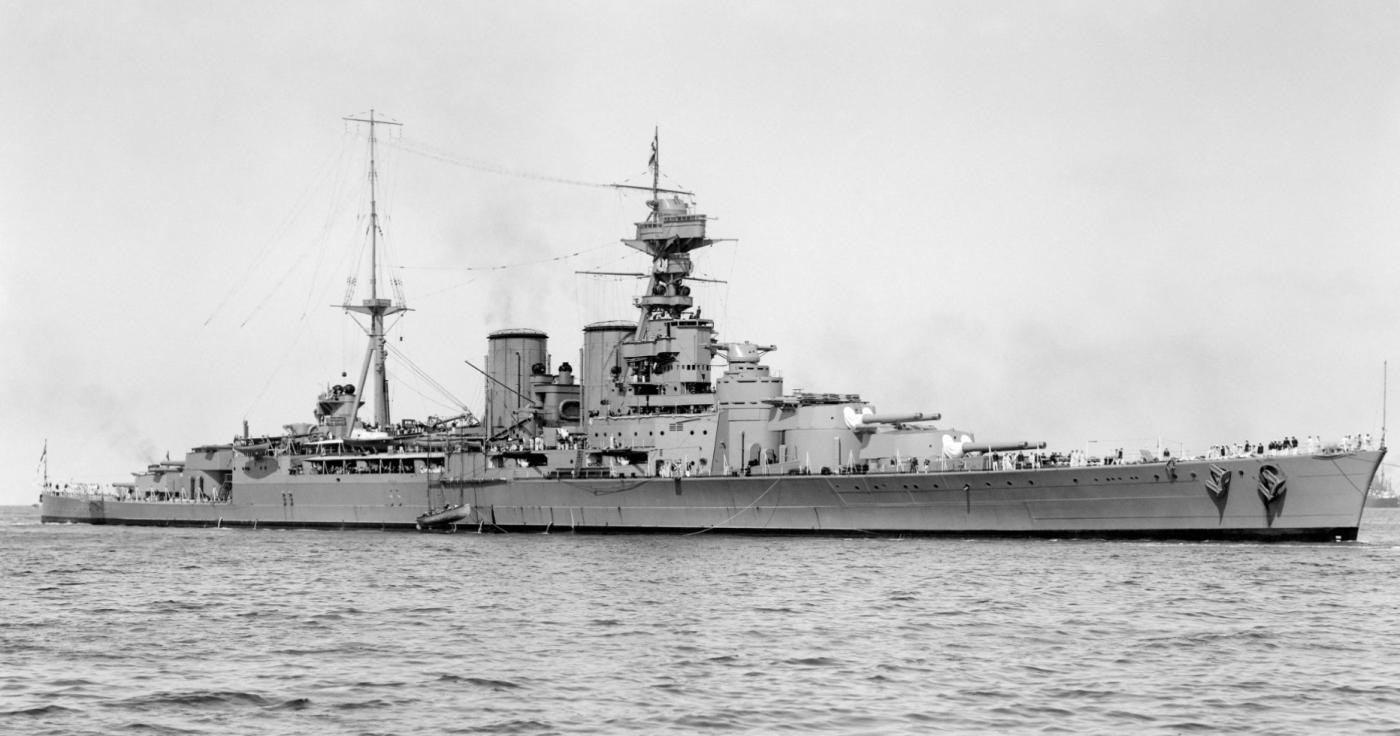
At the time of completion, HMS Hood was the largest warship in the world. Standard displacement was about 42,100 tons, while full-load displacement was around 46,000 to 48,000 tons, depending on fuel, stores and later additions. Overall length was approximately 860 feet 7 inches, with a beam of about 104 feet 2 inches. Such dimensions were extraordinary for the period, and the long, graceful hull gave Hood a distinctive appearance that made the ship instantly recognisable.
The machinery was extremely powerful. Hood used geared steam turbines supplied by twenty-four Yarrow boilers, producing around 144,000 shaft horsepower and driving four propeller shafts. Designed speed was about 31 knots, very fast for such a large and heavily armed vessel. This speed allowed Hood to operate with cruisers as well as capital ships, making the battlecruiser useful for rapid deployment, fleet operations and overseas visits.
The main armament consisted of eight 15-inch guns mounted in four twin turrets. These were arranged in the classic layout of two forward and two aft. The forward turrets were named “A” and “B”, while the after turrets were “X” and “Y”. The 15-inch gun was one of the Royal Navy’s most successful heavy naval weapons, admired for reliability, accuracy and hitting power. Each shell weighed roughly 1,920 pounds, and the guns could strike targets many miles away. A full broadside from Hood’s main battery threw nearly eight tons of metal.
The secondary armament changed over time. When first completed, Hood carried twelve 5.5-inch guns intended for use against smaller ships such as destroyers. These weapons were mounted singly and were useful for surface defence, though air attack became a greater threat as the years passed. Later modifications strengthened the anti-aircraft armament, adding weapons such as 4-inch anti-aircraft guns, multiple 2-pounder “pom-pom” mounts and smaller machine-gun weapons. Like many older warships, Hood had to be adapted to meet the growing danger from aircraft, but a full modernisation was never completed.
Torpedo tubes were also fitted when the ship entered service. Hood carried submerged torpedo tubes and later above-water tubes as well, although torpedoes became less central to capital ship combat as naval tactics developed. Their inclusion reflected older naval thinking, when large warships were still sometimes expected to fight at closer ranges.
Armour protection was much heavier than on earlier British battlecruisers. The main belt was up to 12 inches thick, protecting the central part of the ship, including machinery spaces and magazines. Turret armour was also substantial, with heavy frontal protection. However, like many ships designed during the First World War, deck armour was not as strong as later battleship standards required. As naval gunnery improved, long-range shells falling at steeper angles made deck protection increasingly important.
Crew size varied depending on role, period and wartime additions. In peacetime, Hood carried roughly 1,300 officers and ratings. In wartime, with extra anti-aircraft crews, communications personnel and other specialists, the complement rose to around 1,400 or more. Life aboard such a large warship was a world of its own. Gunnery crews, engineers, stokers, signalmen, Royal Marines, cooks, stewards, armourers, medical staff, officers and petty officers all had vital parts to play in keeping the vessel moving, fighting and functioning.
One of the most interesting aspects of Hood’s career was the ship’s role as a diplomatic instrument. During the interwar years, Hood travelled widely and became known as “The Mighty Hood”. The battlecruiser visited ports across the world and took part in the famous Empire Cruise of 1923–1924, officially called the Special Service Squadron world cruise. This voyage was intended to demonstrate British naval strength and imperial unity after the First World War. Hood’s impressive size and appearance made the vessel ideal for this role, and crowds often gathered wherever the ship arrived.
Appearance contributed greatly to the fame. Hood had a long, low, balanced profile, with tall funnels, powerful turrets and a sleek hull. Many naval enthusiasts and sailors considered the ship one of the most handsome warships ever built. The design looked fast, modern and powerful, which mattered at a time when warships were not only weapons but also symbols of national prestige.
By the late 1930s, Hood was no longer a new ship. The design belonged to the First World War era, although modifications had been made over the years. There were plans for a major reconstruction, including improvements to deck armour, machinery, anti-aircraft defences and fire-control systems. Such work would have required taking the ship out of service for a long period, and the growing international crisis made that difficult. Britain needed every major warship available, so the full reconstruction was repeatedly delayed.
The fire-control system was advanced for its day and was updated as technology improved. Large optical rangefinders, directors and later radar-assisted systems helped control the main guns. Before radar became reliable and widespread, naval gunnery depended heavily on optics, careful calculation, spotting the fall of shot and correcting aim. A ship of Hood’s size required well-trained gunnery crews and precise coordination between the bridge, directors, transmitting stations and gun turrets.
Firing the 15-inch guns was a complex operation. Each turret was a heavily armoured machinery space in its own right. Shells and propellant charges had to be brought up from magazines deep within the ship by hoists and handling rooms. The guns were loaded, trained, elevated and then fired either individually or in salvoes. The blast was immense and could damage lighter fittings if precautions were not taken.
The propulsion system also demanded huge effort from the crew. Boilers produced steam to drive the turbines, and the engineering spaces were hot, noisy and dangerous. Stokers and engine-room crews worked deep within the hull, far from daylight, ensuring the ship could maintain speed. A large capital ship’s performance depended as much on engineers as on gunners.
Hood’s classification as a battlecruiser is important. The battlecruiser concept was based on a ship with battleship-sized guns and high speed, achieved by accepting lighter armour than a battleship. Such vessels were intended to hunt cruisers, scout for the battle fleet and use speed to choose when to fight. Hood, however, was more heavily protected than earlier battlecruisers, and some have described the ship as a fast battleship in all but name. Even so, the design retained some of the compromises of the battlecruiser tradition.
Only one Admiral-class ship was completed because the end of the First World War and later naval treaties changed Britain’s shipbuilding priorities. The intended sister ships were cancelled, leaving Hood unique. This added to the reputation. There was no direct sister in service, and for many years Hood stood alone as the Royal Navy’s largest and most prestigious capital ship.
The name carried historic weight. The Hood family had a long naval tradition, and the name connected the ship to earlier British naval commanders and victories. Such tradition mattered deeply in the Royal Navy, where ship names often carried honour, memory and expectation.
By the Second World War, Hood remained fast and powerful, but age was becoming increasingly obvious. The ship continued to serve as a major fleet unit because of speed, heavy guns and symbolic value. The battlecruiser’s presence had a strong psychological effect, both on allies and potential enemies. Hood was not simply another warship; the vessel had become a national icon.
In summary, HMS Hood was designed under Sir Eustace Tennyson d’Eyncourt’s Director of Naval Construction team and built by John Brown & Company at Clydebank. Completed as the only member of the Admiral class, the ship displaced about 42,100 tons standard and around 46,000 tons or more fully loaded. Crew numbers were usually around 1,300 in peacetime and rose to around 1,400 or more in wartime. Main firepower came from eight 15-inch guns, supported by secondary guns, anti-aircraft weapons and torpedo tubes. Fast, elegant, heavily armed and internationally famous, HMS Hood became one of the defining naval symbols of the interwar Royal Navy and one of the most recognised warships in history.