Hitler youth cap & Badge
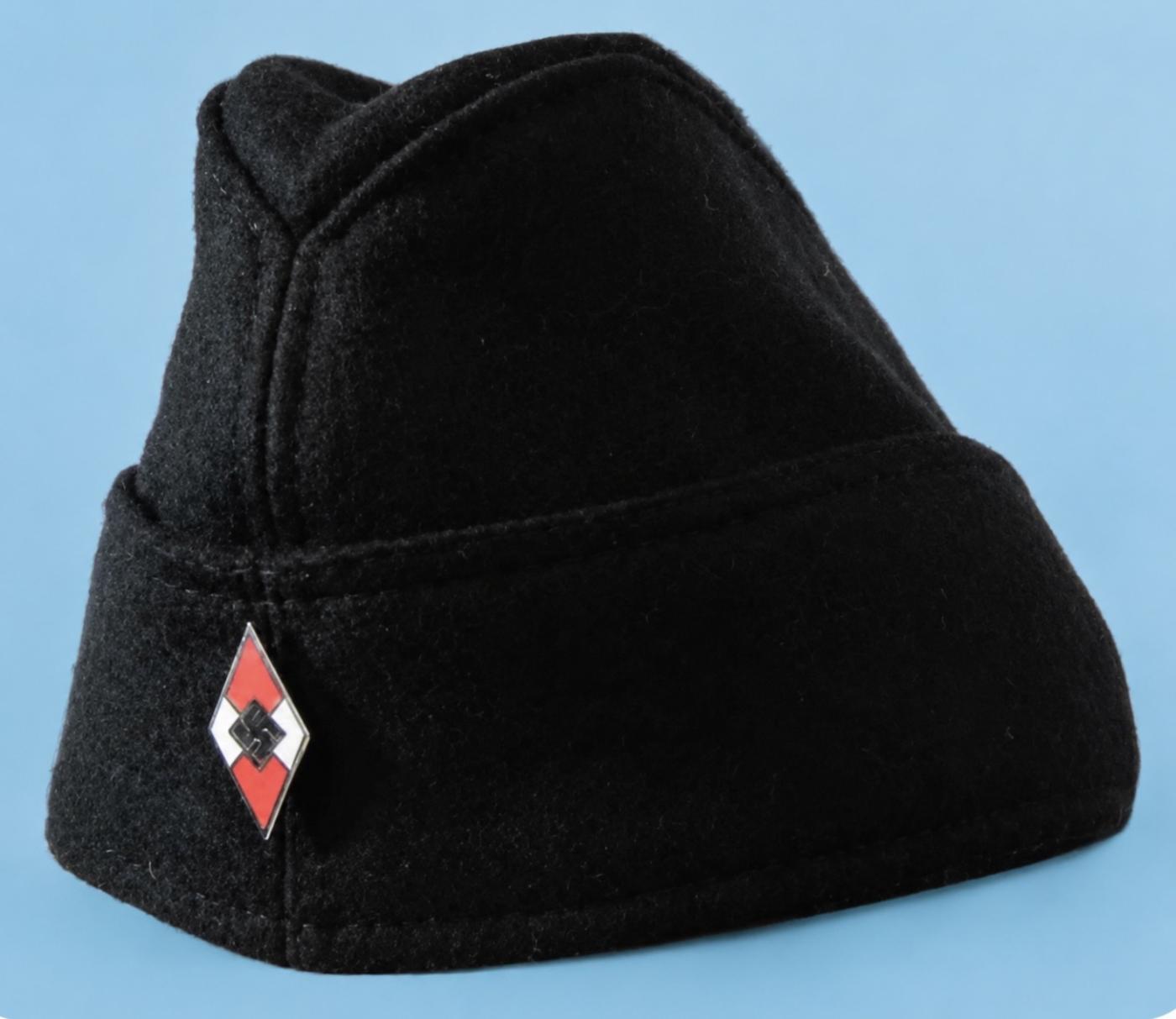
The cap badge shown is a Hitler Youth, or Hitlerjugend, enamel cap badge of the familiar diamond form, marked on the reverse with the RZM emblem and the code M1/128. It is a small object, but it carries a great deal of historical information. It belongs to the controlled system of Nazi Party uniform insignia, where even minor badges were standardised, licensed and distributed through official channels. The design is instantly recognisable: a black swastika in the centre, set over the red and white quartered diamond of the Hitler Youth. On caps, this badge served as the youth organisation’s principal identifying emblem.
The mark M1/128 is especially important. In the RZM system, “M” referred to metal items, and “M1” was the section used for metal badges and insignia. The number after the slash identified the licensed maker. M1/128 is attributed to Eugen Schmidhäussler of Pforzheim, Germany. Pforzheim was one of Germany’s major centres for jewellery, watchmaking, metalwork and small decorative manufacture, so it is not surprising to find many political badges and awards connected with firms from that town. Schmidhäussler produced a range of small metal insignia and decorations, not only Hitler Youth items but also other Nazi Party badges and wartime pieces.
The reverse mark is often misunderstood. The round mark sometimes described by collectors as a “circle” is the RZM logo, standing for Reichszeugmeisterei. This was the Nazi Party’s central quartermaster and licensing authority. Its purpose was to control the quality, pattern, distribution and commercial production of Party uniforms, equipment and insignia. A badge with an RZM code was not simply a souvenir made by any workshop; it was intended to show that the item came from a licensed manufacturer working within the Party’s regulated supply system. That said, modern reproductions also copy RZM marks, so the presence of the mark alone does not prove originality.
The badge was not designed by Eugen Schmidhäussler. The firm was the producer, not the original designer of the Hitler Youth emblem. No single named artist or designer can be securely credited with creating this particular cap badge pattern. The design was an official Nazi youth emblem, derived from the broader Nazi visual language: the black swastika, the red-white-black colour scheme, and the sharp diamond form associated with the Hitler Youth. The colours echoed the National Socialist movement’s use of the old German imperial colours, while the swastika placed the youth organisation visually under the ideology of the Nazi Party.
The Hitler Youth diamond was used in many forms: cap badges, lapel badges, cloth insignia, belt buckles, dagger grips, documents, flags and awards. Its function was both practical and propagandistic. Practically, it identified the wearer as a member of the Hitler Youth. Symbolically, it turned children and teenagers into visible representatives of the Nazi state. The badge therefore should not be treated merely as a decorative piece of enamelwork. It was part of a larger system of political indoctrination, discipline and public display.
The cap itself, when fitted with this badge, would have been part of the uniform appearance of Hitler Youth members. Different branches and ranks used different forms of headgear, including side caps and peaked caps, and the diamond badge could appear on various types of Hitler Youth headwear. On a standard youth cap, the badge was normally mounted at the front or front side, depending on the cap pattern. The enamel diamond gave a strong visual contrast against the cloth, making the emblem easy to recognise in photographs, rallies and parades.
Construction varied by period and maker. Many original Hitler Youth cap diamonds were die-struck from a non-ferrous metal or later zinc-based alloy, then enamelled or painted in red, white and black. Earlier examples tend to be better finished, often with sharper details and more durable enamel. Later wartime pieces can show cheaper materials, thinner finishes or painted surfaces rather than higher-quality enamel. The badge usually has two metal prongs on the reverse for attachment to the cap. These prongs are important because they were bent through the cloth and could break if repeatedly moved. A surviving badge with both prongs intact is generally more desirable to collectors than one with broken or replaced fittings.
The M1/128 mark links the badge to Eugen Schmidhäussler, but it also places the badge within the wider RZM licensing network. Collectors often study the exact placement, size, style and spacing of the RZM and M1/128 marks. On genuine period pieces, the reverse marking normally has the look of being part of the original manufacturing process rather than a crude modern addition. However, because Hitler Youth cap badges have been widely reproduced, authentication should always consider the whole object: metal, enamel quality, prongs, wear pattern, reverse finish, maker mark, size and provenance.
One interesting point is that M1/128 is seen on more than one type of Nazi-era badge. This is because the number identifies the maker, not the badge model. Eugen Schmidhäussler could manufacture different authorised metal badges under the same RZM maker code. Therefore, an M1/128 mark on an NSDAP party badge, a youth shooting award or a Hitler Youth cap diamond all points to the same licensed producer, but not to the same object type.
The badge’s appeal to collectors lies partly in this combination of simplicity and traceability. It is small, but it can often be tied to a known maker, a known production town and a known uniform role. The Pforzheim connection is also notable because the city had a long tradition of precision metal and jewellery manufacture. Firms from such centres were well placed to produce enamelled badges in large quantities, using methods already common in jewellery and civic badge production.
The political meaning of the object is unavoidable. The Hitler Youth was not an ordinary youth club. It was a state-backed organisation designed to shape young people into loyal servants of the Nazi regime. By the mid-1930s, membership was increasingly pressured and later made compulsory for German youth. Uniform items such as this cap badge helped erase individuality and replace it with ideological identity. The badge on the cap marked the wearer as part of a movement that combined youth culture, militarised discipline, racial ideology and loyalty to Hitler.
For dating, a precise year cannot be given from the maker code alone. RZM-marked Hitler Youth cap badges were produced during the Third Reich period, especially after the RZM system became central to Party supply control. Some examples are described by dealers as pre-1939 or wartime depending on material and finish, but dating an individual badge requires close inspection. Zinc construction, painted finish, poor plating or simplified reverse work may suggest later production, while high-quality enamel and better metalwork may suggest earlier manufacture. These are tendencies rather than absolute rules.
The hat and badge together make a more complete historical object than the badge alone. A loose cap badge tells us about manufacture and insignia design; the badge still attached to a period cap can also tell us about wear, placement, branch, condition and possible use. Original stitching, cloth ageing, prong holes and matching wear around the badge can help indicate whether the badge has long belonged to that cap or was added later. Many caps encountered today have had badges replaced, upgraded or reattached, so the relationship between badge and hat should always be studied carefully.