Gurkha selection
The selection of Gurkhas in Nepal is one of the most famous military recruiting systems in the world, not because it is mysterious, but because it is so demanding, public and competitive. Every year, young Nepali men from across the country try to win a place in the British Army as Gurkhas. For many, it is not simply a job application. It is a family ambition, a village honour, a chance of steady service, and a link with more than two centuries of military history.
The story begins long before any modern recruit arrives at a selection centre. The British first encountered the fighting men of Nepal during the Anglo-Nepalese War of 1814 to 1816. The British East India Company had gone to war against the expanding kingdom of Gorkha, whose soldiers had already built a reputation for endurance, discipline and aggressive mountain warfare. The British expected a difficult campaign, but they were struck by the determination of their opponents. At places such as Kalunga, small numbers of Gorkha defenders resisted repeated attacks by much larger forces. British officers came away with a deep respect for their courage, skill and refusal to give in.
This respect was unusual because it grew out of fighting against them. The British did not first admire the Gurkhas because they were allies, but because they had proved themselves as enemies. After the war, under the peace settlement, Gurkhas were permitted to volunteer for service in the army of the East India Company. Recruitment began in 1815, and from that point the Gurkha connection with British military service developed into one of the longest and most distinctive relationships in the history of the British Army.
The reason these men were selected was practical as well as romantic. The British needed soldiers who could move quickly, endure harsh conditions, and fight effectively in difficult country. Nepal’s hill communities produced men used to steep paths, thin mountain air, carrying heavy loads, physical hardship, and a life where toughness was ordinary rather than exceptional. Many came from rural areas where walking long distances over rough ground was part of daily life. This did not automatically make someone a soldier, but it gave many recruits a natural base of stamina, balance and resilience that could be shaped by military training.
Over time, the Gurkhas became famous for qualities that British commanders valued highly: courage, loyalty, cheerfulness under pressure, discipline, and skill as light infantry. They served in jungles, deserts, mountains, snow, mud and heat. Their reputation grew through campaigns in India, the World Wars, Malaya, Borneo, the Falklands, the Balkans, Iraq and Afghanistan. Their most famous weapon, the kukri, became a symbol of the Gurkha soldier, although the real strength of the Gurkha has always been the man himself rather than the blade.
Modern selection in Nepal is far more regulated than the old recruiting systems of the nineteenth and early twentieth centuries. Today the British Army describes Gurkha recruiting as free, fair and transparent. Candidates are warned that paying money to middlemen, often known as dalals, cannot improve their chances. The system is open to applicants from all castes, family backgrounds, skin colours and parts of Nepal. In theory and in official policy, a young man from a remote hill village and one from a town or city has the same right to compete.
The first step is online registration. Young men who wish to become Gurkhas register as potential recruits. They must meet the published eligibility requirements, which change from time to time and must be checked in the official recruiting instructions for the relevant year. The candidates who successfully register are called potential recruits, usually shortened to PRs. Being registered does not mean they have joined the Army. It only means they have earned the right to attend the first formal stage.
Phase 1 is registration and initial screening. It is held in Nepal at British Gurkhas Pokhara, British Gurkhas Dharan and the Area Welfare Centre Bheri in Surkhet. The recruit must arrive on the correct date and at the correct place shown on the call-forward list. This sounds simple, but it is already part of the test: a candidate must be organised, punctual and able to follow instructions.
At Phase 1, documents are checked carefully. The candidate must bring original documents and photocopies, including his Nepali citizenship papers, passport, parents’ citizenship papers, education certificates and any other required documents. Mistakes can end the attempt. If a form is wrong, a document is missing, or the details do not match, the candidate may be disqualified. This is important because the British Army is not only choosing strong runners and climbers. It is selecting future soldiers who must be honest, accurate and reliable.
The first physical test at this early stage includes over-arm heaves. Candidates must complete the required number, and this immediately removes those who are not physically ready. They must also pass English and mathematics tests. This part is sometimes overlooked by people who only imagine the Gurkha selection process as a test of raw strength. In reality, the modern Gurkha must be able to learn, communicate, understand orders, complete technical training and serve in a professional army. English matters because Gurkhas serve inside the British Army system, and mathematics matters because modern soldiering involves navigation, equipment, measurements, communications and technical procedures.
There is also a basic medical test. Eyesight, colour perception, depth perception, height, weight, body condition, teeth, joints and other basic health matters are checked. A candidate may be strong and fast but still fail if he does not meet medical standards. This can seem harsh, but the Army is trying to avoid taking someone who may be injured by training or unable to serve safely.
Those who pass Phase 1 are called forward to Phase 2, known as Initial Selection. This takes place at British Gurkhas Pokhara. By this point the competition is already serious. Many candidates train for months or years, often rising before dawn to run, carry loads, practise heaves, study English and mathematics, and prepare for interviews. In Nepal, stories of Gurkha selection are passed down through families and communities. Some candidates are sons, nephews or grandsons of former Gurkhas. Others have no family connection but are drawn by the reputation of the Brigade and the chance to change their lives.
At Phase 2, the physical assessments become more demanding. The current British Army recruiting information lists over-arm grip heaves, an 800-metre run and a repeated lift-and-carry test. Candidates are told to give their best effort, because higher scores improve their chance of being called forward to the final stage. This is not just a pass-or-fail process in the simple sense. It is an order of merit. The strongest candidates, academically, physically, medically and personally, rise to the top.
Medical checks continue at Phase 2. Blood pressure, ears, teeth and general physical condition are assessed. Body Mass Index is checked. Candidates must bring a medically fit-to-attend certificate, signed and stamped by a doctor registered with the Nepal Medical Council. This shows how formal the system has become. The old image of a recruiting sergeant choosing likely-looking hillmen has been replaced by a careful process involving paperwork, medicine, scoring and transparency.
The final and most famous stage is Phase 3, Final Selection, again at British Gurkhas Pokhara. This is the stage that has made Gurkha recruiting famous far beyond Nepal. Candidates who reach it have already survived registration, documents, early medical checks, education tests and initial physical tests. Now they face the most intense part of the competition.
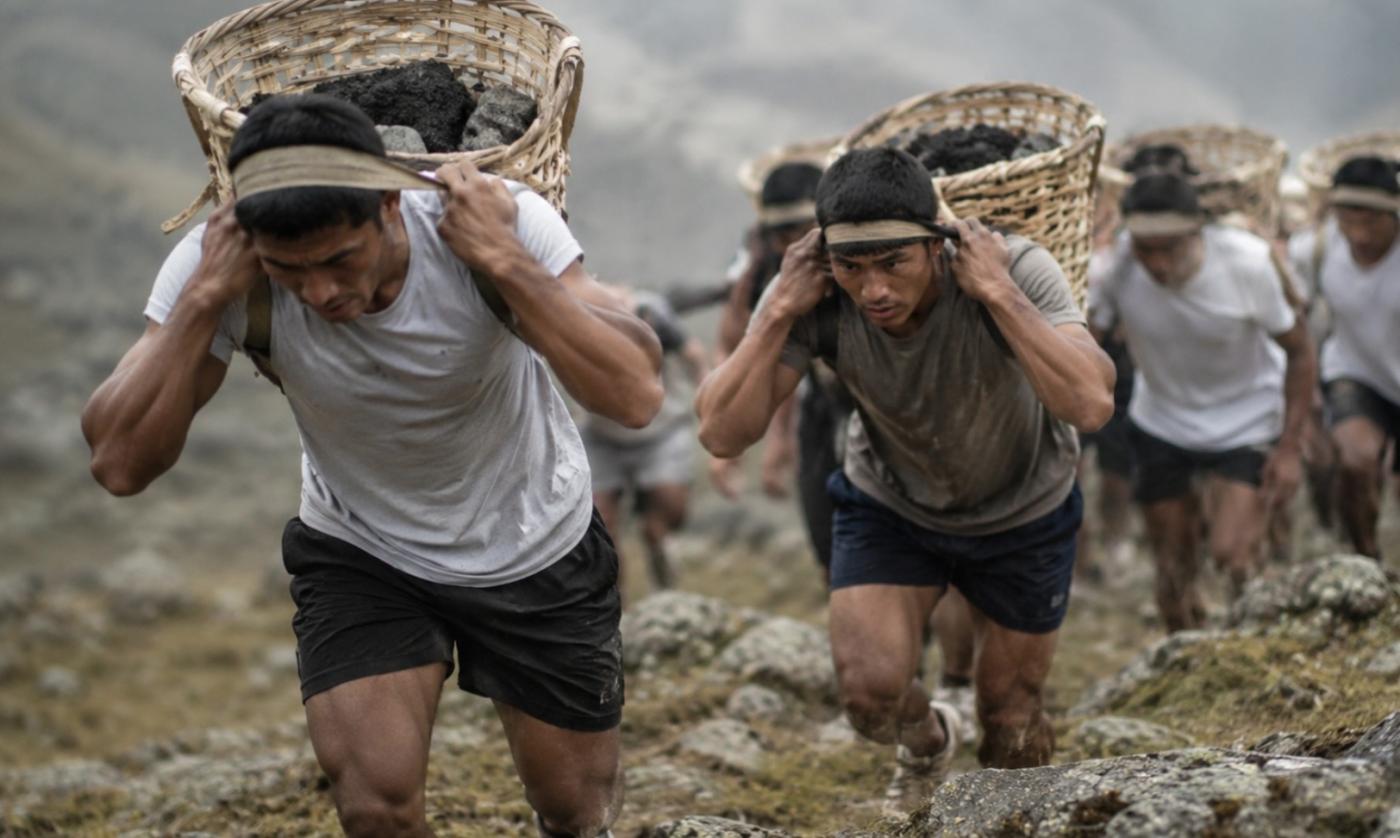
The physical tests at Final Selection include a 2-kilometre run, a jerrycan carry, the doko run, and British Army-only strength assessments such as the mid-thigh pull and medicine ball throw. The doko run is especially well known. A doko is a traditional Nepali carrying basket, usually carried with a strap across the forehead. In selection it has become a symbol of the link between rural Nepali hardship and military endurance. The candidate must carry a heavy load over difficult ground within a set time. It is not just a race. It tests legs, lungs, balance, determination and the ability to keep going when the body is under strain.
The doko run fascinates outsiders because it seems to belong to an older world. It is not a gym machine or a laboratory test. It reflects the mountain paths and carrying culture of Nepal, where people have long transported food, fuel, water, tools and supplies over steep routes. For Gurkha selection, it becomes a military filter. The man who can carry weight uphill at speed, under pressure, while competing against others, has shown a kind of practical endurance that no certificate can fake.
The jerrycan carry is another test with obvious military meaning. Soldiers often have to move ammunition, water, fuel and equipment by hand. A recruit who can carry weight quickly and safely is showing useful battlefield strength. The 2-kilometre run measures speed and cardiovascular fitness, while the mid-thigh pull and medicine ball throw measure power. Together, the tests look for the complete candidate: not merely a distance runner, not merely a strongman, but someone with stamina, power, coordination and mental drive.
Education is tested again at Final Selection. Candidates face English assessments, including writing and speaking or listening elements. This matters because a modern Gurkha soldier may later work with radios, vehicles, engineering equipment, logistics systems, weapons, maps, computers and multinational forces. He must understand instructions and express himself clearly. The Gurkha of legend may be imagined as silent and fearless, but the Gurkha of today must also be educated and adaptable.
The interview is another crucial part of the process. By the time a candidate reaches interview, he has already done extremely well. The interviewers want to know who he is, why he wants to serve, and whether he has the character required. The British Army is looking for honesty, motivation, maturity and suitability for military life. A candidate who is physically excellent but dishonest, arrogant, badly motivated or unable to work in a team may not be the right man. Gurkha selection is therefore not simply a search for the fittest bodies. It is a search for men who can carry the reputation of the Brigade into the future.
The competition is severe because the prize is so valuable. A successful recruit joins a military tradition admired across the world. He gains a career, training, pay, status and the possibility of supporting his family. In many communities, becoming a Gurkha is a matter of immense pride. The family may have invested time, food, encouragement and sacrifice into helping him prepare. When a young man is selected, the honour belongs not only to him but often to his household and village.
This is part of what makes the selection so emotional. Failure is common, and many candidates who have trained hard do not make it. Some fail on documents, some on medical grounds, some on education, some on physical scoring, and some simply because others score higher. It is not enough to be good. A candidate must be better than most of the other good candidates around him.
The modern system also shows how the Gurkha tradition has changed. In the past, recruitment was shaped by empire, war and the British Indian Army. After Indian independence and Partition in 1947, the old Gurkha regiments were divided between India and Britain. Four regiments transferred to British service, eventually forming the modern Brigade of Gurkhas. Today, Gurkhas are not a colonial force raised in the old manner. They are Nepali citizens selected through a formal recruiting system to serve in the British Army under modern standards.
Yet the old qualities still matter. The British originally selected Gurkhas because they had seen, on the battlefield, a rare combination of courage, toughness and discipline. The modern tests try to identify those same qualities in a fairer, more structured way. The over-arm heaves, runs, carries, medical checks, education exams and interviews are all modern tools for finding something older: resilience under pressure, willingness to work, obedience to standards, and pride in service.
The image of the Gurkha as a “hardy man” is not just a stereotype, although it can be simplified too much. Nepal is not one single mountain village, and Gurkhas do not come from only one background. But the reputation grew from real conditions: a country of hills and mountains, hard physical work, long walking routes, close communities, and a tradition of military service. The British Army did not invent Gurkha toughness. It recognised it, recruited it, trained it and gave it a regimental identity.
Selection in Nepal is therefore a bridge between two worlds. On one side is the village, town, family, school, hillside path and Nepali identity of the candidate. On the other side is the British Army, with its discipline, equipment, rank structure, training establishments and global deployments. The selection process stands between them, asking whether this young man can leave one world without losing his roots, and enter another without failing its standards.
Those who are finally selected have done more than pass a fitness test. They have proved they can prepare, endure, compete, learn, obey instructions, face scrutiny and keep their composure. They have shown that they are medically fit, physically strong, mentally alert and personally suitable. They have also accepted the responsibility of joining a name that was first earned in battle more than two hundred years ago.
Only after this long process in Nepal does the next stage begin. The successful recruits leave Nepal and travel to the United Kingdom, where they begin formal training with Gurkha Company at the Infantry Training Centre, Catterick, in North Yorkshire, before moving on to their future Brigade of Gurkhas units.