granatenwerfer 16
The German Granatenwerfer 16 and its distinctive Wurfgranate 16 projectile were among the more unusual weapons to emerge from the brutal trench warfare of the First World War. Sometimes encountered by collectors under shortened or misunderstood names associated with the “Werfer 16”, the grenade formed part of a compact German grenade-throwing system designed to provide infantrymen with a weapon capable of delivering explosive fragmentation bombs considerably farther than a soldier could throw a conventional hand grenade.
By 1915 the static conditions of the Western Front had created an urgent requirement for lightweight weapons that could engage enemy trenches, machine-gun positions and groups of soldiers hidden behind cover. Heavy artillery was enormously powerful but could not always respond quickly to small targets directly in front of the infantry. Conventional mortars and Minenwerfer were effective but many were comparatively heavy and difficult to move through shattered trenches and shell holes. This system offered a useful middle ground between the hand grenade and the larger trench mortar.
The weapon developed from an Austro-Hungarian design associated with Dr László Vécer, a Hungarian priest and seminary director. The unusual background of its designer led to early versions becoming known informally as the “Priesterwerfer”, or priest thrower. Germany subsequently adopted and modified the principle, placing it into production during 1916. German manufacturers associated with production included firms such as Stock & Co of Berlin, Gebrüder Bing of Nuremberg and Maschinenfabrik Alfred Wolff of Berlin.
Unlike a conventional mortar, it operated on the spigot principle. Instead of dropping a bomb down the inside of a large mortar tube, the grenade fitted over a comparatively short metal spigot. The projectile incorporated a hollow tail section which slid over this central launching rod. This allowed the complete weapon to remain relatively compact and portable while still throwing a substantial explosive projectile across the battlefield.
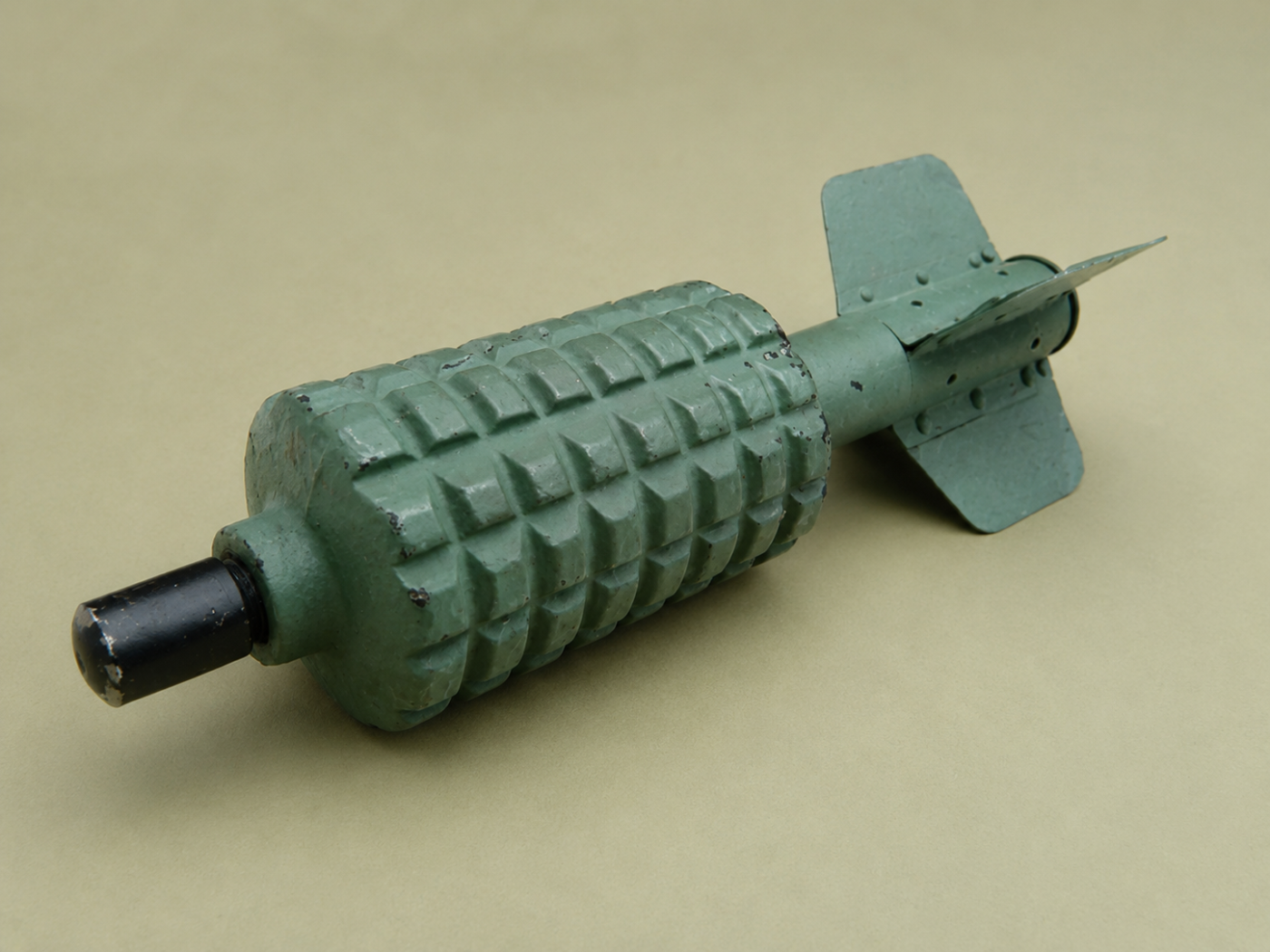
The Wurfgranate 16 was instantly recognisable because of its unusual appearance. The main explosive body was positioned above a long tail assembly fitted with stabilising fins. These fins helped keep the projectile stable during flight and contributed to its characteristic shape, which is today immediately identifiable to experienced First World War ordnance collectors.
A typical high-explosive fragmentation projectile weighed approximately 1.8 kilograms and carried roughly 400 grams of explosive. This gave it considerably greater destructive potential than the standard hand grenades carried by individual infantrymen. Its purpose was primarily anti-personnel, showering an area with dangerous fragments when the explosive charge detonated. Depending upon the angle of fire and battlefield conditions, the weapon could be used against troops occupying trenches, communication routes, shell holes and other protected positions.
The launcher itself could be adjusted for elevation and direction, allowing the crew to deliver both relatively flat and high-arcing fire. Maximum range is generally recorded at around 460 metres, although practical battlefield ranges could vary according to the propellant charge, elevation and conditions. This gave German infantry the ability to place explosive fire well beyond normal hand-grenade range without immediately calling upon conventional artillery.
Different propellant charges were available, allowing the crew to alter the distance travelled by the projectile. Special blank cartridges were used as part of the firing system, with variations reportedly identified by coloured markings. Selecting the appropriate charge and adjusting the elevation of the launcher enabled trained crews to engage targets at different distances.
The weapon was normally operated by a small crew, often described as consisting of two men, although additional soldiers could carry ammunition. Its relatively modest size was one of its principal advantages. Compared with the heavier German Minenwerfer, it could be moved through the confined trench system and carried forward over difficult terrain with greater ease. This mobility became especially valuable during attacks when infantry units advanced beyond their established trench lines and required immediate supporting fire.
The rate of fire could reach approximately four or five rounds per minute in the hands of an experienced crew. While this was not exceptionally rapid compared with later mortars, several launchers operating together could place a considerable volume of fragmentation fire onto a selected area. The psychological effect of incoming grenades must also have been considerable, particularly for soldiers occupying exposed trenches with limited overhead protection.
Although high-explosive fragmentation ammunition was the most important type, the system was reportedly capable of firing several specialised projectiles. Smoke and illumination ammunition could be used for battlefield signalling or observation, while propaganda-carrying projectiles were also developed for distributing printed material into enemy positions.
The weapon saw extensive service with German forces during the later years of the First World War and was also associated with other Central Powers. It was particularly suited to the close-range fighting that dominated much of the Western Front, where opposing trench systems could sometimes be separated by only a few hundred metres. From a concealed emplacement the small launcher could bombard enemy positions while presenting a much smaller target than conventional artillery.
For Allied troops facing it, its projectiles represented yet another danger in an already deadly battlefield environment. The unusual flight characteristics and sound of the finned grenades reportedly made them distinctive to soldiers who experienced them. Once the projectile had been launched there was often little time to locate adequate cover before impact.
The weapon nevertheless had limitations. Its fragmentation ammunition was primarily intended to attack personnel rather than destroy heavily fortified positions. Larger Minenwerfer and artillery pieces remained necessary for smashing reinforced dugouts, cutting wire obstacles and demolishing substantial defensive works. The small grenade thrower therefore complemented rather than replaced heavier weapons.
Its greatest strengths were portability, simplicity and the ability to provide infantry units with their own short-range explosive support. In many respects the concept anticipated the widespread use of lightweight infantry mortars during later conflicts. Soldiers could establish the weapon relatively close to the front and quickly engage targets that would otherwise have required rifle grenades, hand grenades or artillery intervention.
Today surviving Wurfgranate 16 projectiles and related components are sought after by specialist collectors of First World War militaria. Complete original launchers are considerably rarer than individual inert projectiles and can be found in military museums and important private collections. Surviving grenades must always be treated with extreme caution unless professionally confirmed as completely inert, as unexploded First World War ammunition continues to be recovered from former battlefields more than a century after the fighting ended.
Collector interest is particularly strong when an example retains original surface finish, manufacturer markings or clear evidence of its wartime construction. Many battlefield-recovered examples are heavily corroded after decades underground, while better-preserved specimens illustrate the surprisingly sophisticated engineering incorporated into what was essentially a compact infantry grenade-launching system.
The Wurfgranate 16 is now a fascinating reminder of the technological improvisation produced by trench warfare. Its distinctive finned appearance, association with the German system and relatively unusual method of launch make it stand apart from the more familiar stick grenades and egg grenades of the Imperial German Army.
Although overshadowed in popular history by machine guns, artillery and poison gas, weapons such as this played an important role in the daily struggle for control of the trenches. Compact enough to accompany infantrymen near the front yet powerful enough to throw a substantial explosive grenade hundreds of metres, it represented an ingenious attempt to solve one of the central problems of First World War combat: how to deliver accurate explosive fire against an enemy protected by trenches and terrain.
More than one hundred years later, the unmistakable Wurfgranate 16 remains one of the most interesting pieces of German First World War ordnance, representing a period when military engineers on all sides were rapidly developing new weapons to meet the unprecedented challenges of industrialised trench warfare.