Glade of Armistice
The Glade of the Armistice, hidden in the Forest of Compiègne in northern France, is one of the most symbolic places in modern European history. It was here, in a quiet railway clearing near Rethondes, that the First World War effectively came to an end on 11 November 1918. Twenty-two years later, Adolf Hitler deliberately returned to the same spot to force defeated France to sign another armistice, this time in favour of Nazi Germany. What followed was not only a military and political humiliation, but also an act of calculated historical revenge: the Germans destroyed the memorial site, dismantled its monuments, removed the famous railway carriage, and tried to erase the place from the landscape.
The choice of the Glade of the Armistice in 1918 was partly practical and partly symbolic, though it became far more symbolic afterwards. Marshal Ferdinand Foch, the Allied Supreme Commander, needed a secure and discreet place for negotiations with the German delegation. The Forest of Compiègne was close enough to the front and to Allied headquarters, but secluded enough to avoid crowds, interference, or public spectacle. The railway lines in the forest had been laid during the war for heavy artillery and military transport, so Foch’s train and the German delegation’s train could be brought there and placed on parallel tracks. This meant the talks could take place in a controlled military environment, away from a city, in a railway carriage that served as Foch’s mobile office.
The famous carriage was Compagnie Internationale des Wagons-Lits carriage No. 2419D. It had originally been a dining car before being converted for military use. In the early hours of 11 November 1918, the German delegates entered the carriage and accepted the Allied terms. The armistice was signed at about 5:15 in the morning and came into effect at 11:00 a.m., giving rise to the remembered phrase: the eleventh hour of the eleventh day of the eleventh month. For France and Britain, the carriage became a shrine of victory. For many Germans, especially nationalists and later Nazis, it became a symbol of humiliation.
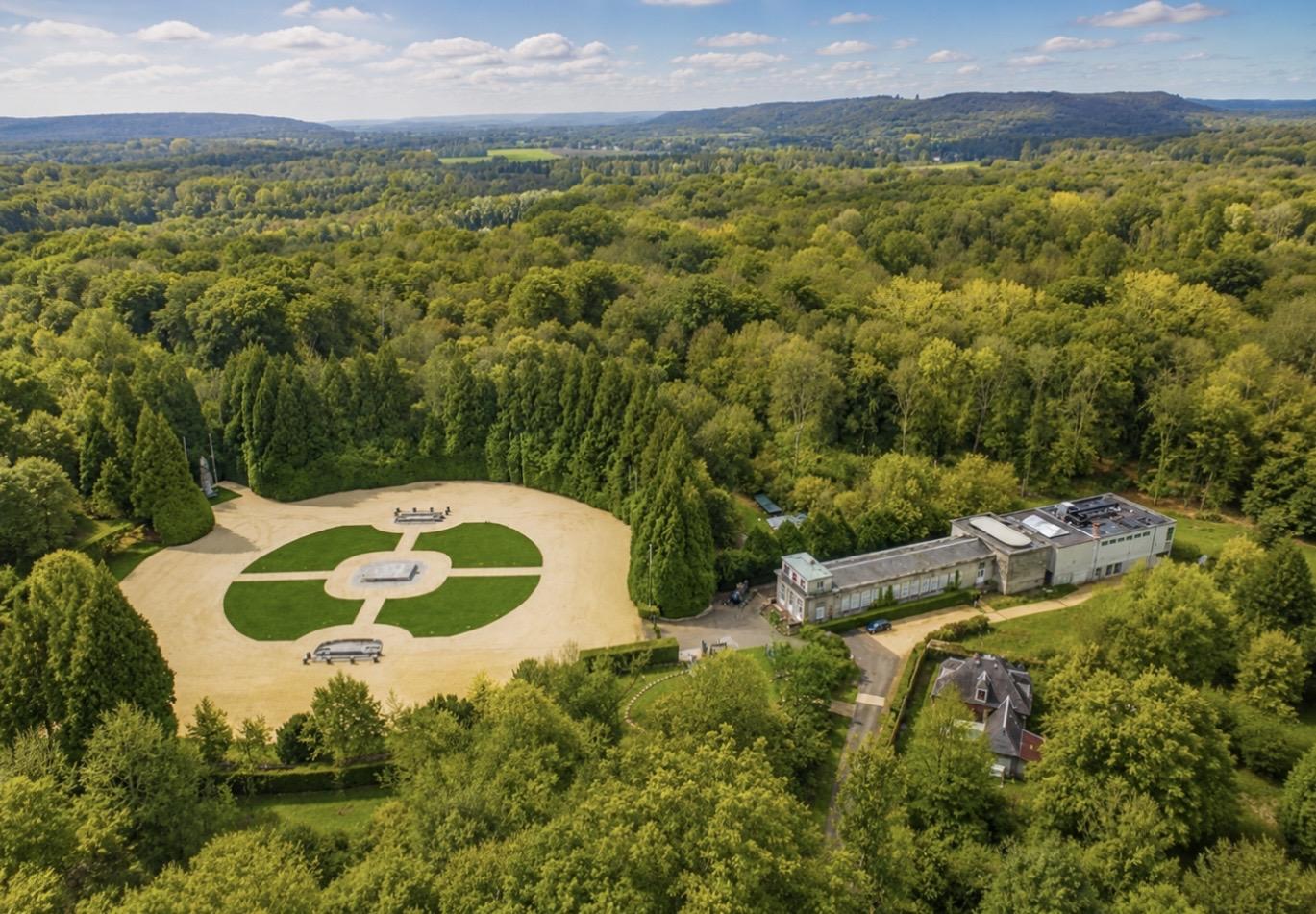
After the war, the site was turned into a memorial. The clearing was formally inaugurated in 1922. A long avenue led into the open space, and monuments were added, including the Sacred Slab, which carried an inscription declaring that the “criminal pride” of the German Empire had been defeated there, and the Alsace-Lorraine Monument, celebrating the return of the provinces lost to Germany after the Franco-Prussian War of 1870–71. The railway carriage itself was first displayed at Les Invalides in Paris, then moved back to the Armistice Clearing in 1927 and placed in a purpose-built shelter. By the 1930s, the Glade had become a national place of remembrance for France.
That is why Hitler chose it in June 1940. After the rapid German victory over France, he did not simply want an armistice; he wanted a theatrical reversal of 1918. He ordered that the original carriage be removed from its museum shelter and placed back on the exact spot where the 1918 signing had occurred. On 21 June 1940, Hitler visited the clearing with senior Nazi and military leaders. He entered the carriage and sat where Foch had sat in 1918. The message was unmistakable: Germany had returned, and France was now the defeated power.
The 1940 armistice was signed on 22 June 1940. Hitler himself did not remain for the final signing; after making his symbolic appearance and ensuring the setting had delivered its intended humiliation, he left the detailed proceedings to his representatives. The French delegation, led by General Charles Huntziger, signed the terms imposed by Germany. France was divided, with much of the country occupied by German forces and a collaborationist government later established at Vichy. For Hitler, the event was meant to erase the shame of 1918 and replace it with a new image of German triumph.
The destruction of the Glade followed almost immediately. It was done on Hitler’s orders and carried out by German military engineers and Nazi authorities. The memorial buildings were demolished, the carriage shelter was destroyed, the railway tracks were removed, the avenues were ploughed up, and the decorative planting was cut down. The Sacred Slab and the Alsace-Lorraine Monument were dismantled and taken away to Germany. The site was deliberately razed so that it would no longer function as a French memorial of victory. The destruction was not random vandalism; it was political theatre and revenge expressed through demolition.
One striking detail is that the statue of Marshal Foch was left standing. This appears to have been deliberate. By leaving Foch alone in an emptied and ruined clearing, the Germans turned the statue into a symbol of mockery: the victorious Allied commander of 1918 now looked out over a wasteland. The effect was cruelly symbolic. Everything around him that celebrated France’s victory had been stripped away, but the man associated with Germany’s 1918 defeat was left isolated.
The original armistice carriage was taken to Germany as a trophy. It was displayed in Berlin, at one point near the Brandenburg Gate, as a captured symbol of France’s humiliation. Later, as Allied bombing made Berlin increasingly dangerous, it was moved into central Germany, eventually to Thuringia. Its final fate is not completely free from uncertainty, but the accepted account is that it was destroyed near the end of the Second World War in 1945, in the area around Crawinkel or Ohrdruf. Many accounts say it was burned or blown up by SS personnel as American forces advanced, though some versions suggest it may have been damaged by bombing or accidental fire. What is certain is that the original 2419D carriage never returned to France. Only fragments survived.
After the liberation of France, the ruined clearing became a place of renewed memory. The Germans had tried to erase it, but that act only deepened its significance. The site was gradually restored after the war. The monuments were recovered or reconstructed, the avenue and clearing were remade, and a replacement railway carriage was found. In 1950, the Compagnie Internationale des Wagons-Lits donated carriage No. 2439D, a car from the same series as the original and almost identical in design. It was renumbered 2419D to represent the lost carriage and placed in the rebuilt museum at Compiègne.
Today, visitors to the Glade of the Armistice see a reconstructed memorial landscape rather than the untouched original of 1918. Yet that does not make it less powerful. In some ways, the rebuilding tells an even larger story: the end of the First World War, the humiliation and revenge politics that helped feed the Second World War, the Nazi attempt to rewrite history, and the post-war determination to restore memory. The carriage now on display is not the original, but it stands in the same historical role. Inside the museum, the arrangement of the carriage helps visitors understand where the delegations sat during the signing, and exhibitions explain both the 1918 and 1940 armistices.
The Glade is also filled with smaller details that make the story vivid. The place was not a grand palace or government building, but a forest railway clearing chosen for secrecy and convenience. The first armistice was signed in a railway dining car, an ordinary object turned into one of the most famous rooms in world history. The 1940 ceremony was staged almost like a piece of propaganda theatre, with Hitler using the exact geography of defeat and victory to reverse the meaning of the place. The destruction afterwards shows how seriously the Nazis took symbols: they did not only conquer territory; they attacked memory itself.
The Glade of the Armistice survived because memory proved harder to destroy than stone, rails, or timber. Hitler could order the monuments dismantled and the carriage carried away, but he could not make the place meaningless. Rebuilt after the war, it now stands not only as a memorial to the end of the First World War, but also as a warning about revenge, humiliation, and the dangerous power of political symbolism. The Germans destroyed the clearing because they understood what it represented. The French rebuilt it for the same reason.