German Spotlight
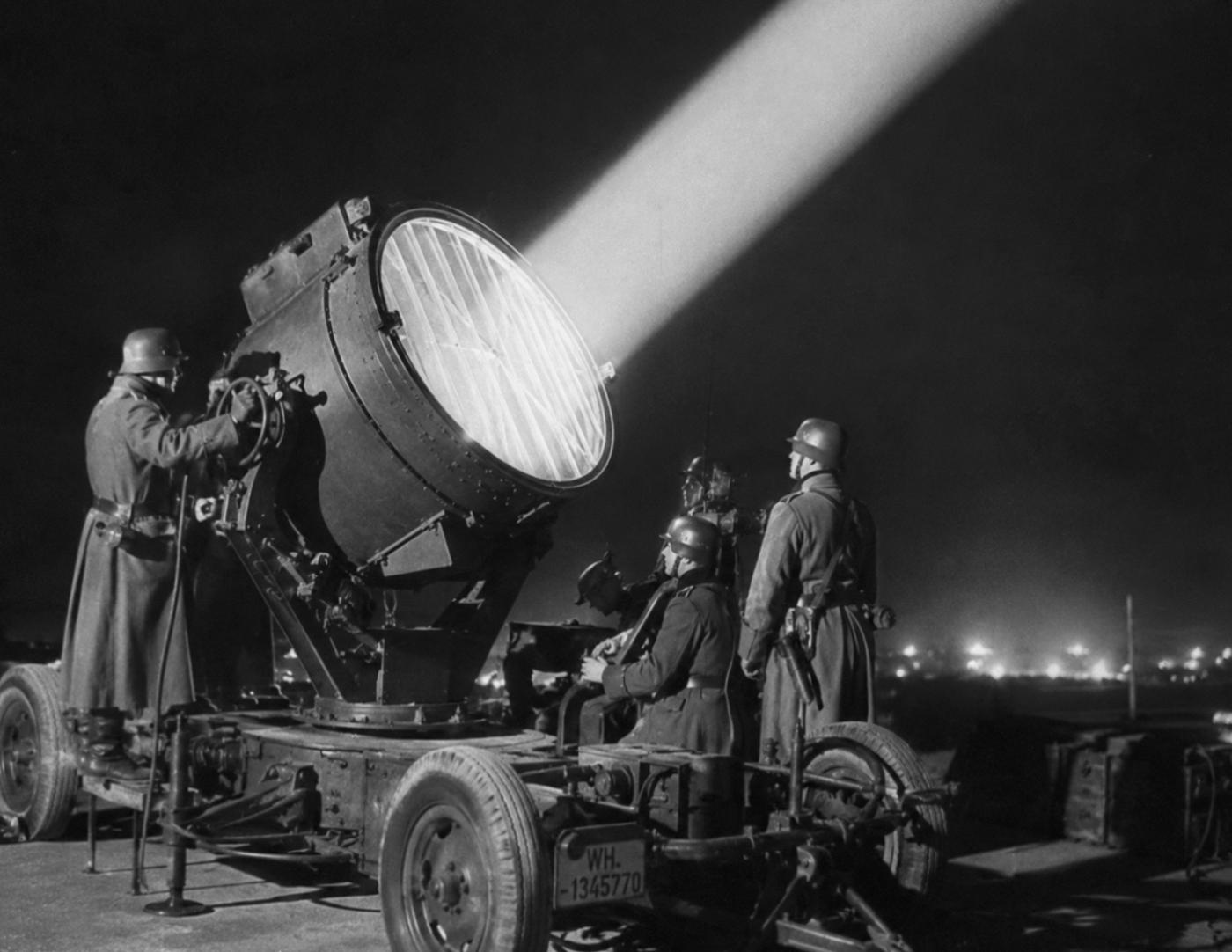
The German anti-aircraft spotlight in the picture is best described as a Flakscheinwerfer, meaning “flak searchlight.” The large type most people associate with wartime photographs is the 150 cm Flakscheinwerfer 34 or later Flakscheinwerfer 37. The “150 cm” refers to the diameter of its mirror: roughly five feet across. It was not just a lamp, but a complete anti-aircraft detection system, normally including the searchlight itself, a generator trailer, cables, a trained crew, and some form of direction-finding aid such as a sound locator or, later in the war, radar.
These searchlights were part of Germany’s night air-defence network. Their job was to find Allied aircraft in the dark, hold them in a beam of light, and allow anti-aircraft guns and night-fighters to engage them. In the early part of the war, German searchlight crews often worked with acoustic sound locators, which pointed the light toward the approximate position of an approaching aircraft. Once the target was caught, other searchlights would join in and “cone” the aircraft, trapping it in intersecting beams. As radar became more common, radar direction increasingly replaced sound-location methods, making the searchlights faster and more accurate.
The standard 150 cm Flakscheinwerfer had a glass parabolic reflector 150 cm in diameter, with a focal length of about 650 mm. At its heart was a carbon-arc lamp, not a bulb in the modern sense. A carbon arc works by passing a heavy electric current between carbon rods, producing an intensely bright white light. The lamp was self-regulating and mounted in an inverted position inside the projector barrel, meaning the lamp mechanism hung downward inside the housing. This was a sophisticated piece of optical and electrical engineering, built to throw a tight beam into the sky rather than simply flood an area with light.
In brightness, the 150 cm Flakscheinwerfer was astonishing. U.S. wartime manuals rated the 150 cm German searchlight at about 990 million candlepower, roughly equivalent to about 990 million candelas in later wording. In favourable weather, it could reach aircraft at about 8,800 yards, or around 8 km, when the aircraft were flying at roughly 13,000 to 16,500 feet, which is about 4,000 to 5,000 metres. Some preserved-equipment descriptions give similar figures of around 1,000 million candelas and beam ranges of about 10 km under suitable conditions.
The power needed to run such a light was enormous. The 150 cm unit was normally supplied by a separate 24-kilowatt generator driven by an eight-cylinder internal-combustion engine. Wartime technical descriptions give the electrical output as about 200 amperes at 110 volts. The generator was normally placed away from the searchlight and connected by a heavy cable. This allowed the noisy engine and generator to be set some distance from the operating crew and from the light itself.
The searchlight could be rotated through a full 360 degrees and elevated through a wide arc so it could sweep the sky above its position. It was normally carried on a special wheeled trailer, commonly the Sonderanhänger 104, while the generator was carried on a second trailer. This made the system mobile, although it was still heavy, awkward, and slow compared with a gun or truck-mounted weapon. A typical complete 150 cm searchlight outfit needed about seven crewmen to operate it.
The question of who designed these searchlights is more complicated than naming one inventor. There does not seem to be a well-known single designer in the way that some aircraft or weapons are associated with one engineer. They were developed as military-industrial equipment to German armed-forces requirements, drawing on Germany’s strong electrical and optical industries. Surviving examples and nameplate evidence identify Siemens-Schuckert-Werke AG as a manufacturer of the 150 cm Flakscheinwerfer 34. Siemens & Halske A.G. is also associated with preserved examples. Both firms belonged to the wider Siemens industrial group and had long experience with heavy electrical machinery, generators, motors, lighting systems, and precision electrical equipment.
Other German industrial firms may have been involved in components, trailers, generators, or related equipment, but the safest attribution for the 150 cm Flakscheinwerfer 34 is to Siemens-Schuckert-Werke AG, with Siemens & Halske also connected to production. It is better to think of the Flakscheinwerfer as the product of a military specification and an industrial manufacturing programme rather than the invention of one named individual.
The “34” in Flakscheinwerfer 34 indicates the model associated with the mid-1930s. The type is commonly described as having been developed or introduced around 1934. It was later joined by the Flakscheinwerfer 37, which performed the same general role. Both types used the same basic principle: a large parabolic mirror, a powerful carbon-arc light source, a wheeled mounting, and a separate generator unit. In German documents and captions the name might be shortened to Flak-Sw. 34, SW 34, or Flak-Scheinwerfer.
Germany used searchlights in several sizes. Smaller 60 cm searchlights were used at lower altitudes and were often paired with lighter anti-aircraft guns such as 20 mm and 37 mm weapons. These smaller lights were easier to move and required less power, but they lacked the reach of the heavy 150 cm models. The 150 cm searchlight was the main heavy German wartime anti-aircraft searchlight for much of the war. Later, as Allied bombers flew higher and raids became larger, Germany also used even larger 200 cm searchlights. These had still greater power and range, but were heavier and more demanding to operate.
The 150 cm searchlight was not usually meant to work alone. A common arrangement was for searchlights to be laid out in a grid, often in front of or around heavy flak batteries. When one searchlight caught an aircraft, nearby crews would swing their beams onto the same target. Several lights converging on one bomber made it much easier for gun predictors and anti-aircraft crews to follow it. This was known as “coning” an aircraft. For the aircrew, being coned by searchlights was terrifying. Once trapped in several beams, the aircraft became clearly visible against the night sky, and flak bursts or night fighters might follow within seconds.
A typical German heavy flak defence system was layered. Radar or sound locators detected an incoming raid. Searchlights tried to illuminate the aircraft. Heavy guns such as the famous 8.8 cm Flak fired at altitude, while lighter guns defended against low-level attacks. Night fighters operated in the same wider defensive network. The searchlight was therefore not just a lighting device, but one part of a much larger system of detection, tracking, illumination, and attack.
The searchlights were especially important before airborne radar became widespread in night fighters and before ground-based radar control became highly developed. In the early war years, an illuminated bomber was far easier to attack, either from the ground or by a fighter pilot who could see it visually. As the war went on, radar became increasingly important, and searchlights became only one part of the night defence system. They still remained useful, however, because visual confirmation made aiming and engagement easier.
Operating one of these lights was hard work. The crew had to deploy the trailers, connect heavy cables, start and regulate the generator, manage the carbon rods, aim the projector, and coordinate with other crews and command posts. The carbon rods burned away during use and had to be fed or replaced. The lamp produced intense heat as well as intense light. Crews also had to work in darkness, often under threat from air attack, while trying not to reveal more of their own position than necessary.
The beam itself was both powerful and vulnerable. Mist, smoke, cloud, rain, and haze could greatly reduce its effectiveness. In clear conditions the beam could reach high-flying aircraft, but in poor weather it might scatter or be absorbed. Allied bombers sometimes used cloud cover to avoid searchlights, while German crews tried to catch aircraft in gaps or use radar guidance to point the beam where the target was expected to appear.
The searchlight batteries also had to deal with Allied countermeasures. Bomber crews used evasive manoeuvres when caught in beams, diving or turning sharply to escape the cone. Some raids used Window, strips of metal foil dropped to confuse radar, which complicated the wider air-defence picture. Smoke, cloud, and massed bomber streams also made individual tracking more difficult. Even so, a successful searchlight cone could be deadly, because it allowed several weapons and observers to concentrate on one aircraft.
One interesting detail is that the searchlight was part of the Luftwaffe’s anti-aircraft arm, not simply an army lighting unit. German anti-aircraft defence, or Flak, belonged largely to the Luftwaffe. Searchlight crews served within that system alongside gun crews, rangefinder operators, radar personnel, and command staff. Some searchlight units also used female auxiliaries later in the war, especially in supporting roles, as Germany faced manpower shortages.
The engineering of the 150 cm Flakscheinwerfer shows the mixture of old and modern technology that characterised much of wartime equipment. The carbon arc was a 19th-century lighting principle, but the optical mirror, electrical regulation, generator system, and integration with radar or sound-location networks made it a modern military instrument. It was simple in concept, a giant light aimed at the sky, but complex in practice.
The physical appearance of the 150 cm Flakscheinwerfer made it one of the most dramatic pieces of wartime equipment. The large circular face, ribbed glass front, heavy yoke mounting, hand wheels, wheeled carriage, and thick cables gave it an almost industrial look. At night, with the beam shining upward, it became a symbol of the air war over Europe. Photographs of searchlights sweeping the sky over cities such as Berlin, Hamburg, and the Ruhr remain among the most recognisable images of the bombing war.
For Allied aircrew, German searchlights were hated and feared. A bomber might fly for hours in darkness, trying to remain unseen, only suddenly to be caught in a white glare. The light could be dazzling, making it hard for pilots to see outside the aircraft. Once caught, the bomber’s silhouette became visible to gunners and night fighters. Crews often described the experience as being pinned in the sky.
Despite their power, searchlights did not guarantee success. They worked best in clear weather, against aircraft flying within their effective ceiling, and as part of a well-coordinated defence. Against large bomber streams, fast aircraft, bad weather, electronic countermeasures, and radar confusion, they were less decisive. By the later war years, radar-directed guns and radar-equipped night fighters became more important than searchlights alone.
After the war, many German searchlights were scrapped because they were large, heavy, and of limited peacetime use. A number survived in museums, private collections, and battlefield sites. Preserved examples are valuable because they show the scale of the equipment far better than photographs can. Standing next to a 150 cm Flakscheinwerfer makes clear that this was not a small spotlight, but a major piece of heavy electrical machinery.
In simple terms, the German Flakscheinwerfer was a giant electrically powered searchlight used to find and illuminate enemy aircraft at night. The best-known wartime version was the 150 cm Flakscheinwerfer 34, manufactured by Siemens-related firms such as Siemens-Schuckert-Werke AG. It used a carbon-arc lamp, a huge parabolic mirror, and a powerful generator to produce a beam of roughly one billion candlepower. It could reach aircraft several miles away in good conditions and was operated by a trained crew as part of Germany’s wider anti-aircraft defence system.