German horse training
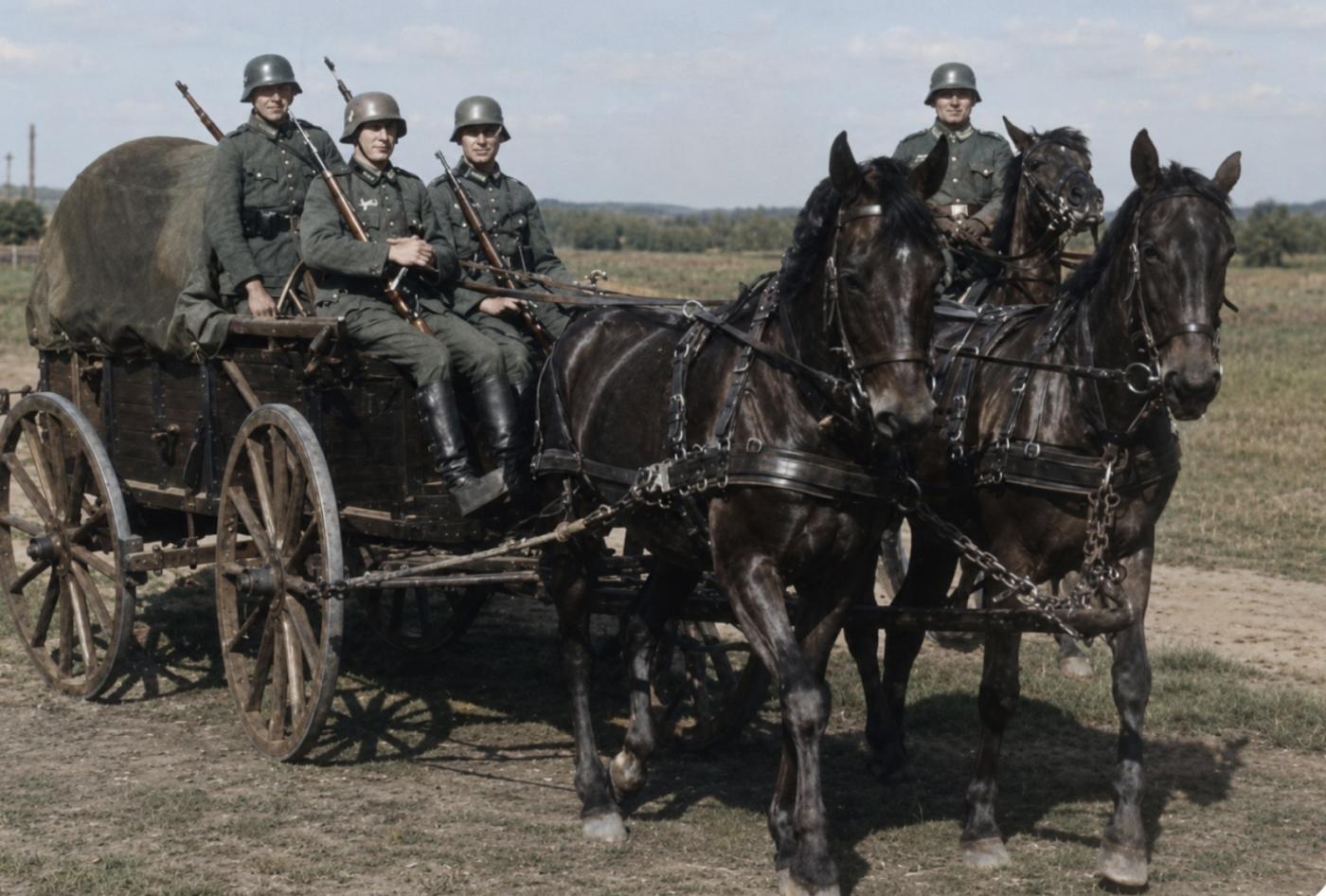
Although the German army of the Second World War is often remembered for tanks, armoured vehicles and fast-moving Blitzkrieg attacks, much of it still depended on horses. The most modern units used tanks and lorries, but the ordinary infantry divisions relied heavily on horses to move artillery, ammunition, food, field kitchens, medical wagons, engineer equipment and general supplies. Horses also carried officers, messengers, scouts and cavalry troops. Without them, large parts of the German army would have struggled to move beyond the railways.
Germany did not have just one type of horse training centre. It had a whole military horse system. There were remount depots, where young or newly acquired horses were received, inspected, rested, fed, hardened and prepared for military use. There were riding and driving schools, where soldiers learned to ride horses, drive teams, handle wagons and care for animals properly. There were army studs, veterinary units, farrier schools, horse hospitals and horse parks behind the front. Together these formed a large network that supplied and maintained the horses needed by the Wehrmacht.
The German word often used for a replacement military horse was “remount”. A remount depot was not simply a stable. It was a place where horses were assessed and prepared for army service. Some were young horses bought from breeders. Others were working horses taken from farms, businesses or occupied territories. Each animal had to be examined to decide what it was fit for. A strong, steady horse could be sent to pull artillery or heavy supply wagons. A lighter, quicker horse might be used for riding duties, scouting or messages. Smaller hardy horses were useful for carts, pack work and difficult country where large horses struggled.
Before the war Germany already had a long tradition of military horsemanship. The old Prussian and Imperial German armies had used remount depots for cavalry and artillery horses. This system did not disappear when motor vehicles arrived. It was reduced after the First World War, but it expanded again when Germany rearmed in the 1930s. Old horse facilities were reopened, new ones were adapted, and studs and depots were brought under military control.
Known centres included Krampnitz near Potsdam, which became one of the most important army riding and driving schools. It trained soldiers as well as horses, especially for riding, team driving and military horsemanship. Other places connected with the remount and horse-training system included Breithülen in Württemberg, Altefeld in Hesse, Grabau in Schleswig-Holstein, Aalen, Demmin, Lyck in East Prussia, Weeskenhof and Rosslinde. These were not all identical. Some were remount depots, some were riding or driving schools, and some were studs or army horse establishments. The exact total number changed during the war as Germany occupied new territories and later lost them again.
The number of staff at these centres depended on their size and purpose. A smaller depot might have only a few dozen permanent staff, while a large riding or driving school needed officers, instructors, non-commissioned officers, grooms, farriers, veterinary staff, clerks and labourers. Breithülen gives a useful example of scale, as it could train up to about 400 horses a year with around two dozen staff. Larger establishments would have needed many more people, especially where they trained soldiers as well as animals.
The time needed to produce a well-trained military horse varied greatly. A young horse trained properly from the beginning might need many months, and for a high-quality riding or cavalry horse the process could take a year or more. The animal had to become used to being handled, groomed, saddled or harnessed, shod, loaded for transport and worked among other horses. It also had to learn to stay calm around shouting, gunfire, wagons, smoke, flags, crowds and confusion.
In wartime, however, the Germans often did not have the luxury of long training. Many horses were already working animals before they entered the army. Farm horses, cart horses and draught horses already knew how to pull and obey basic commands. For these animals, military training was often more like conversion. They were inspected, classified, fitted with harness or saddle, shod properly, taught army routine and introduced to military wagons or guns. A calm farm horse could become useful quite quickly, especially if handled by an experienced driver.
The German army had standards for accepting horses. A horse had to be sound, strong enough for its job, not too old, not badly lame, not diseased and not dangerously nervous. Good legs and hooves were essential, because a horse with weak feet would soon become useless on long marches. Temperament mattered as much as appearance. A plain but steady horse was often more valuable than a fine-looking animal that panicked easily. Horses had to stand in lines, work in teams, pull through mud, accept gunfire and keep going when tired.
Germany acquired horses from many sources. The first source was Germany itself. In the 1930s, many farms, tradesmen and transport firms still used horses every day. These animals could be listed, inspected and requisitioned for military service. Farmers often hated losing good horses because a horse was not just property; it was essential to farm work.
After Germany expanded, it gained more horses from Austria and Czechoslovakia. When Poland, France, Belgium, the Netherlands, Denmark, Yugoslavia and parts of the Soviet Union were occupied, horses were also taken from those territories. Some were bought, many were requisitioned, and others were captured from defeated armies. Poland, France and the Soviet Union were especially important sources.
On the Eastern Front the Germans made great use of local horses and carts. Small eastern horses were often less impressive than German warmbloods, but they were tough, hardy and better suited to poor roads, cold weather and rough feeding. The Germans also used local peasant carts, often called Panje wagons. These were simple, light and useful in mud or snow where heavier German wagons and motor vehicles struggled.
The German army entered the war with hundreds of thousands of horses. At the beginning of the Second World War it had roughly 573,000. For the invasion of the Soviet Union in June 1941, about 750,000 horses were prepared. Over the whole war, German forces used around 2.75 to 2.8 million horses and mules. These figures show that horses were not a minor part of the war effort. They were central to the movement of the German army.
A standard German infantry division could require several thousand horses. Many divisions had around 4,000 to 6,000, depending on the year and organisation. These horses pulled guns, ammunition wagons, supply carts, field kitchens and medical transport. Even when a division had some motor vehicles, it still often needed horses for ordinary movement and supply. As the war went on and Germany ran short of fuel, tyres, spare parts and lorries, horses became even more important.
The burden placed on the animals was enormous. They had to march long distances, often with heavy loads, through heat, dust, mud, snow and ice. They needed water, oats, hay, straw, rest, grooming and shoeing. When any of these failed, the horse began to fail too. A motor vehicle could be parked without food, but a horse had to be cared for every day. This made the horse both useful and vulnerable.
The Eastern Front was especially deadly. The distances were vast, the roads were often terrible, and the weather could be brutal. In autumn mud, wagons sank and horses exhausted themselves trying to pull them free. In winter, animals froze, slipped, starved or died from exposure. During retreats, wagons were overloaded and there was little time to rest or feed the teams. Many horses died not directly from bullets or shells, but from hunger, exhaustion, disease, wounds, bad shoeing and overwork.
German records show huge horse losses. From the start of the invasion of the Soviet Union in June 1941 to the end of 1944, more than 1.5 million German army horses were lost. The usual monthly loss was around 30,000 horses, and most of these losses were on the Eastern Front. Some months were even worse. Horses were killed by artillery, bombing and gunfire, but many more died because the conditions of war simply wore them out.
When horses collapsed, their fate was usually grim. Some were shot to end their suffering. Some were butchered for meat, especially when troops were short of food. Others were abandoned during retreats. In places such as Stalingrad, starving soldiers ate horses that had once pulled their guns and wagons. The horse was both a servant of the army and, in desperate situations, a source of survival.
Veterinary services tried to save as many animals as possible. The German army had veterinary officers, horse hospitals, farriers and medical transport for animals. Sick or injured horses might be sent behind the lines to recover, then returned to service. But the numbers were overwhelming. Tens of thousands could be sick or injured at any one time, and in fast-moving campaigns there was often no chance to treat them properly.
After the war, the surviving horses had mixed fates. Some were captured by the Allies or the Red Army. Some were taken by local farmers. Some were returned to civilian use because Europe badly needed draught animals for farming and transport after so much destruction. Others were sold, redistributed or simply absorbed into local economies. In many cases, no one could trace the original owner. A horse taken from a French, Polish, German or Soviet farm might end the war hundreds of miles away.
In western Europe, some former army horses went back into agriculture. In eastern Europe and the Soviet-occupied zones, many were taken over by new authorities, local communities or individual farmers. A few valuable breeding animals survived and were used again in studs, though many breeding programmes had been badly disrupted by the war. The famous horse-breeding areas of East Prussia suffered terribly as people and animals fled westward in 1944 and 1945. Many horses died in the evacuation, while others were seized or scattered.