Dienstglas Binoculars
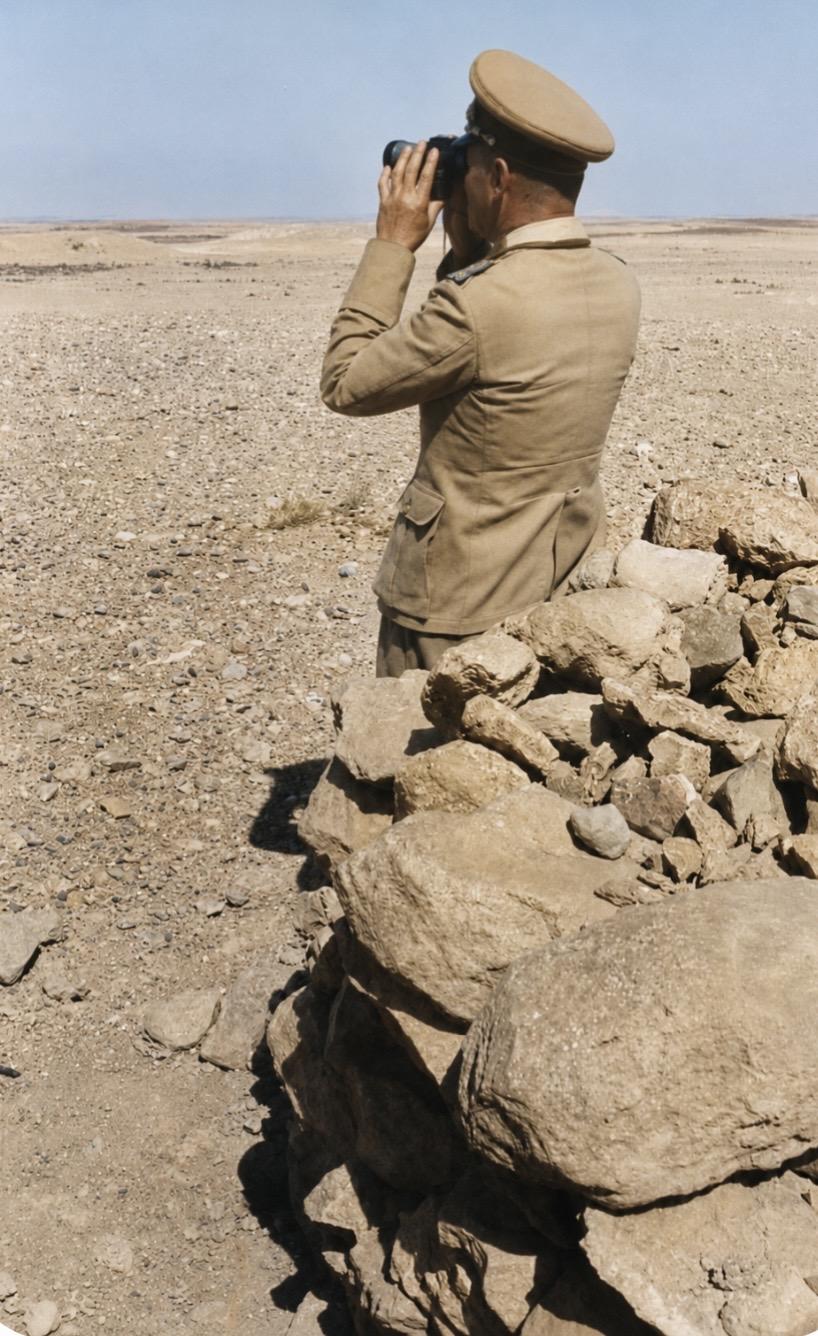
Erwin Rommel’s most familiar field binoculars were the German Dienstglas 10x50, a powerful military glass that suited exactly the kind of war he fought in North Africa: long views, open horizons, dust, glare, movement, and the constant need to judge distance quickly. “Dienstglas” simply meant “service glass”, the official military marking used on German-issue binoculars. The numbers 10x50 tell the story of the instrument: ten-power magnification and large 50 mm objective lenses. Compared with the smaller 6x30 binoculars commonly issued to ordinary soldiers, the 10x50 gave a stronger, brighter, more detailed view, though at the cost of extra size and weight. It was not the casual pocket glass of an infantryman; it was the sort of binocular favoured by officers, artillery observers, panzer commanders and men who needed to read a battlefield before anyone else could.
Rommel’s reputation was built on speed, observation and nerve, and the 10x50 Dienstglas fitted that image perfectly. In the desert, where a vehicle, gun flash or dust plume might be visible miles away, good optics were almost as important as maps. Rommel was famous for pushing forward to see for himself, often standing in exposed positions or riding close to the front. In photographs he is often shown with his binoculars hanging ready on his chest, alongside the British-pattern dust goggles that became part of his image. One interesting detail often noted by collectors is that Rommel’s 10x50 binoculars appear to have had their Bakelite eyecups removed. This may have made them easier to use while wearing goggles, because eyecups that are comfortable against the face can become awkward when pressed against glass or celluloid lenses. Whether he personally ordered the alteration or simply used a field-modified pair is impossible to prove with certainty, but it is exactly the kind of practical change a front-line commander would have appreciated.
The Dienstglas 10x50 was not a single model made by one factory in one neat production run. It was a military category supplied by several German optical manufacturers, though the most important names for the wartime 10x50 were Carl Zeiss and Ernst Leitz. Carl Zeiss of Jena was the older giant of German optical engineering, famous for microscopes, camera lenses, telescopes and binoculars. Ernst Leitz of Wetzlar, later known worldwide through Leica cameras, was another first-class maker of precision optics. During the war, open maker names were increasingly replaced by three-letter military codes. Carl Zeiss Jena commonly appears as “blc”, and later Zeiss production can appear under “rln”. Ernst Leitz Wetzlar appears as “beh”. These codes were intended to obscure production sources from enemy intelligence, but today they help collectors identify who made a particular pair.
The basic optical idea behind these binoculars reached back long before Rommel. The 10x50 Dienstglas used a Porro-prism layout, the classic stepped binocular shape in which the objective lenses sit wider apart than the eyepieces. The Porro prism itself was named after the Italian inventor Ignazio Porro, who developed the image-erecting prism system in the nineteenth century. Carl Zeiss, working within the great German tradition of optical design associated with Ernst Abbe and Otto Schott, helped turn the Porro-prism binocular into a practical, high-quality manufactured instrument. By the time of the Second World War, German firms had decades of experience in making binoculars that were rugged, optically sharp and suitable for military use.
The Zeiss 10x50 Dienstglas was closely related to the civilian Carl Zeiss Jena Dekaris 10x50, introduced in the late 1920s. In simple terms, the military Dienstglas version took the proven optical concept of a powerful Zeiss field glass and adapted it for service conditions. Some Zeiss versions used a wide-angle Erfle-type eyepiece, which gave a notably broad field of view. That mattered on a battlefield because a wide view made it easier to scan for movement, follow vehicles, and keep a sense of the ground while using high magnification. Leitz also made 10x50 Dienstglas binoculars, some with a simpler Kellner-type eyepiece giving a narrower but bright image, and later a wider-angle version that collectors often call the WA. The difference between Zeiss and Leitz examples is one of the interesting details of the type: they served the same military purpose, but the optical character could differ depending on maker and year.
A typical 10x50 Dienstglas was built around a strong metal body, Porro prisms, individual eyepiece focusing and a military reticle in one side on many examples. The reticle, usually in the right ocular, allowed estimation of distance or correction of fire when the observer knew the approximate size of an object. The binoculars were often finished in black or later rough textured paint, sometimes with leatherette or substitute coverings depending on date and wartime economy. Bakelite, an early plastic, was used for eyecups and some accessories. As the war went on, materials and finish often changed. Brass gave way increasingly to lighter alloy and aluminium, leather was reduced or replaced, and late-war examples could look plainer and more utilitarian than the beautifully finished pre-war instruments.
Cold-weather markings are another fascinating detail. Some wartime Dienstglas binoculars carry small symbols such as a blue cross, “o”, “+” or other lubrication marks. These referred to greases and lubricants suitable for different temperature ranges. The German Army needed optics that could still focus in the heat of the desert and the deep cold of Russia. A binocular that seized up because its grease thickened was more than an inconvenience; it could be useless at the very moment an observer needed it. Thus these small marks, easy to overlook, are part of the history of German logistics and the enormous range of climates in which the Wehrmacht fought.
Today the Dienstglas 10x50 is one of the most sought-after categories of Second World War military binoculars. Collectors value them not only for their association with famous commanders such as Rommel, but also for their excellent optical quality, wartime markings, manufacturer codes and historical significance. Examples retaining their original finish, straps, eyecups, lens covers and carrying cases command the highest prices, while binoculars with matching serial numbers and clear optics are especially desirable. Rare maker codes, early-war production, tropical-use examples and binoculars with documented provenance can attract considerable interest from specialist collectors.
Prices vary widely depending on condition and rarity. A worn but complete Dienstglas 10x50 can often be found in the region of £250 to £500. Good original examples with clear optics and intact markings typically sell for between £600 and £1,200. Scarcer Carl Zeiss or Ernst Leitz variants in excellent condition frequently achieve £1,500 to £3,000 or more, particularly when accompanied by original accessories. Exceptional examples with strong provenance, especially any verifiable connection to notable wartime figures, can command substantially higher prices and are often sold through specialist militaria auctions rather than ordinary collectors’ markets.