On this day in military history…
On 3 August 1914, Germany formally declared war on France, transforming a rapidly escalating European crisis into a conflict that would engulf the continent and ultimately much of the world. What had begun only weeks earlier with the assassination of Archduke Franz Ferdinand in Sarajevo had developed with extraordinary speed into a confrontation between Europe’s great powers. By the evening of 3 August, Germany and France, two nations whose rivalry had shaped European politics for more than forty years, were officially at war.
The origins of the confrontation stretched back well beyond the events of the summer of 1914. France and Germany had been bitter rivals since the Franco-Prussian War of 1870–71, when France suffered a crushing defeat and the German states were united into the German Empire. France was forced to surrender the provinces of Alsace and much of Lorraine to Germany, territories whose loss remained deeply painful to generations of French people. The memory of that defeat and the desire among some Frenchmen to recover the lost provinces became an enduring feature of relations between the two countries.
During the decades that followed, Europe became increasingly divided into competing alliances. Germany was allied with Austria-Hungary, while France developed a powerful military alliance with Russia. Britain, although not bound to France by an automatic obligation to go to war, had gradually moved closer to both France and Russia through a series of diplomatic agreements. By the beginning of the twentieth century, Europe had effectively divided into two major blocs, each deeply suspicious of the other.
Germany faced a particularly difficult strategic problem. In the event of a major European war, German military planners expected to fight France in the west and Russia in the east. Fighting two powerful enemies simultaneously presented an enormous danger. German planning therefore centred on defeating one opponent quickly before turning the full strength of the German Army against the other.
Much of this thinking was associated with Field Marshal Alfred von Schlieffen, Chief of the German General Staff between 1891 and 1906. Schlieffen developed plans for a massive attack against France designed to achieve victory before Russia could fully mobilise its enormous army. Although the operational plans used in 1914 had subsequently been modified under his successor, Helmuth von Moltke the Younger, the basic strategic principle remained: France had to be dealt with rapidly before Germany became trapped in a prolonged two-front war.
The immediate crisis began on 28 June 1914 when Archduke Franz Ferdinand, heir to the Austro-Hungarian throne, and his wife Sophie were assassinated in Sarajevo by Gavrilo Princip, a Bosnian Serb nationalist. Austria-Hungary blamed Serbia for encouraging the nationalist movement that had contributed to the assassination and, with strong support from Germany, issued Serbia with a severe ultimatum on 23 July.
Serbia accepted many of the demands but refused to accept them all. Austria-Hungary subsequently declared war on Serbia on 28 July 1914. What might have remained a regional Balkan conflict rapidly expanded because of the European alliance system and the mobilisation plans of the major powers.
Russia regarded itself as a protector of Serbia and other Slavic peoples in the Balkans. As Austria-Hungary prepared for war, Russia began military preparations of its own. On 30 July Russia ordered general mobilisation. Germany regarded Russian mobilisation as a direct threat to its security and demanded that it be halted.
On 31 July Germany sent an ultimatum to Russia demanding the suspension of Russian mobilisation. When Russia failed to comply, Germany declared war on Russia on 1 August 1914 and ordered its own general mobilisation.
France now found itself drawn towards the conflict because of its alliance with Russia. Germany could not assume that France would remain neutral while German armies fought the Russians. German military planning was also based upon extremely strict mobilisation timetables. Once mobilisation began, millions of men, thousands of trains and enormous quantities of equipment had to move according to schedules prepared long before the crisis. German commanders believed that any significant delay could destroy their chances of defeating France quickly.
Germany therefore sought clarification of French intentions. France had already begun mobilisation and made it clear that it would act according to what it regarded as its national interests and alliance commitments. The French Government understood that war with Germany was becoming increasingly unavoidable.
France nevertheless attempted to avoid appearing responsible for beginning hostilities. French forces were ordered to remain some distance from parts of the German frontier in an effort to reduce the possibility of accidental clashes being used as justification for war. Despite these precautions, incidents and accusations soon appeared along the border.
The German Government claimed that French forces and aircraft had violated German territory. German diplomatic communications alleged that French troops had crossed the frontier and that French aircraft had flown over German territory. France rejected accusations that it had deliberately begun hostilities.
Whether individual border incidents occurred exactly as described became far less important than the strategic situation facing Germany. German military planning already required an offensive against France, and with Germany now at war with Russia the machinery of mobilisation was moving rapidly towards implementing that plan.
On 3 August 1914 the German Ambassador in Paris, Baron Wilhelm von Schoen, arrived at the French Foreign Ministry. He presented the German declaration of war to the French Government. Germany stated that French hostile actions had placed the two countries in a state of war. According to the French Government’s subsequent diplomatic notification, Germany’s declaration took effect at 6.45 p.m. on 3 August 1914.
Europe had crossed another threshold. France and Germany were now officially at war.
For ordinary people on both sides of the frontier, years of tension had suddenly become reality. Railway stations were crowded with mobilised soldiers leaving for their regiments. Reservists said farewell to wives, children and parents while trains carried hundreds of thousands of men towards mobilisation centres and military depots. Horses were requisitioned, equipment issued and ammunition moved towards the front.
Many soldiers believed that the war would be short. Few could have imagined that the struggle beginning in August 1914 would last more than four years or that industrialised warfare would kill and wound millions of men.
Germany’s declaration of war against France also brought another crucial issue to the centre of the crisis: Belgium.
German planners believed that a direct assault against the heavily fortified Franco-German frontier would make a rapid victory extremely difficult. The main German attack was therefore intended to sweep through Luxembourg and Belgium before turning south into northern France. German armies could then attempt to outflank the main French forces and threaten Paris.
Luxembourg had already been occupied by German troops on 2 August.
Belgium presented a far greater political and military problem.
Belgian neutrality had been internationally recognised and guaranteed by the major European powers. Germany therefore demanded permission for its troops to pass through Belgian territory, claiming that France intended to attack Germany through Belgium. The Belgian Government rejected the demand. Allowing a foreign army to march through the country would effectively have meant surrendering Belgian neutrality and independence.
Belgium chose to resist, and this decision immediately widened the war.
During the early hours of 4 August 1914, German troops crossed the Belgian frontier. Belgian soldiers and gendarmes resisted the advance, and within days some of the strongest fortifications in Europe around Liège became the scene of bitter fighting.
The invasion of Belgium radically changed Britain’s position.
Britain had attempted throughout the July Crisis to find a diplomatic solution, and there remained considerable disagreement within the British Government and among the British public over whether Britain should become involved in a continental war. Britain had developed close military and diplomatic relations with France, but those arrangements did not automatically require Britain to fight simply because France and Germany were at war.
Belgium was different.
Britain was one of the powers associated with the international agreements guaranteeing Belgian neutrality. German troops entering Belgium therefore provided the British Government with both a strategic and moral justification for intervention. Britain was also deeply concerned that a German victory over France and control of the Belgian coast would dramatically alter the balance of power in Europe.
Britain demanded that Germany respect Belgian neutrality and withdraw. Germany refused.
At 11 p.m. British time on 4 August 1914, Britain was at war with Germany.
With Britain came the enormous resources and manpower of the British Empire. A crisis which had begun in the Balkans had therefore expanded within little more than a week into a major European war involving Austria-Hungary, Serbia, Russia, Germany, France, Belgium, Britain and much of the British Empire. Other countries would join the conflict as the war continued.
For France, the German declaration of 3 August revived memories of the disastrous war of 1870–71. Yet the French Army of 1914 was very different from the force that had been defeated by Prussia four decades earlier. France had introduced widespread military conscription and had developed its own offensive strategy, known as Plan XVII.
French commanders intended to take the offensive rapidly, particularly towards Alsace and Lorraine. The determination to recover the provinces lost in 1871 carried enormous emotional significance, although French military planning was based upon broader strategic considerations rather than simply national revenge.
Within days of the declaration of war, French troops crossed into Alsace. Soldiers reportedly received emotional welcomes in communities that had been under German rule since 1871. However, the opening French offensives soon encountered determined German resistance and resulted in heavy casualties.
Meanwhile the enormous German right wing moved through Belgium and into northern France. The movement was conducted on a scale rarely witnessed before. Hundreds of thousands of German soldiers marched westwards while an immense railway system transported troops, horses, artillery, ammunition and supplies towards the advancing armies. German commanders hoped to destroy the French Army in a rapid campaign and bring France to the negotiating table before Russia could become fully effective in the east.
Instead, Belgium resisted more strongly than German planners had hoped, British troops began arriving in France, and French forces remained capable of continuing the fight despite serious early defeats.
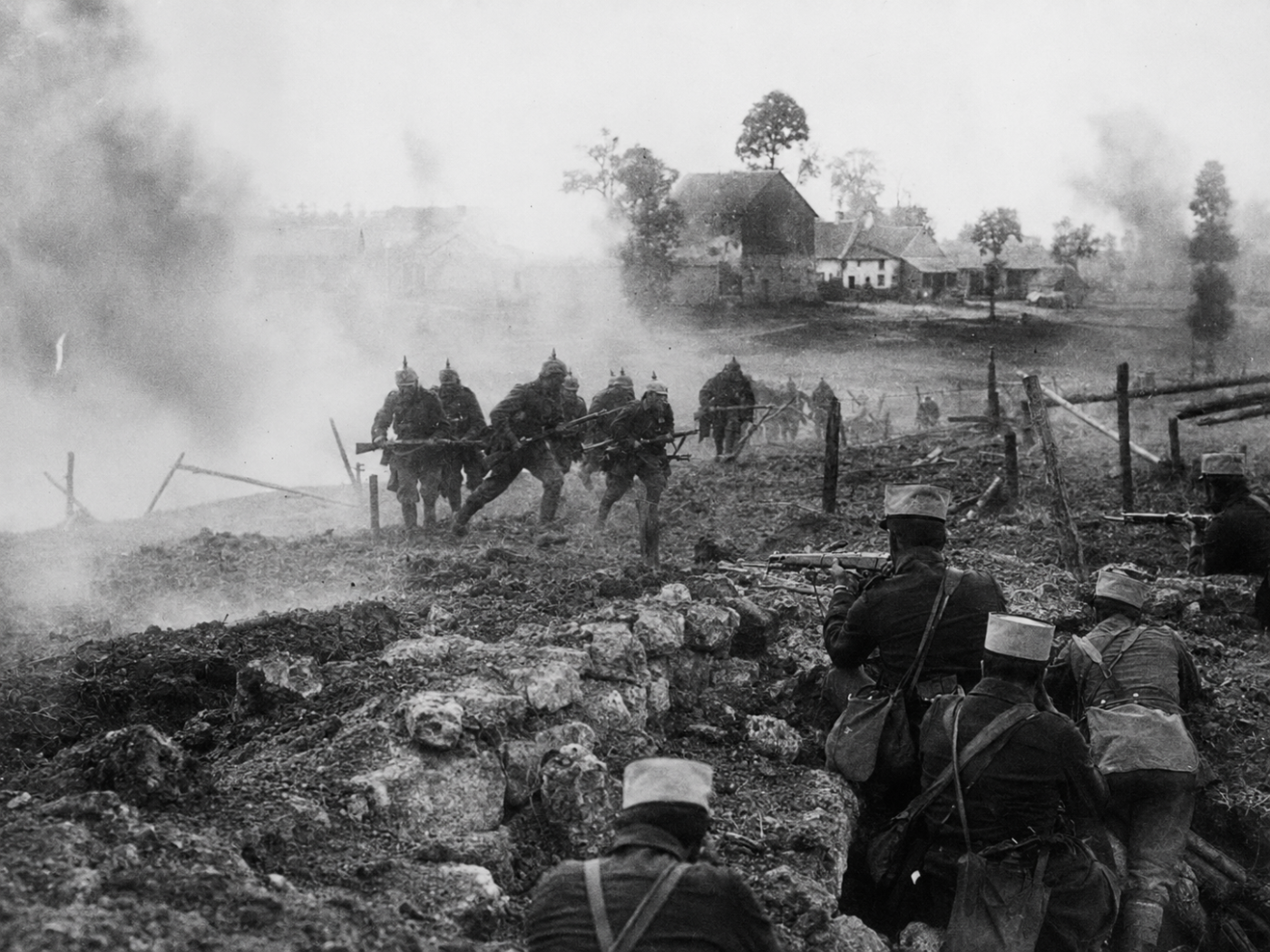
During August 1914 a series of enormous battles erupted along the Western Front. French, German, Belgian and British soldiers fought at places that would soon become famous throughout the world. The Battle of the Frontiers resulted in enormous casualties as armies wearing brightly coloured uniforms and advancing in formations influenced by nineteenth-century military thinking confronted modern artillery, machine guns and rapid-firing rifles.
The German advance continued. By early September German armies had pushed deep into France and appeared to threaten Paris itself. The French Government temporarily relocated to Bordeaux, while preparations were made to defend the capital.
Yet the decisive German victory anticipated by pre-war planners never came.
At the First Battle of the Marne in September 1914, French and British forces counter-attacked. The German advance was halted and the invading armies were forced to withdraw towards the River Aisne.
Both sides attempted to outflank one another as their armies moved northwards in what became known as the Race to the Sea. Eventually the opposing forces reached the Belgian coast. Neither side could break through.
Soldiers began digging defensive positions. Simple rifle pits became trenches. Trenches became interconnected defensive systems protected by barbed wire, machine guns, artillery and fortified strongpoints. Before long a continuous battlefront stretched roughly from the North Sea to the Swiss frontier.
The rapid war anticipated in August had failed to materialise. Instead, Germany and France became locked together in one of the most destructive military confrontations in history.
For the next four years, millions of soldiers would fight across the Western Front. Battles such as Verdun, the Somme, Passchendaele and the great German offensives of 1918 would become symbols of the extraordinary human cost of the First World War.
France itself suffered devastating destruction. Large areas of northern and eastern France were occupied by German forces, towns and villages were destroyed, farmland was devastated and millions of civilians experienced displacement, occupation or bereavement.
Germany also paid an enormous price. The country eventually faced mounting battlefield casualties, food shortages, economic hardship and the effects of the Allied naval blockade. By 1918 the strain of four years of industrial warfare had placed tremendous pressure on German society and the political system of the German Empire.
The war which Germany had hoped to win rapidly had become exactly the kind of prolonged struggle that its pre-war strategists had feared.
When the fighting finally ended with the Armistice on 11 November 1918, the political landscape of Europe had been transformed. The German, Austro-Hungarian, Russian and Ottoman empires had either collapsed or were breaking apart. Millions of soldiers and civilians were dead, millions more had been wounded, and an entire generation had been permanently affected by the conflict.
France recovered Alsace and Lorraine under the post-war settlement, while Germany was subjected to the terms of the Treaty of Versailles. The bitterness created by the war and its aftermath would continue to influence European politics for decades and eventually contribute to the conditions in which another, even more destructive world war emerged.
The declaration delivered in Paris on 3 August 1914 therefore represented far more than another diplomatic announcement during the July Crisis. It marked the formal beginning of the war between Germany and France and immediately activated military plans that had been prepared over many years.
Within hours, enormous armies were moving towards one another. Within a day, German troops would invade Belgium. Within another day, Britain and its empire would be at war. And within weeks, the fields of France and Belgium would be filled with trenches, artillery, shattered villages and the graves of thousands of soldiers.
On 3 August 1914, Europe took another decisive step into the catastrophe that would become known as the Great War.