On this day in military history…
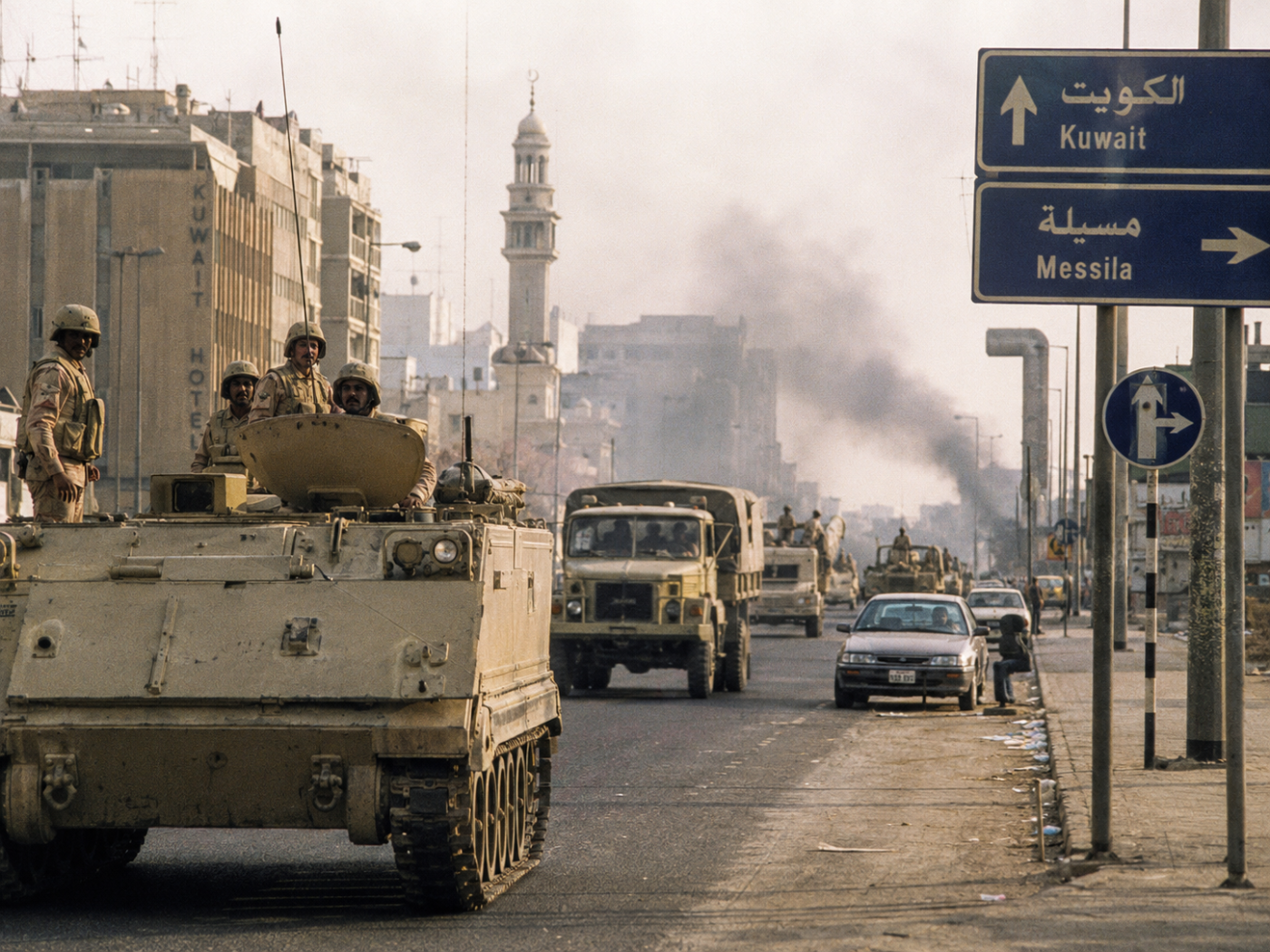
On 2 August 1990 the Middle East was plunged into one of its most serious post-war crises when Iraqi forces under Saddam Hussein crossed the border into neighbouring Kuwait. What began in the early hours as a rapid armoured assault would lead to the occupation of an entire country, the taking of thousands of foreign nationals as hostages and ultimately the Gulf War of 1991.
The invasion had been building for months. Iraq had emerged from its eight-year war with Iran in 1988 with one of the largest armies in the region, but its economy was badly damaged and the country was burdened by enormous debts. Kuwait and other Gulf states had loaned Iraq billions of dollars during the conflict, money Saddam argued had been spent defending the Arab Gulf states from revolutionary Iran. He wanted much of this debt cancelled, but Kuwait was unwilling to meet his demands. By 1990 Iraq reportedly owed Gulf creditors around $37 billion.
Oil was another major source of bitterness. Iraq desperately needed higher oil prices to rebuild its economy, while Saddam accused Kuwait and the United Arab Emirates of producing more oil than their agreed OPEC quotas, helping to push world prices down and depriving Baghdad of badly needed revenue. He also accused Kuwait of taking oil from the huge Rumaila oilfield, which extended across the Iraq-Kuwait border. Kuwait rejected the allegations, but Saddam increasingly portrayed the dispute as deliberate economic warfare against Iraq.
There were also older territorial ambitions. Iraqi governments had previously questioned Kuwait's independence and the precise position of the border. Saddam demanded concessions including greater Iraqi access towards the Gulf and control of the strategically important Kuwaiti islands of Bubiyan and Warbah. Kuwait's enormous oil reserves, small population and relatively weak armed forces made the country an extremely valuable target for a regime struggling under debt and economic pressure.
In the early hours of 2 August approximately 100,000 Iraqi troops poured across the frontier. Republican Guard formations drove rapidly towards Kuwait City while Iraqi special forces moved against important government buildings, airfields and other strategic positions. Kuwaiti forces resisted in several locations, but they were heavily outnumbered and the speed of the Iraqi attack overwhelmed organised resistance. Members of Kuwait's ruling family escaped into Saudi Arabia, and within hours much of the country was under Iraqi control. Iraq would later attempt to absorb Kuwait formally, declaring it an Iraqi province.
Caught directly in the unfolding invasion was British Airways Flight 149, a Boeing 747 travelling from London Heathrow to Kuala Lumpur with a scheduled stop at Kuwait. The aircraft left Heathrow on the evening of 1 August and landed at Kuwait International Airport at approximately 1.13am GMT on 2 August, while Iraqi forces were already moving into Kuwait. Around 45 minutes after the aircraft landed, the airport was closed and the Boeing could no longer leave. Its passengers and crew suddenly found themselves trapped inside a country being invaded.
Iraqi forces subsequently detained passengers and crew from the flight. Some were taken to Baghdad and others were held at hotels or moved to strategic and military locations. Men, women and children became part of Saddam Hussein's hostage strategy, with foreign nationals placed at important sites as what became known as “human shields”, intended in part to discourage attacks against Iraqi military and industrial installations. In October 1990 Parliament was told that people from Flight 149 were among those being held at strategic sites, while hundreds of British citizens remained trapped in Iraq and Kuwait.
One of the most disturbing images of the crisis came when Saddam appeared on television with detained Western families. Five-year-old British boy Stuart Lockwood, who had been aboard Flight 149, was shown being approached and patted by the Iraqi leader. The propaganda appearance demonstrated just how vulnerable the foreign civilians had become and caused outrage in Britain and around the world. Some hostages were gradually released, particularly women and children, while others remained prisoners for months. The final hostages connected with Flight 149 were not released until December 1990.
For many years a controversy surrounded exactly what the British Government knew before Flight 149 landed. At the time the public position was that the aircraft had arrived before the scale of the invasion was known. However, documents released by the Foreign, Commonwealth and Development Office in November 2021 revealed an important piece of information that had not previously been disclosed to Parliament or the public.
The documents showed that at around midnight GMT, while Flight 149 was still travelling towards Kuwait, the British ambassador in Kuwait contacted the Foreign Office in London with reports that Iraqi troops had crossed the border. That information was passed to senior Foreign Office officials and also to No. 10, the Ministry of Defence, the Cabinet Office and the Secret Intelligence Service. Crucially, it was not passed to British Airways. The aircraft landed approximately an hour later. In 2021 the Foreign Secretary acknowledged that the existence of this call had never previously been publicly disclosed or acknowledged and described that failure as unacceptable, issuing an apology.
This does not mean that the suffering of the passengers themselves was kept secret at the time. Their capture and Saddam's use of Western hostages became international news during the crisis. What remained undisclosed for more than thirty years was the fact that the British Government had received information about an Iraqi incursion before Flight 149 landed. The released files also indicated that the ambassador did not then know whether the Iraqi movement represented a limited border incursion or a full-scale invasion. Long-running allegations that the flight had deliberately been allowed to land in order to insert British special forces or intelligence personnel have never been officially substantiated, and the British Government has consistently denied using the aircraft for such a purpose.
Saddam appears to have expected that Kuwait could be seized rapidly and that the outside world might eventually accept the occupation or negotiate with him. Instead, the invasion produced almost universal condemnation. The United Nations demanded Iraq's immediate and unconditional withdrawal and imposed sanctions, while the United States, Britain, Saudi Arabia and numerous other nations began assembling a huge military coalition in the Gulf.
The Iraqi leader refused to withdraw. After months of diplomatic pressure and military preparation, coalition air operations began in January 1991, followed by the ground offensive that drove Iraqi forces from Kuwait in February. What Saddam had intended as a swift solution to Iraq's economic and territorial ambitions instead brought destruction to his armed forces, international isolation and years of sanctions.
The invasion of 2 August 1990 therefore became far more than a dispute between two neighbouring Arab states. It triggered an international war and changed the political and military balance of the Middle East for decades. For the passengers and crew of British Airways Flight 149, however, the great geopolitical crisis had a far more personal meaning. A routine refuelling stop had placed them directly in the path of an invading army, and many would spend weeks or months as prisoners of Saddam Hussein, pawns in a confrontation that was rapidly drawing much of the world towards war.